
The Inheritance We Choose
Conclusion of Generational Liberation. What the book found, what it could not establish, and what follows for one person, a family, a community, an employer and a country.
Published
Contents
Conclusion of Generational Liberation: Healing the American Family.
This book began with a question: does what happened to your grandparents live on in you? Thirteen chapters later the honest answer is yes, though mostly not in the way the headlines say.
What we found
Part I, What We Inherited. The evidence that trauma is passed down in human genes is thin and disputed (The Epigenetic Inheritance). The evidence that it is passed down in households is strong. A generation came home from war and depression with no one to talk to and no word for what they carried (The Therapy Gap). Nearly two in three American adults report at least one serious adversity in childhood (Adult Children of America). And yet most Americans, about six in ten in the best national survey, describe themselves as securely attached (Attachment Theory for a Nation). Trouble is common. It is not universal, and it is not destiny.
Part II, The Squeeze. From the 1970s on, wages stalled while the cost of raising a family rose, and two incomes became necessary where one had served (When One Income Stopped Being Enough). Childhood adversity carries an economic cost counted in trillions of dollars a year, most of it in years of healthy life lost (The Hidden Cost of the American Dream). By 2024 the Surgeon General was warning that parents themselves were under dangerous strain (The 2026 Tipping Point). Families did not simply fail. They were asked to do more with less time.
Part III, The Divide. Each living generation learned a different way to handle pain: silence, endurance, self-reliance, therapy (Four Generations, Four Languages for Pain). When those ways collide in public the result is "OK Boomer" (OK Boomer). When they collide in private the result can be a parent who finally changes and a grown child who has stopped waiting (When the Boomer Does the Work and the Zoomer Walks Away). Even there the data are kinder than the stories. Most estrangements between parents and adult children end.
Part IV, The Work. Cycles can be broken, and what breaks them is steady relationships more than willpower (The Cycle Breakers). Some treatments for trauma are well tested, some are promising, and some popular ideas are disputed (Reparenting and the Nervous System). Treating a family together makes sense and has support for young children, though much is still being studied (Healing Together).
What we did not find
An earlier draft of this book made larger claims. It said that 70 to 80 percent of American families are dysfunctional, that most Americans are insecurely attached, that therapy reverses inherited changes in our genes, and that particular programs heal two generations in a few weeks. When those claims were checked against their sources, they did not hold, and they have been taken out.
That matters for more than accuracy. A person who is told that nearly every family is broken, and that the damage is written in the genes, has been handed a reason to give up. The truth is more useful. Harm in families is widespread, it has causes that can be named, and at every stage there are things that reduce it.
What follows
What comes next is argument, not research. It is where the evidence in this book points, as I read it.
For one person
Your recovery is not self-indulgence. If The Cycle Breakers is right, the most valuable thing you can do for the people who come after you is to find one or two steady relationships and let them change you.
- Get help if you can: a therapist, a group, a fellowship.
- Learn to speak to yourself as a decent parent would.
- Set the limits you need, and keep the door open where it is safe to.
- Do not wait until you are finished to be useful to someone younger.
For a family
- Begin with whoever is willing.
- Ask the oldest for their story.
- Where there are children, let the adults go first.
- Accept partial results. They are still results.
For a community
People recover in company. A town that wants stronger families needs places where the generations meet and no one is selling anything: meeting rooms, congregations, libraries, clubs, culture kept alive. Much of this already exists and is short of volunteers. Show up.
For employers
When One Income Stopped Being Enough traced how much of the strain on families is a shortage of time. An employer who offers predictable hours, real parental leave and pay a household can live on is doing more for children than any wellness program.
For the country
If adversity in childhood costs what The Hidden Cost of the American Dream says it does, then prevention is the cheapest investment on offer. The measures are familiar: care for mental health that people can reach and afford, support for parents in the first years, and wages and housing that give a family room to breathe. Reasonable people will differ on how to deliver them. The case for trying rests on arithmetic, not sentiment.
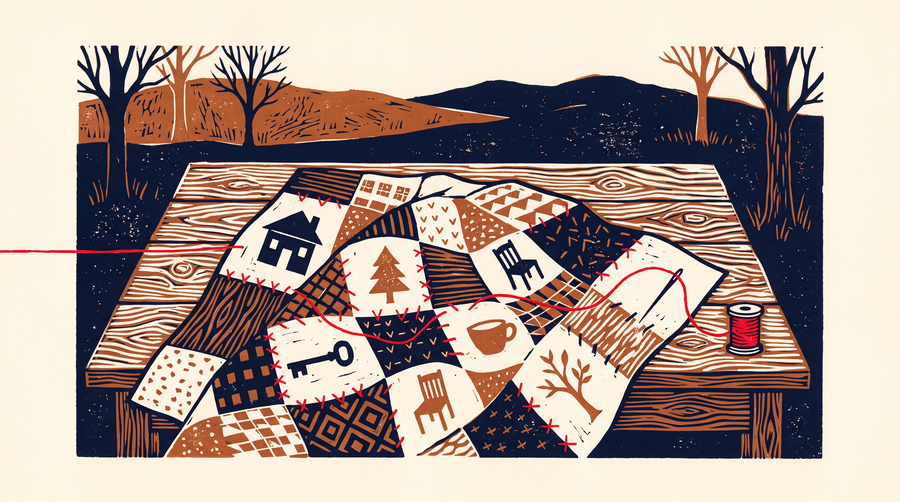
The inheritance we choose
Nobody chooses what they are handed. A man raised in silence did not pick silence. His daughter did not pick the distance that followed.
But the hand-off is not automatic. Somewhere in most families there is a person who notices what is being passed along, and who decides, usually with help and usually at some cost, to pass along something else. Their children will not know what they were spared. That is the point.
Four generations are alive at once. The ones who could not talk and the ones who can are sitting at the same tables. That has not often been true, and it will not be true for long.
The question is not whether healing is possible. It is whether we will use the time.
Resources
If you are in crisis: call or text 988.
- SAMHSA National Helpline: 1-800-662-4357
- Adult Children of Alcoholics & Dysfunctional Families: adultchildren.org
- Al-Anon Family Groups: al-anon.org
- National Alliance on Mental Illness: nami.org
This book is educational. It is not medical advice. Sources for every figure in this conclusion are given in the chapters named.
Previous: Healing Together. See also the Glossary and the contents page.