
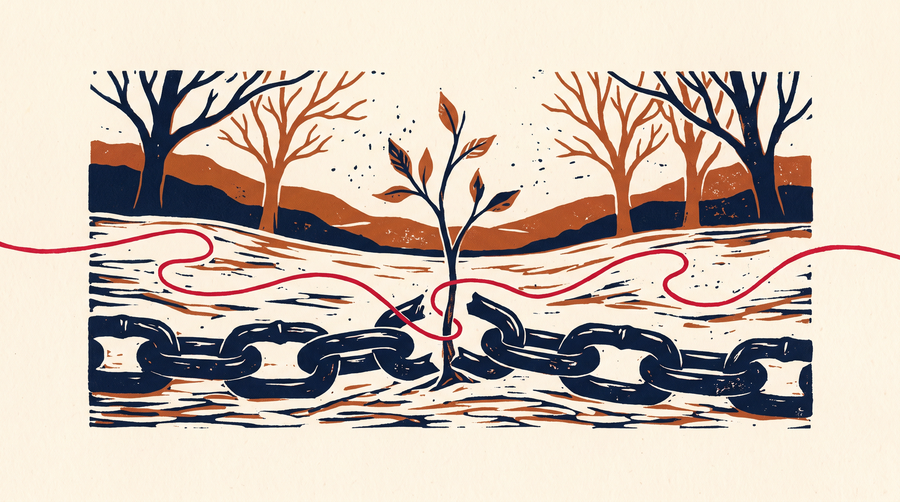
The Cycle Breakers: What It Takes, and What It Costs, to Be the One Who Stops It
Chapter 11 of Generational Liberation. Some people decide that a family pattern ends with them. What research says about whether cycles can be broken, why the person who starts is so often the one the family called the problem, what the work costs in loneliness, and how to set a limit and find company.
Published
Contents
Part IV, The Work. Chapter 11 of Generational Liberation: Healing the American Family.
Maya, Sarah and Kai are composites, drawn from patterns that recur in accounts of family recovery. They are not real people.
At 28 Maya sat in a therapist's office and was asked to describe her relationship with her mother. "Fine," she said. "Normal." The therapist asked what normal meant. Maya described walking on eggshells, working for an approval that never quite arrived, and a constant fear of disappointing. Then she heard herself.
Her mother had been raised the same way. So had her grandmother, by a woman who got through the Depression on control and silence. Each had tried to be a little warmer than the one before. Each had passed on the core of it anyway: you are worth what you achieve.
Maya is 34 now, engaged, and hoping for children. "It stops with me," she says. Her mother has come to a few sessions. Her grandmother thinks therapy is nonsense. Her brother says their childhood was fine.
People who make Maya's decision have a name for themselves: cycle breakers. This chapter is about what that takes and what it costs.
What the phrase means
"Cycle breaker" is not a clinical term. It comes from popular psychology and from recovery rooms. It marks a change of stance, from something is wrong with me to something was handed to me, and I can decline to hand it on.
Nobody knows how many people would describe themselves this way. Figures that circulate online, one in three of this generation or half of that, have no survey behind them.
Can a cycle be broken? What the research says
Three findings matter here.
The cycle is real, and it is not fate. One long-running American study followed people from childhood to age 30, using child-protection records at both ends. Those who had been maltreated as children were about two and a half times as likely to maltreat a child themselves. The authors drew two conclusions from the same data: the risk is real, and repetition is far from certain.[1]
What interrupts it is other people. A review pooled the five long-term studies that had tested the question. Safe, stable, nurturing relationships weakened the link between one generation's maltreatment and the next. These were not only bonds between parent and child. A steady partner, a co-parent or another supportive adult counted. Five studies is a small base, and the authors say so, but they all point the same way.[2]
Security can be acquired late. Attachment researchers describe some adults as "earned secure": people who recount a hard childhood clearly and without being swamped by it. Such adults have been found to parent as well as those whose childhoods were easy. There is a useful twist. When a Minnesota team checked the actual childhood records of adults like this, many turned out to have had more support along the way than their own accounts suggested.[3] Nobody earns security alone. Somebody helped.
That is the most practical thing in this chapter. Breaking a cycle is less an act of will than a matter of finding, and accepting, at least one steady relationship.
The one who carries it
Family therapists have long used the term "identified patient" for the member a family treats as the source of its trouble: the difficult one, the sensitive one, the black sheep. One therapist who writes on the subject describes this person as often the most emotionally honest in the house, not the most unwell, and the one who shows what everyone else is carrying.[4]
This is a clinical idea, not a measured finding. But it explains something many people recognize. The one who was sent to counselors as a teenager is frequently the first to go back by choice as an adult. The pain was never deniable for that person, so the work begins there.
When the family pushes back
A family organized around one person being the problem is unsettled when that person changes. The same writer notes that the family tends to resist, and may press the person to take up the old part again.[4] It usually sounds like this:
- "You've become selfish since you started therapy."
- "You think you're better than us."
- "Why do you keep bringing up the past?"
- "We're fine. You're the one who needs help."
None of it has to be malicious. People are defending the only arrangement they know.
What it costs
The cost is loneliness. The cycle breaker sees a pattern others cannot or will not see, grieves a childhood nobody else admits was lacking, and is changing while everyone else holds still.
There is also a particular tiredness in giving what you were not given. A parent who was never comforted has to work out how to comfort a crying child from first principles, at the end of a long day.
And the reward may not be visible. If the work succeeds, what follows is an absence: a child who never learns to walk on eggshells. Nobody thanks you for what did not happen.
Setting a limit
For someone raised to manage other people's feelings, saying no feels like cruelty. It is a skill, and it can be learned in steps. One practical guide lays them out roughly as follows.[5]
- Find the resentment. Be specific. Not "she interferes" but "she comes to my workplace after I asked her not to."
- Plan it. Pick a calm time and place.
- Say it briefly, in the first person. "I need you to call before you come over."
- Stay level when it is not well received. You cannot control the response.
- Expect it to get worse before it gets better. Pushing harder is the usual first reaction to a new limit.
- If it is ignored repeatedly, name a consequence you are willing to carry out.
You will feel guilty. The guilt is old training, not evidence that you are doing wrong.
A limit does not have to mean a break. Many people settle on a workable distance: enough contact to keep a relationship, enough room to stay well. When the Boomer Does the Work and the Zoomer Walks Away looks at what happens when the distance becomes a wall.
Finding your people
The research above points to the remedy for the loneliness. If steady relationships are what break cycles, then finding them is the work, not a side benefit of it.
For some that is a partner or a friend. For many it is a room: a twelve-step fellowship such as Adult Children of Alcoholics & Dysfunctional Families, a therapy group, a congregation. The discovery people report on walking in is the same each time. They had thought they were the only one.
Two more, briefly
Sarah, 68, grew up with a father who drank and a mother who managed him. She married a man much like him and managed him for thirty-five years. In her late fifties, after her children were grown, she went to Al-Anon and then to a therapist. One daughter has joined her. Two children are angry that she is "changing." She says it is never too late, and that it would have been easier at thirty.
Kai, 22, had the opposite childhood: parents so anxious to do better than their own parents that they managed every hour. Kai reached college unable to choose a class without calling home. Breaking that cycle means saying less and deciding more, and watching two loving people take it as rejection.
Reader exercise
Take half an hour. If it stirs up more than you expected, stop, and talk with someone you trust.
- Name one pattern you can trace through at least two generations of your family.
- Who in your family was "the difficult one"? What were they showing that others were not?
- Who has been a steady presence in your life? If no one comes to mind, where might you look?
- What is one limit you need to set? Write the sentence.
Resources
If you are in crisis: call or text 988.
- Adult Children of Alcoholics & Dysfunctional Families: adultchildren.org
- Al-Anon Family Groups: al-anon.org
- Co-Dependents Anonymous: coda.org
- SAMHSA National Helpline: 1-800-662-4357
This chapter is educational. It is not medical advice.
The person who breaks a cycle is rarely the strongest in the family. More often it is the one who could not pretend, and who then found somebody to lean on. That is not a lesser kind of courage. It is how the thing is actually done.
Previous: When the Boomer Does the Work and the Zoomer Walks Away. Next: Reparenting and the Nervous System.
Works cited
- Thornberry TP, Henry KL, Smith CA, Ireland TO, Greenman SJ, Lee RD. "Breaking the Cycle of Maltreatment: The Role of Safe, Stable, and Nurturing Relationships." Journal of Adolescent Health, 2013. https://calio.dspacedirect.org/handle/11212/1791
- Schofield TJ, Lee RD, Merrick MT. "Safe, Stable, Nurturing Relationships as a Moderator of Intergenerational Continuity of Child Maltreatment: A Meta-Analysis." Journal of Adolescent Health 53(4):S32-S38, 2013. https://pmc.ncbi.nlm.nih.gov/articles/PMC3784834
- Roisman GI, Padrón E, Sroufe LA, Egeland B. "Earned-Secure Attachment Status in Retrospect and Prospect." Child Development 73(4):1204-1219, 2002. https://doi.org/10.1111/1467-8624.00467
- Wright A. "Are You the Identified Patient in Your Family?" anniewright.com, first published 2020. https://anniewright.com/are-you-the-identified-patient-in-your-family/
- Villamor M. "How to Set Boundaries With Emotionally Immature Parents." terricole.com, 9 September 2025. https://www.terricole.com/how-to-set-boundaries-with-emotionally-immature-parents/