
OK Boomer: A Case Study in Generations Talking Past Each Other
Chapter 9 of Generational Liberation. A two-word retort went around the world in 2019. What a study of TikTok videos found underneath it, why the reaction was as revealing as the meme, and what it would take to turn a dismissal into a conversation.
Published
Contents
Part III, The Divide. Chapter 9 of Generational Liberation: Healing the American Family.
In the autumn of 2019 an older man posted a video on TikTok. Young people, he said, were infantile. They suffered from Peter Pan syndrome and thought their utopian ideals would survive adulthood. Thousands of them answered with the same two words.[1]
On October 29 the New York Times ran a story headlined "'OK Boomer' Marks the End of Friendly Generational Relations."[2] A week or so later a 25-year-old member of New Zealand's Parliament, Chlöe Swarbrick, was speaking on a climate bill when an older colleague heckled her. She said "OK boomer" and carried on.[1]
It was treated as a declaration of war. Looked at closely, it is something sadder and more useful: a record of two generations failing to hear each other. That makes it a good case study for this book.
What it means
On the surface it is a brush-off. You are not worth arguing with.
Underneath it is tiredness. The speaker has explained before and has stopped expecting to be heard.
And it is not really about age. The man who heckled Swarbrick was not a Baby Boomer. He belonged to Generation X.[1] "Boomer" in the phrase names a stance: lecturing, not listening, assuming your own conditions still apply.
What was underneath
Two researchers in Singapore analyzed 332 TikTok videos tagged #OkBoomer or #Boomer, which between them had been viewed more than 5.4 billion times. They sorted what young people were actually saying.[3]
- 79 percent described a bad encounter with an older person.
- 58 percent were about a clash of values or beliefs.
- 39 percent showed older people going after the young first.
- 22 percent invoked the "Karen" stereotype.
- 7 percent were about the gap in wealth.
The authors' conclusion is balanced. Some of the content was plainly ageist. Much of it reflected something more complicated than prejudice.[3] In a later and larger study of 673 videos, the same researchers found that about half contained negative stereotypes of older people, and that half did not.[4]
So the meme was not unprovoked, and it was not innocent either. Much of it was retaliation. Young people had been called lazy, entitled and fragile for years, and had found a way to answer.
The reaction
The response from older commentators was as revealing as the phrase. A radio host called "boomer" a slur comparable to the worst in the language, and was mocked for it.[1] Serious writers argued, with more justice, that contempt for the old is one of the last acceptable prejudices, and that many older Americans are poor and need solidarity, not scorn.[1]
There is an irony in a generation that had called its children snowflakes taking two words so hard. It is worth sitting with instead of scoring a point from. People who were raised never to show hurt are not practiced at saying "that stung." It comes out as outrage.
Two wounds, one exchange
Here the chapter moves from evidence to interpretation.
Read in the light of the earlier chapters, the exchange looks like this. A young person says: I can't afford rent, the climate frightens me, and you keep telling me I'm lazy. An older person, raised on endurance (Four Generations, Four Languages for Pain), hears: you failed, you are a bad person. He defends himself. The young person, who has now been dismissed again, stops trying.
Each is taking personally something that is mostly structural. Housing costs and stagnant wages (When One Income Stopped Being Enough) are nobody's character flaw. Neither is having been raised in a house where no one talked.
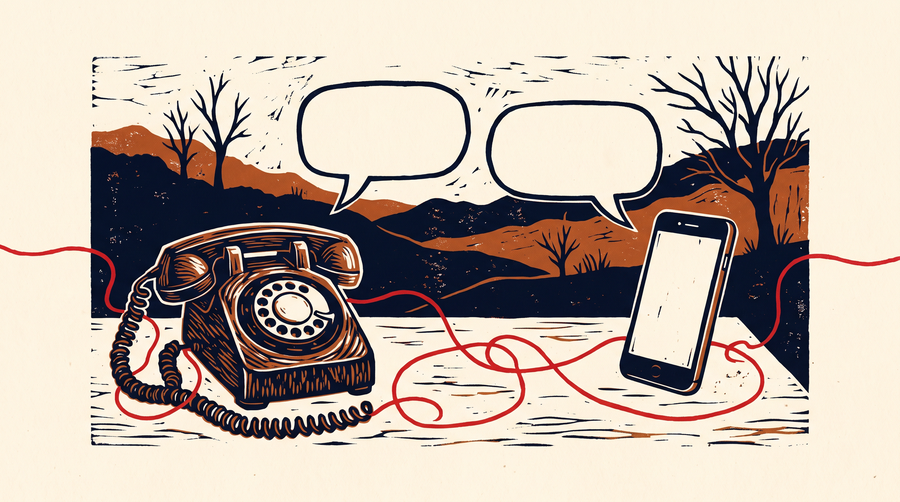
And the medium made it worse. One person talks to a camera, uninterrupted. Another replies to a camera, uninterrupted. There is an audience and no conversation. It is two monologues.
What it could have been
Imagine the same exchange with one change on each side.
The older person, instead of defending: "I can hear you're angry. Tell me what it's like. I don't think I know."
The younger, instead of dismissing: "I'm scared, and when you tell me to work harder it feels like you don't believe me."
That is not a fantasy of harmony. They would still disagree about a great deal. But they would be disagreeing with each other, and not with a caricature.
From "OK Boomer" to "Help me understand"
If you are older. You do not have to accept blame for the housing market to listen to someone who cannot find a home. Listening is not a confession.
If you are younger. The people who raised you were raised too. You can hold them to account and still be curious about what made them.
For everyone. Find a room, a church hall, a kitchen table, where people of different ages talk and no one is filming.
Reader exercise
- When did you last dismiss someone of another generation? What were you tired of?
- When were you last dismissed? What did you want them to understand?
- Pick one person a generation away from you. What question could you ask them that you do not already think you know the answer to?
"OK Boomer" means: I have given up on you understanding me. The work of this book runs the other way.
Previous: Four Generations, Four Languages for Pain. Next: When the Boomer Does the Work and the Zoomer Walks Away.
Works cited
- "OK boomer." Wikipedia. https://en.wikipedia.org/wiki/OK_boomer
- Lorenz T. "'OK Boomer' Marks the End of Friendly Generational Relations." The New York Times, 29 October 2019. https://www.nytimes.com/2019/10/29/style/ok-boomer.html
- Ng R, Indran N. "Hostility Toward Baby Boomers on TikTok." The Gerontologist 62(8):1196-1206, 2022. https://www.ncbi.nlm.nih.gov/pmc/articles/PMC9451021/
- Ng R, Indran N. "Videos about older adults on TikTok." PLoS One 18(8):e0285987, 2023. https://www.ncbi.nlm.nih.gov/pmc/articles/PMC10395947/