
Four Generations, Four Languages for Pain
Chapter 8 of Generational Liberation. Each living generation learned a different way to handle distress: silence, endurance, self-reliance, therapy. What federal data shows about who gets which kind of help, why Boomer parents and their grown children so often miss each other, and how to start a conversation across the gap.
Published
Contents
Part III, The Divide. Chapter 8 of Generational Liberation: Healing the American Family.
The people in this chapter are composites, drawn from patterns that recur in accounts of family life. They are not real people.
Sarah is 34. Her mother was diagnosed with breast cancer and did not tell her for three weeks. Sarah heard it from an aunt. When she called, hurt, her mother said, "I didn't want to burden you." When Sarah pressed, her mother said, "I'm fine. Let's not make a big deal out of this."
To the mother, this was consideration. To the daughter, it was a door closed in her face.
Neither is lying. They are speaking different languages about pain, and each learned hers from the generation before. This chapter is about those languages.
One caution first. Generations are rough categories. Not every Boomer is stoic and not every twenty-year-old is in therapy. Read what follows as tendencies with long roots, and check them against the people you know.
Silence
The generation that grew up in the Depression and the war years learned that you did not speak of trouble. Mental illness was a family shame. Someone who broke down "went away for a rest." Feeling was a luxury, and for men, a failing. The Therapy Gap describes what that cost.
Endurance
The Baby Boomers were raised by those parents. They heard: don't complain, tough it out, keep family business in the family. Many of them resolved to be closer to their own children than their parents had been to them, and they were. They came to the school plays. They knew the teachers' names.
That produced a puzzle their children still describe. A parent who managed every detail of a child's life and could not talk about a single feeling. "She knew my class schedule better than I did," one version goes, "and when I was depressed she told me to stay positive and changed the subject."
The likeliest explanation is not coldness. It is that involvement can be learned from a book, while speaking about fear and grief has to be learned from someone who does it. They had no one.
So the Boomer says "I'm fine" in the hospital corridor. It protects a self built on not needing anyone, and it is meant, sincerely, to protect the children.
Self-reliance
Generation X grew up with a key on a string (see When One Income Stopped Being Enough) and the first shelf of self-help books. Its habit is pragmatic: get help for a crisis, a divorce or a death, then stop. Handle the rest yourself.
Therapy
Millennials and Generation Z talk about anxiety and depression the way their grandparents talked about the weather. For many of them therapy is maintenance, like the dentist.
What the numbers show
These sketches would be mere stereotype if the data did not bear them out. In part, it does.
In a 2019 federal survey, 11.6 percent of adults aged 18 to 44 had received counseling or therapy in the past year. Among those 45 to 64 it was 9.1 percent. Among those 65 and over it was 5.7 percent. Older adults were not going without help altogether. They were getting it as medication.[1]
The gap then widened. Between 2019 and 2021 the share of adults aged 18 to 44 receiving any mental health treatment rose from 18.5 to 23.2 percent. For the two older groups it did not change significantly.[2]
The young are more open, and they also have more to be open about. In 2023, 40 percent of American high-school students reported persistent feelings of sadness or hopelessness, and 20 percent had seriously considered suicide.[3] How much of that is greater distress and how much is greater willingness to say so, nobody can cleanly separate. Probably both.
Caring for a parent while recovering from one
Many people in midlife now find themselves in an odd double position. On Tuesday they are in a therapist's office working through what a parent could not give them. On Wednesday they are driving that parent to the oncologist.
The feelings do not line up neatly. There is love, and duty, and anger at being asked to give a kind of care that was never received. There is guilt about the anger. And each visit carries a small hope that this time the parent will finally open up, followed, usually, by "I'm fine."
There are three honest ways to live with it. You can keep the relationship and lower the expectation: practical help, without waiting for a closeness that may not come. You can ask plainly for something different, knowing it may not be given. Or you can step back, for a time or for good. None of these is the right answer for everyone. What matters is choosing, instead of staying out of obligation and resenting it.
What each can learn from the others
- From the oldest: perspective. Hard times pass. Routine, work and neighbors hold a person up.
- From the Boomers: showing up. They invented the involved parent.
- From Generation X: competence, and the sense to guard one's own time.
- From the young: that saying it out loud is not weakness, and that it is never too late to start.
Starting the conversation
A counselor who writes about family trauma suggests five steps, and they are a sound place to begin.[4]
- Start with yourself. Get clear on your own story before you bring anyone else into it.
- Choose the moment. Not a holiday and not a crisis. Somewhere calm and private.
- Lead with curiosity. "I've been wondering what it was like for you growing up" opens a door. "You made me this way" closes one.
- Keep it safe. Keep early conversations short. Stop if it turns heated. Accept that some people are not ready.
- Get help if you need it. A therapist, a mediator or a minister can hold a conversation the family cannot hold alone.
Four generations at one table: a composite
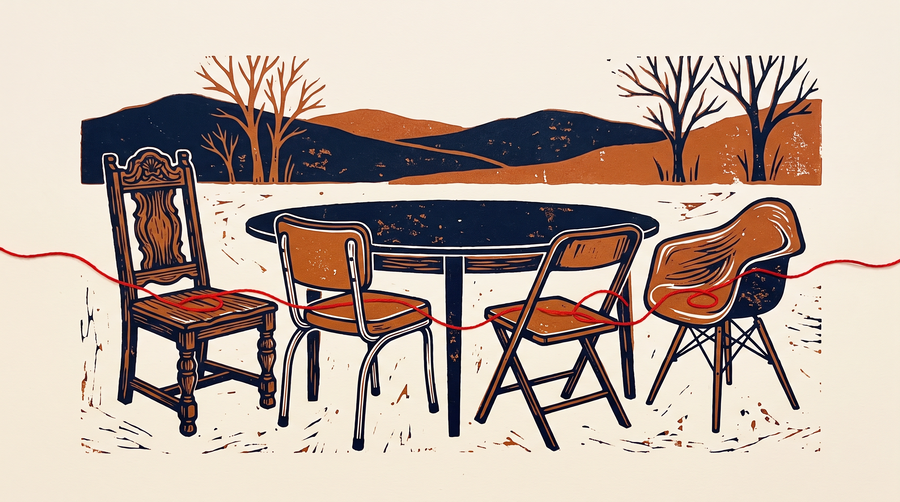
Dorothy, 88, was raised in the Depression and raised her own children the same way: fed, clothed, and kept at arm's length. Her son Richard, 64, was depressed for forty years before a health scare sent him to a therapist. His daughter Susan, 42, started in her thirties. Her daughter Maya, 18, has never known a time when you could not talk about it.
When Susan finally raises the family's history, Dorothy bristles. "We didn't have time for feelings. We were surviving." Richard answers, gently, that he understands, and that it cost them. Dorothy cries. Nobody at the table has seen that before. "I didn't know how to do better," she says. "Nobody taught me."
Nothing is solved. But for the first time each of them can see where the one before was standing.
Reader exercise
Take half an hour. If it stirs up more than you expected, stop, and talk with someone you trust.
- How did your parents handle distress? What did they say about people who asked for help?
- How do you handle it? Where did you learn that?
- What do you need from a parent that they have not been able to give? Have you asked?
- If you are the parent: what have you kept from your children to protect them? What did it cost you both?
Resources
If you are in crisis: call or text 988.
- SAMHSA National Helpline: 1-800-662-4357
- National Alliance on Mental Illness: nami.org
- Adult Children of Alcoholics & Dysfunctional Families: adultchildren.org
This chapter is educational. It is not medical advice.
Four generations are alive at once, each with its own way of bearing pain. That is a source of misunderstanding. It is also an unusual chance, because everyone who needs to be in the conversation is still here.
Previous: The 2026 Tipping Point. Next: OK Boomer.
Works cited
- Terlizzi EP, Zablotsky B. "Mental Health Treatment Among Adults: United States, 2019." NCHS Data Brief No. 380, September 2020. https://www.cdc.gov/nchs/products/databriefs/db380.htm
- Terlizzi EP, Schiller JS. "Mental Health Treatment Among Adults Aged 18-44: United States, 2019-2021." NCHS Data Brief No. 444, September 2022. https://www.cdc.gov/nchs/products/databriefs/db444.htm
- Centers for Disease Control and Prevention. "Mental Health," summarizing the Youth Risk Behavior Survey Data Summary & Trends Report: 2013-2023. https://www.cdc.gov/healthyyouth/mental-health/
- Clare G. "5 Steps to Talk About Intergenerational Trauma With Your Family." GoodTherapy. https://www.goodtherapy.org/blog/5-steps-talk-intergenerational-trauma/