
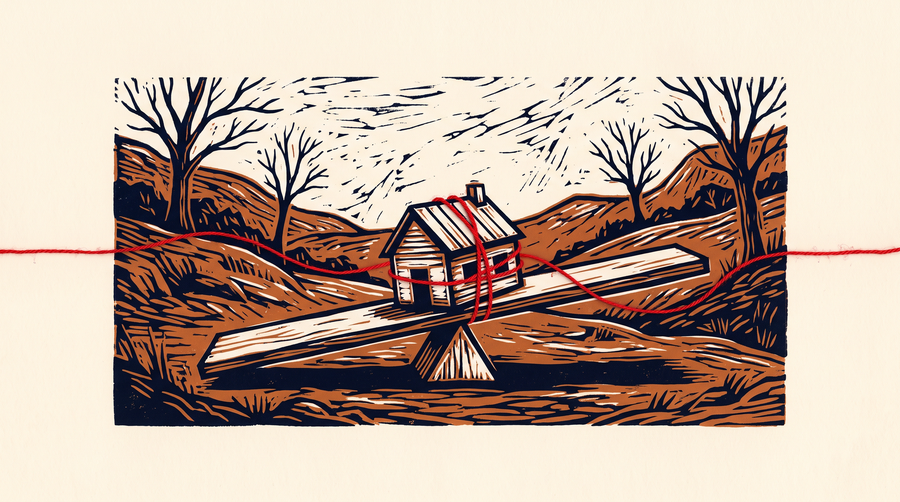
The 2026 Tipping Point: Is the American Family Beyond Repair?
Chapter 7 of Generational Liberation. Warnings about the American family now come from the Surgeon General and the Heritage Foundation alike. What the indicators show, where the two sides part company, and three ways the next twenty years could go.
Published
Contents
Part II, The Squeeze. Chapter 7 of Generational Liberation: Healing the American Family.
In January 2026 the president of the Heritage Foundation, introducing a report on the family, said the country was "dangerously close to being unable to reverse the decline."[6]
In 2024 the U.S. Surgeon General issued a formal advisory on the mental health of parents, the kind of document usually reserved for tobacco or an epidemic.[1]
These two institutions agree on very little. When a conservative think tank and the nation's top doctor both say the American family is in trouble, it is worth asking what they are looking at, and whether "point of no return" is a fair description.
Indicator 1: parents
The Surgeon General's advisory found that a third of parents reported high stress in the past month, compared with a fifth of other adults. Forty-eight percent said that on most days their stress is completely overwhelming. Forty-one percent said that on most days they are so stressed they cannot function.[1]
A Pew survey of more than 3,700 parents found that about four in ten are extremely or very worried that their children will struggle with anxiety or depression. It was their top worry, ahead of bullying, drugs and physical danger. About six in ten said being a parent has turned out harder than they expected.[2]
Indicator 2: children
The parents are not imagining it. In the CDC's 2023 survey of high-school students, 40 percent reported persistent feelings of sadness or hopelessness. Twenty percent had seriously considered attempting suicide, and 9 percent had attempted it.[3]
There is a small piece of good news inside those numbers. They are slightly better than in 2021, when 42 percent reported persistent sadness and 22 percent had seriously considered suicide.[7] The line has bent, a little, in the right direction.
Indicator 3: money
In the 2025 American Family Survey, just over 70 percent of adults said that raising children is unaffordable. The view held across parties, incomes and racial groups. Cost was the leading reason people gave for having fewer children. More than a third of respondents reported at least one economic crisis in the past year, such as going hungry or skipping medical care.[4]
Indicator 4: the children who came back
In a 2026 national survey, 44 percent of parents said an adult child between 18 and 35 had moved back home after living independently. Housing costs were the main reason. More than half of those parents expected the arrangement to last at least a year, and nearly one in five said they would cut their own savings or retirement contributions to manage it.[5]
This is the squeeze of the last two chapters arriving at the front door. Parents who were stretched while raising children are now supporting them as adults, out of money meant for old age.
Two readings of the same facts
The Heritage report reads these facts as a crisis of family formation. It describes marriage and fertility as historically low and a growing share of children as raised outside married-parent homes. Its remedies include a $2,500 investment account for every newborn, removing marriage penalties from welfare programs, larger adoption and child tax credits, discouraging online dating, and a minimum age of 16 for social media.[6]
The Surgeon General reads them as a crisis of support. His remedies include paid family and medical leave, child care assistance, affordable mental health care and places for parents to find each other.[1]
The disagreement is real. One side holds that family structure is the cause and hardship the result. The other holds the reverse. You do not have to settle it to notice how much the two lists overlap. Both would put money in the hands of families with children. Both would restrain the technology companies. Both treat the family as something the country has a stake in. And in the American Family Survey, fewer than one in five adults opposed universal child care or larger child tax credits.[4]
Is this a tipping point?
The phrase claims that decline feeds itself: children raised in strained families become strained parents, and past some threshold there is no way back.
There are reasons to doubt it.
- Every generation has said this. Divorce in the 1970s, latchkey children in the 1980s, working mothers in the 1990s. Families turned out to be more adaptable than their mourners expected.
- Some indicators are improving. Teen sadness and suicidal thinking both eased between 2021 and 2023.[7]
- The causes are not mysterious. Much of the pressure is the cost of housing, care and medicine. Those are policy matters.
- Something new is present. For the first time, large numbers of people have the language and the means to deal with what their families handed them. Part IV of this book is about them.
And there is a reason to take it seriously. The mechanisms in this book are real. Stress in one generation does reach the next. A system like that can run in either direction.
Three futures
What follows is the author's judgment, not a forecast from data.
Decline. Nothing much is done. Costs keep rising, fewer people form families, and those who do are more strained. Each generation starts further back.
Drift. Some help arrives, unevenly. Families with money buy their way to stability. Others do not. Individuals heal themselves where they can. This is the present, extended.
Repair. Families get economic room, treatment is within reach, and enough people do their own work that the next generation starts from a better place. Not a golden age. A higher floor.
Which of these happens is not written anywhere. That is the meaning of a tipping point properly understood: a moment when a push in either direction counts for more than usual.
Reader exercise: your own neighborhood
Statistics describe the country. Take half an hour to describe what you can see.
- Among the parents you know, how many seem to be coping, and how many barely?
- Among the teenagers you know, how many are struggling? Can their families get help?
- How many adult children you know have moved home?
- Is it getting better or worse where you are? What one change would help most?
What one person can do
- Do your own work, so that less is passed on.
- Be useful to a parent you know. Watch a child for an afternoon. Bring a meal.
- Join or start something local where parents can meet.
- Tell your representatives what families near you need.
Resources
If you or a young person you know is in crisis: call or text 988.
- 211: dial 2-1-1 for local help with food, housing and child care.
- SAMHSA National Helpline: 1-800-662-4357
- National Alliance on Mental Illness: nami.org
This chapter is educational. It is not medical advice.
The American family is under real strain, and both ends of the political spectrum now say so. Beyond repair is another matter. Nothing in the evidence says that, and some of it says the opposite.
Previous: The Hidden Cost of the American Dream. Next: Four Generations, Four Languages for Pain.
Works cited
- Office of the U.S. Surgeon General. Parents Under Pressure: The U.S. Surgeon General's Advisory on the Mental Health & Well-Being of Parents. 2024. https://www.hhs.gov/sites/default/files/parents-under-pressure.pdf
- Pew Research Center. "Parenting in America Today." 24 January 2023. https://www.pewresearch.org/social-trends/2023/01/24/parenting-in-america-today/
- Centers for Disease Control and Prevention. "Mental Health," summarizing the Youth Risk Behavior Survey Data Summary & Trends Report: 2013-2023. https://www.cdc.gov/healthyyouth/mental-health/
- "Sticker shock: Is the American dream still attainable?" Deseret News, 13 November 2025, reporting the 2025 American Family Survey. https://www.deseret.com/special-series/2025/11/13/american-family-survey-is-american-dream-still-attainable/
- Thrivent. "Boomerang Kids," reporting the 2026 Boomerang Kids Survey conducted by Ipsos. https://www.thrivent.com/insights/financial-planning/boomerang-kids-in-2025-why-young-adults-are-moving-back-in-with-their-parents
- "Heritage Foundation warns America 'dangerously close' to family breakdown point of no return." Fox News, 10 January 2026. https://www.foxnews.com/politics/heritage-foundation-warns-america-dangerously-close-family-breakdown-point-no-return
- "More teens missing school due to safety concerns since 2013." Healio, 16 August 2024, reporting the CDC's Youth Risk Behavior Survey trends report. https://cm.healio.com/news/pediatrics/20240816/more-teens-missing-school-due-to-safety-concerns-since-2013