
When One Income Stopped Being Enough
Chapter 5 of Generational Liberation. Wages stalled in the 1970s, two paychecks became the norm, and nothing was built to hold the family up while both parents worked. What the data shows about tired parents, and why presence matters more than hours.
Published
Contents
Part II, The Squeeze. Chapter 5 of Generational Liberation: Healing the American Family.
Carol and her family are a composite, drawn from patterns that recur in accounts of working family life. They are not real people.
In 1965 Carol's father worked at an auto plant outside Detroit and her mother stayed home with four children. They owned a three-bedroom house, took a week at the lake every summer and put something aside. One blue-collar wage did that.
In 1995 Carol taught school and her husband was an engineer. Two professional salaries, and they were always short. Childcare took most of what she earned. She left before the children woke and came home after supper, used up. "I'm doing what my mother did," she said, "except I'm also working forty hours a week. I'm never enough in either place."
By the time Carol's daughter had a child of her own, she and her partner were each working more than one job.
Three generations, three arrangements, and in each a different way for a parent to be missing: there in body and gone in spirit, gone to work, or simply worn out. This chapter is about how that happened and what it did.
What happened to wages
For a generation after the Second World War, American pay rose with American output. Then it stopped. In real terms, average hourly earnings peaked in January 1973. By 2018 the average wage bought about what it had in 1978. What gains there were since 2000 went mostly to the top: real weekly wages rose about 3 percent for the lowest tenth of earners and nearly 16 percent for the highest tenth.[1]
Meanwhile the things a family cannot do without, a house, a doctor, a college place, kept getting dearer.
Two paychecks
Families answered in the only way open to them. In 1960 about a quarter of married couples with children had two incomes. By 2011 it was nearly six in ten.[2]
This is usually told as a story about women's liberation, and it is partly that. Women wanted work, fought for it and were right to. But for most households the second paycheck was not a choice between fulfilment and the kitchen. It was the rent.
The support that never came
A country that needs both parents at work needs somewhere good for the children to be, leave when a baby arrives, and jobs that bend when a child is sick. Other rich countries built those things. The United States, for the most part, told families to work it out.
This is an argument about policy, and you may weigh it differently. The effects on the ground are not in much dispute.
The latchkey years
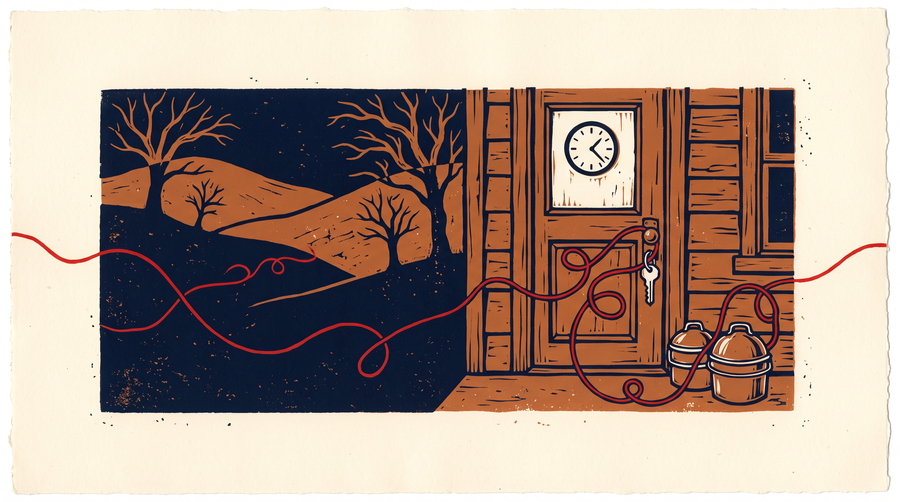
The first visible effect was the child with a house key on a string. A 1985 magazine report put the number of American children aged six to thirteen who regularly came home to an empty house at about seven million. It described the work of two researchers, Thomas and Lynette Long, who interviewed more than 1,500 such children around Washington, D.C. A slight majority described the experience as a bad one. Some were frightened. Some were carrying responsibility for younger brothers and sisters far too early. Others, it should be said, became capable and independent.[3]
Many of those children are today's parents and grandparents. If you were one, you may recognize a certain over-responsibility in yourself, a difficulty asking for help, and a determination that your own children will never be alone.
Tired parents, by the numbers
In 2024 the U.S. Surgeon General issued an advisory on the mental health of parents. Its figures describe a squeeze from both sides.[4]
- More paid work. Mothers' weekly hours of paid work rose 28 percent between 1985 and 2022.
- More childcare too. Over the same years, the time mothers spent on primary childcare rose 40 percent. For fathers it rose 154 percent.
- The stress shows. A third of parents reported high stress in the past month, against a fifth of other adults. Nearly half said that on most days their stress is completely overwhelming, against about a quarter of other adults.
- Money is a large part of it. Two thirds of parents said money worries consume them. Child care prices rose about 26 percent in a decade.
- And they are lonely. About 65 percent of parents reported loneliness, against 55 percent of adults without children.
Put the first two together. Today's parents are not neglecting their children for their jobs. They are doing more of both than their own parents did, and the difference comes out of sleep, friendship and their own reserves.
The sociologist Arlie Hochschild named part of this decades ago: the second shift, the day's housework and care that begins when the paid day ends, and that still falls mostly to mothers.
Presence, not hours
Here is the finding that should lift some guilt. In a study of nearly 900 professionals and their children, the hours a parent worked did not appear to harm the children. What did was a parent who was preoccupied: home, and somewhere else. The researcher who reports it, Stewart Friedman of the Wharton School, warns that phones have made that kind of absence easier than ever.[5]
That cuts both ways. It means a parent with a demanding job can still be a good one. It also means the 1950s were not the golden age they are remembered as. A father who ate in silence and went to the garage was present in the census and absent from his children's lives.
A child needs to be noticed. Half an hour of real attention does more than an evening in the same room.
Reader exercise
Take half an hour with a notebook.
Then. For each parent: how much were they physically there? When they were there, could you reach them? Which mattered more to you?
Now. If you are a parent: when you are with your children, where is your attention? What takes it? What is one thing you could put down?
The household. Who carries the list in their head: the appointments, the shoes, the permission slips? Is that arrangement one you chose?
What would help
The Surgeon General's recommendations are a fair summary of what families have been missing: paid family and medical leave, paid sick time, help with the cost of child care, flexible schedules, affordable mental health care, and places in every community where parents can meet each other.[4]
None of this is about returning to 1965. It is about making it possible for a family to choose how it lives: one earner, two, or some arrangement of its own, without the choice being made for it by the rent.
Resources
If you are in crisis: call or text 988.
- 211: dial 2-1-1 for local help with food, housing and child care.
- SAMHSA National Helpline: 1-800-662-4357
- Postpartum Support International: postpartum.net
This chapter is educational. It is not medical or financial advice.
Work came home because it had to. The parents who carried it were not failing their children. They were holding up an arrangement that was never built to stand.
Previous: Attachment Theory for a Nation. Next: The Hidden Cost of the American Dream.
Works cited
- DeSilver D. "For most U.S. workers, real wages have barely budged in decades." Pew Research Center, 7 August 2018. https://www.pewresearch.org/short-reads/2018/08/07/for-most-us-workers-real-wages-have-barely-budged-for-decades/
- Pew Research Center. "Breadwinner Moms," chapter 3: "Married Mothers Who Out-Earn Their Husbands." 29 May 2013. https://www.pewresearch.org/social-trends/2013/05/29/chapter-3-married-mothers-who-out-earn-their-husbands/
- "Latchkey Kids." D Magazine, July 1985. https://www.dmagazine.com/publications/d-magazine/1985/july/latchkey-kids/
- Office of the U.S. Surgeon General. Parents Under Pressure: The U.S. Surgeon General's Advisory on the Mental Health & Well-Being of Parents. 2024. https://www.hhs.gov/sites/default/files/parents-under-pressure.pdf
- Friedman SD. "How Our Careers Affect Our Children." Harvard Business Review, 14 November 2018. https://hbr.org/2018/11/how-our-careers-affect-our-children