
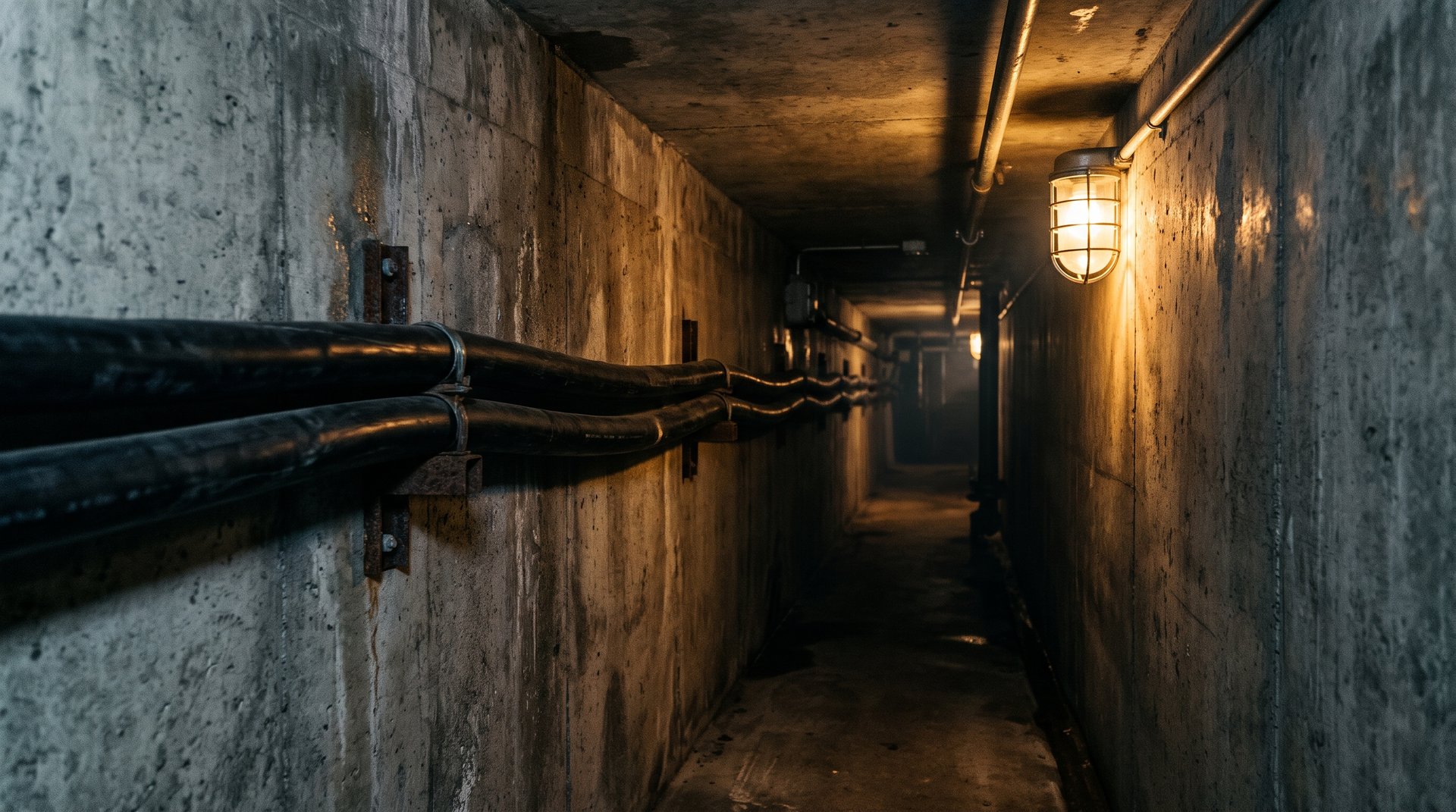
When the Redundant Cable Shares the Same Tunnel
On the heaviest pre-holiday travel day, a look back at Atlanta's 2017 airport blackout shows what happens when primary and backup power share one tunnel—and tens of thousands are stranded.
Wednesday before Thanksgiving is the heaviest pre-holiday travel day of the year—the true all-time airport record now belongs to the Sunday after Thanksgiving, three years running—and tens of thousands of travelers will funnel through Hartsfield-Jackson Atlanta International Airport today. As a commercially licensed pilot, I still watch airport ramps with an instrument eye, looking for the hidden single points of failure behind smooth departures. What follows is not a prediction for tonight's concourse; it is a forensic look back at a real Sunday in Atlanta—December 17, 2017—when the world's busiest airport proved that "redundant" on paper can still mean zero power in the dark.
Yesterday we looked at Clarksburg, where 92 percent of residents stay put and extended families share a woodstove down the road. An international hub is the exact opposite environment: peak zero-kinship fragility. Thirty thousand strangers sit at gates with dead phone batteries, cashless boarding passes, and no cousin ten miles away with a spare bedroom.
Check the Gauges: The Airfield Worked and the Building Did Not
Hartsfield-Jackson handled 106.3 million passengers in 2025, making it the busiest airport on earth. On December 17, 2017, around 1:00 p.m., a switchgear fault sparked an electrical fire inside a Georgia Power underground facility serving the airport. Because both the primary power feed and the redundant backup cables ran side by side through the same underground tunnel, one fire severed both.
For roughly 11 hours, the terminal complex went dark. Roughly 1,180 flights were canceled that Sunday and more than 400 more on Monday, costing Delta Air Lines an estimated $40 million.
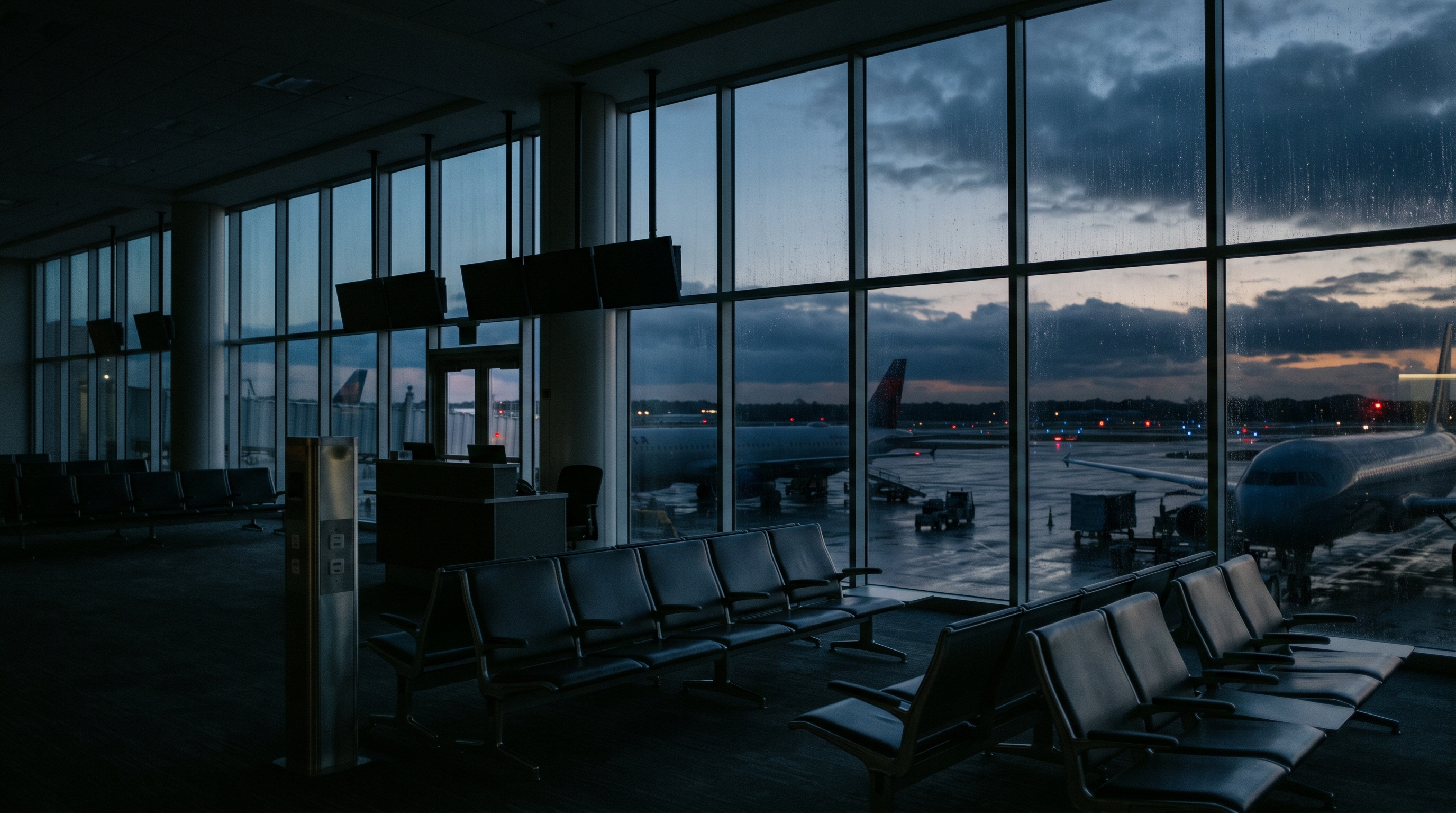
Here is the detail that jumps off the page if you have ever flown an instrument approach: the Federal Aviation Administration (FAA) control tower kept working normally. Airfield lighting, tower radios, and approach radars sit on dedicated backup power, so controllers cleanly instituted a ground stop and diverted inbound aircraft. Meanwhile, inside the terminals, jet bridges froze, the underground Plane Train stalled, baggage carousels stopped, and passengers sat trapped on dark aircraft on the tarmac for hours while crews burned through federal duty-time limits. The airfield worked. The building did not.
Myth Versus Forensic Reality
Put thirty thousand exhausted holiday travelers into pitch-black concourses with dead Wi-Fi and no estimated restoration time, and Hollywood writes a riot scene. That is not what happened in Atlanta.
Passengers shared battery packs, water bottles, and floor space. Atlanta Fire and Rescue coordinated mutual-aid crews from surrounding counties to evacuate stuck SkyTrains and elevators and check on medically vulnerable travelers. MARTA kept running continuous rail service into the airport all night so stranded riders could get downtown, and local food vendors—including Chick-fil-A, normally closed on Sundays—opened kitchens to deliver meals to hungry terminals.
When the system snapped, ordinary people held the line. What broke down was communication: for hours, pilots on the tarmac and passengers in dark gates had no clear timeline, proving again that an information vacuum stresses human beings faster than darkness itself.
Who Built the Fragility—and Who Is Already Fixing It
Putting primary and backup cables in one shared vault is a textbook cost-saving shortcut—the same habit of trimming safety margin we saw in When Everything Runs on Duct Tape, Peace Is the Only Answer. It looks efficient on a quarterly spreadsheet right up until a single switch arcs.
We owe honest credit to the people who stepped up when the smoke cleared: the Georgia Power line crews who went into a damaged underground vault to splice high-voltage cables before midnight, the metro firefighters and MARTA operators who kept people safe, and the civic groups—from consumer advocates to the Georgia Public Service Commission's own Public Interest Advocacy Staff—who now show up in IRP hearings to press for proactive transmission planning and genuine redundancy instead of paper promises.
Rising up looks like showing up—nonviolent, lawful, and in the open.
Organize Here: One Document, One Room, One Hour
In Atlanta, the public rooms where grid redundancy and airport resilience are debated are the Georgia Public Service Commission and the Atlanta City Council Transportation Committee. Wherever you live, your equivalent rooms are your state public utility commission and your city or county transportation board.
One hour this week: Stress-test your travel and utility redundancy
- Household: If you are traveling this week, carry a charged battery bank, paper boarding info and local family phone numbers, a small amount of cash, and one day of essential medications in your personal carry-on
- Block: Check in with one neighbor whose family is traveling or who is staying home alone over the holiday weekend so nobody sits isolated if a storm hits
- Room (under one hour): Look up your state utility commission's website, find your electric provider's latest Integrated Resource Plan docket, and check the date and instructions for submitting a one-paragraph public comment on grid redundancy
Real redundancy means two independent paths that cannot fail from the same spark. That is true for airport power cables—and it is true for a free people.
Everything here is free. If this one helped you, there’s a tip jar.