
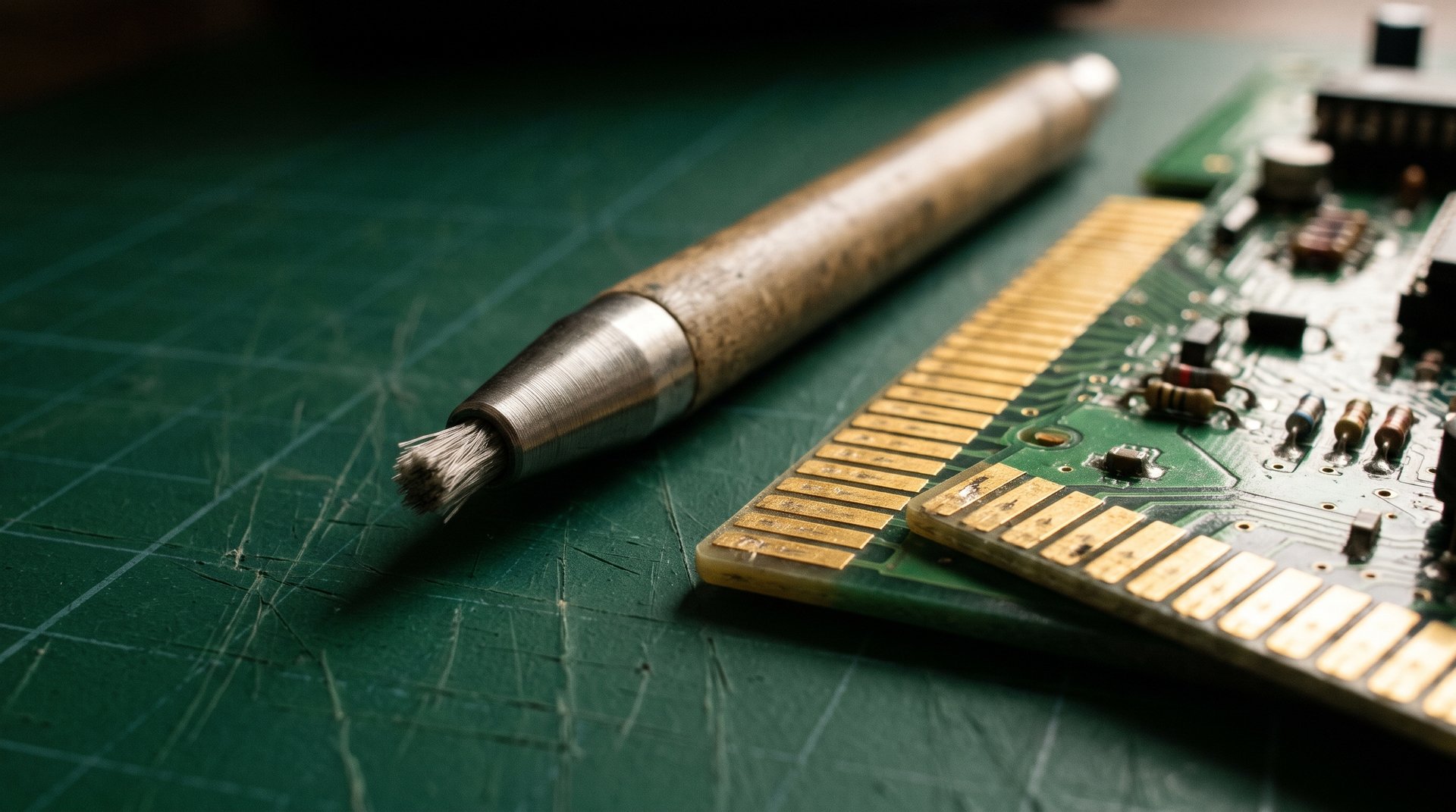
Clean Gold Contacts and the Quiet Work of Repair
You do not fix a tarnished circuit card with sandpaper. How a fiberglass burnishing pen taught me that small, steady acts of care keep family and community connections clear.
When I was a young Army technician learning to maintain digital backplanes, one of the first tools an older sergeant put in my hand looked like an oversized mechanical pencil filled with fine spun glass. It was a fiberglass contact burnishing pen, and his instruction was short enough to remember fifty years later: Never use sandpaper on gold.
The edge connectors on a circuit card carried a thin plating of gold over copper precisely because gold resists corrosion. Over months of heat and humidity, a dull film still settled across the pins, raising contact resistance and chewing away at the signal's safety margin. If an impatient repairman grabbed rough emery cloth to scrub the tarnish off, the board looked shiny for a week—right before the stripped copper underneath corroded twice as fast and ruined the card for good.
The burnishing pen worked because it was gentle. Two light passes lifted the film without wounding the metal underneath.

How Families Build Up Tarnish
Long before a family stops speaking or a friendship goes cold, a thin film settles across the contacts.
Nobody sits down at breakfast planning to sever a bond. Life just gets noisy. A sharp word goes unacknowledged because everyone is rushing out the door. A parent gets tired and snaps; an adult child pulls back a few inches to stay safe. A screen stays lit at the far end of the kitchen table—the quiet interference I wrote about in The Broadcast, the Bundle, and the Jammed Family—until ordinary conversation feels like pushing five volts through an oxidized pin.
When we finally notice the distance, our worst instinct is to reach for the sandpaper. We want one dramatic speech to scrub away ten years of buildup in twenty minutes. We lecture, we defend our intentions, or we demand an immediate reset. All that rough friction usually does is strip away whatever thin plating of trust was still holding the circuit together.

Two Light Passes at a Time
In Adult Children of Alcoholics (ACA) recovery and in Nonviolent Communication (NVC), I learned that real repair looks a lot more like a burnishing pen than a power sander. It is small, unglamorous, and patient:
- Admit your own side of the static quickly. "I was short with you yesterday because I was tired, and you did not deserve that" lifts more corrosion in ten seconds than an hour of explaining yourself.
- Show up when nothing is on fire. A five-minute phone call on a quiet Tuesday, a pot of soup dropped on a porch, or sitting together without a television humming in the corner keeps resistance low before a crisis ever arrives.
- Respect the plating. Listening without rushing to fix someone else's feelings leaves the underlying dignity intact.
Keeping the Commons Clear
The same quiet craft carries straight out the front door onto our streets and into our local commons. Communities do not stay whole because of grand speeches; they stay whole because ordinary neighbors keep wiping away small misunderstandings before they harden into grudges.
Put away the sandpaper. Reach for the gentle tool, make two honest passes, and let the clean gold do what it was built to do.
Everything here is free. If this one helped you, there’s a tip jar.