
No Right Angles on the Fretboard
On an Army oscilloscope and an acoustic guitar, sharp 90-degree corners are an illusion of distance. Zoom in, and the physics—and the music—always live in the curve.
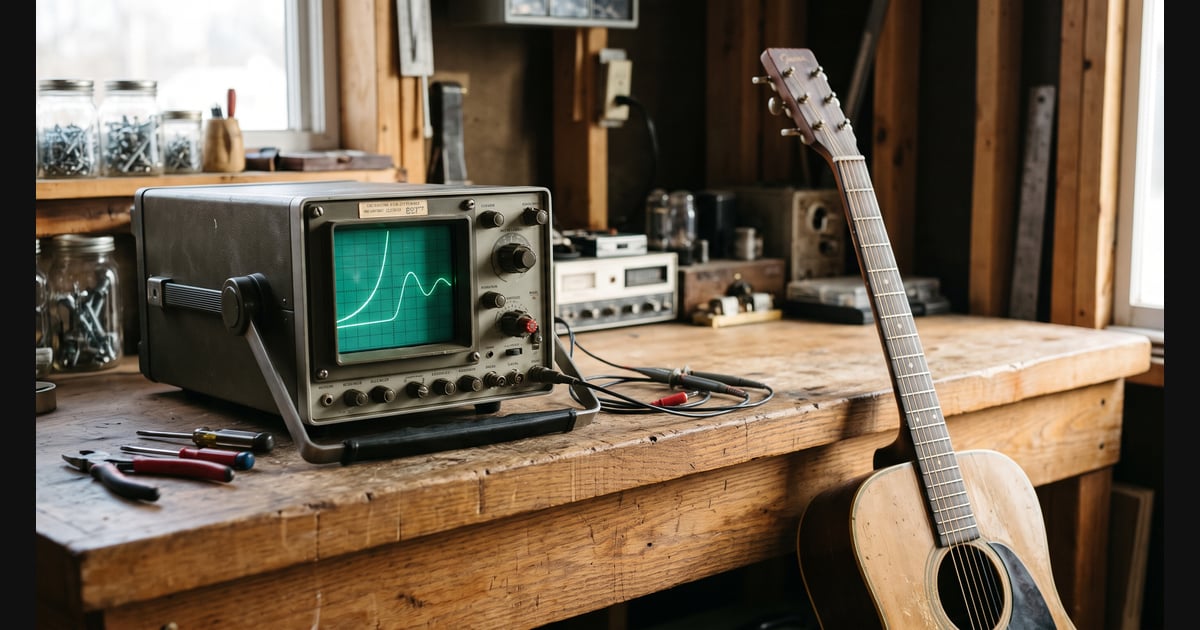
Before I ever wrote a line of software for a living, I spent my days in a U.S. Army repair shop staring into the round green face of a dual-trace oscilloscope. Back in 1976, my job was keeping military computers alive—tracing signals across backplanes and logic cards with a pair of probes and a manual.
If you step three feet back from an oscilloscope displaying a digital clock signal, the trace looks like a clean, rigid staircase. Up at five volts, flat across the top, straight down at a razor-sharp ninety-degree cliff to zero volts, flat across the bottom. Crisp. Certain. Binary.
That macro view is how most of our culture wants us to think about everything—code, arguments, politics, even our own character. Either something is a one or a zero, right or wrong, fixed or broken.
What the Delayed Sweep Reveals
On those old military scopes, there was a control called the delayed sweep. When you engaged it and turned the timebase knob to magnify a single rising or falling edge by a factor of a thousand, the illusion vanished.
That sharp ninety-degree wall wasn't a cliff at all. It was a smooth, sloping exponential curve—climbing quickly at first, rounding gracefully near the top, sometimes overshooting with a tiny damped ring before settling into its plateau. The right angle only existed because we were standing too far away to see the physics of the transition.
If you want to test that illusion for yourself, try zooming in on a five-volt pulse edge and comparing its slow-motion slope against the natural vibration of a plucked string.

What the Fretboard Remembers
Every morning when I sit down with my acoustic guitar, my hands get the same reminder.
You can draw a neat chord chart on paper with straight lines and black dots, yet nothing on a real fretboard happens at right angles. When your fingertip presses a steel or nylon string behind a fret, the pitch doesn't snap into existence like a light switch. Wood flexes, metal stretches, and the note blooms outward in a continuous curve—a fundamental frequency braided together with warm overtones that slowly decay into the room.
Try forcing a guitar to behave like a digital switch—gripping the neck with white knuckles, demanding dead-stop precision on every note—and you choke the life right out of the wood. The music lives in the curve, in the tiny intentional bend of a string, and in the breathing room between one note and the next.
Why Perspective Changes Everything
Across the work I share here—whether we are talking about Professional systems engineering, Personal recovery and emotional sobriety, Political sanity in a noisy country, or Pragmatic toolmaking—the same rule holds:
- Distance creates false binaries. The further back you stand from a complex system, a neighbor, or your own mistakes, the easier it is to flatten everything into rigid right angles.
- Zooming in restores honesty. When you widen the timebase and look closely at how real circuits, real instruments, and real human beings actually move from one state to another, you find curves, transitions, and room to breathe.
- Margin makes the curve possible. Without slack in the timeline, headroom in the amplifier, or grace in the conversation, every curve gets clipped flat into distortion.
Over the next week, we are going to put a probe on all four corners of that idea—from how digital computers actually boot without crashing, to why outrage media flattens neighbors into square waves, to how a simple calibration sticker keeps our own judgment honest.
For today, though, the bench check is simple: the next time a problem, a headline, or an inner critic tries to back you into a ninety-degree corner, reach for the timebase knob and zoom in. You will almost always find a curve waiting underneath.
Everything here is free. If this one helped you, there’s a tip jar.