
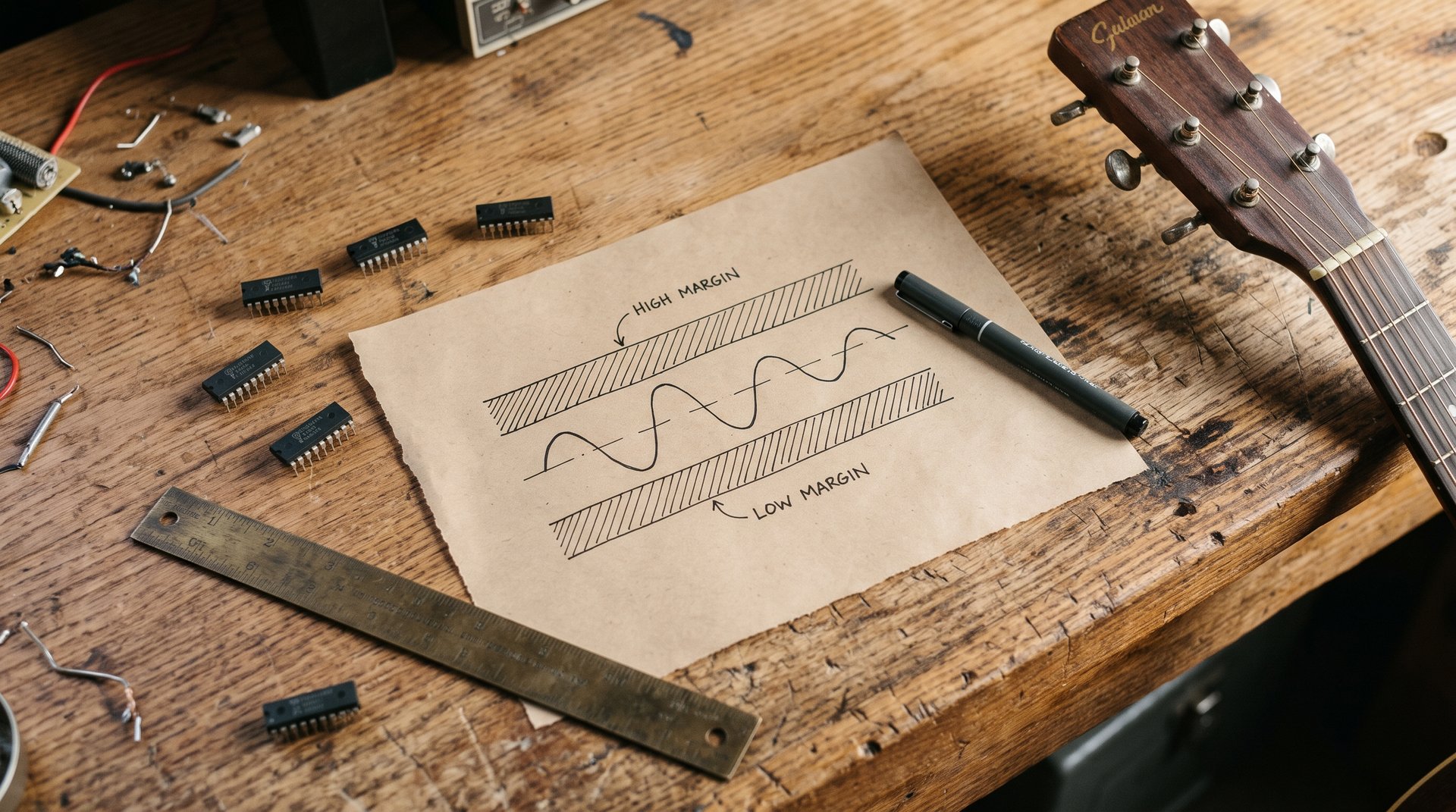
The 0.4-Volt Cushion That Keeps Computers Alive
Digital circuits do not work because voltages are exact; they work because engineers build noise margin into the silicon. Our tools and daily lives depend on the same headroom.
Most people think digital computers work because they are exact. Five volts means a one, zero volts means a zero, and every chip inside the cabinet marches in crisp, mathematical perfection.
Spend a few weeks inside a 1970s military computer cabinet with a probe in your hand, and you learn the opposite. Digital computers do not work because voltages are exact. They work because engineers gave up on perfection and built margin into the silicon.
The Dead Zone Nobody Talks About
In the classic five-volt Transistor-Transistor Logic (TTL) chips I cut my teeth on, the rules were printed right in the semiconductor data book. An output gate promised to deliver at least 2.4 volts for a logic HIGH and no more than 0.4 volts for a logic LOW. Meanwhile, the receiving gate promised to recognize anything above 2.0 volts as a HIGH and anything below 0.8 volts as a LOW.
Look at the math between those two numbers:
- High-state noise margin: 2.4 volts minus 2.0 volts gives you 0.4 volts of headroom.
- Low-state noise margin: 0.8 volts minus 0.4 volts gives you 0.4 volts of headroom.
- The forbidden band: Between 0.8 volts and 2.0 volts sits a no-man's-land where a gate cannot promise whether it is seeing a one or a zero.
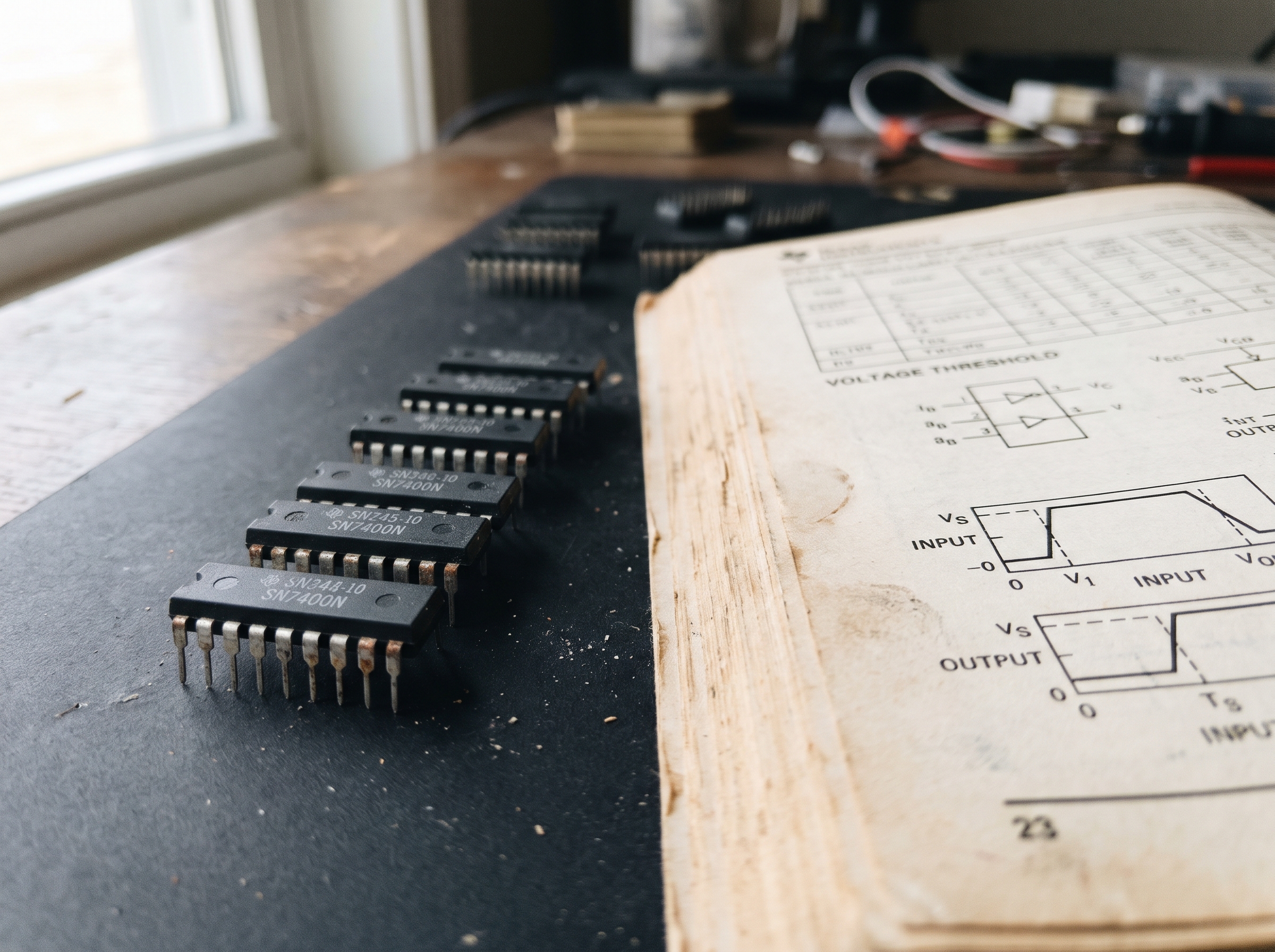
That 0.4-volt cushion is called the noise margin. In a real machine, power supplies ripple, nearby relays click, cooling fans hum, and long backplane wires pick up stray radio interference. Without noise margin, the first stray spike on a wire would flip a bit and crash the whole processor. With it, the circuit shrugs off daily static and keeps right on running.
Try pushing the Line Noise control on the bench below and watch what happens when static begins to eat through that buffer.

What Happens When Headroom Shrinks
Notice that a circuit does not fail the instant noise appears. It fails when the noise exceeds the margin.
We build our modern software—and our daily schedules—as if noise margin were wasted space. Corporate planners strip every ounce of slack out of a project timeline and call it efficiency. Cloud platforms run servers at ninety-five percent utilization and call it optimization. We pack our own days wall to wall with alerts, deadlines, and notifications, leaving zero buffer between one obligation and the next.
Everything looks fine on a quiet Tuesday. Then one small spike hits—a bad software patch, a delayed flight, a sharp comment at the dinner table—and the whole system drops straight into the forbidden band. Nobody can tell what is signal and what is static anymore.
Tuning With Room to Breathe
I run into the exact same principle when I pick up my acoustic guitar in the morning. An analog needle tuner will show you dead-center pitch, yet a real wooden instrument never sits frozen on a single mathematical frequency. Temperature shifts, strings stretch, and the pressure of your fingers changes the pitch slightly from fret to fret.

If your technique depends on every condition being laboratory-perfect, one humid afternoon ruins the song. When you leave a little slack in your grip and listen to how the notes settle together, the music absorbs the minor drift and stays warm.
Building Margin Back Into the Stack
In recovery and in engineering alike, the practical move is the same: stop trying to eliminate every source of noise in the universe, and start widening your margin.
- In your tools: Favor local-first files, plain-text notes, and offline backups so a single cloud outage or broken update cannot lock you out of your own work.
- In your calendar: Leave unscheduled white space between commitments so a small surprise stays an inconvenience instead of a crisis.
- In your nervous system: Guard sleep, quiet mornings, and honest boundaries before your buffer is spent.
The engineers who wrote those yellowed data books understood something our hustle culture forgot. A system with no margin is not lean—it is just one stray spike away from losing its mind.
Everything here is free. If this one helped you, there’s a tip jar.