
One Bad Router, One Narrow Strait, and an Overdue Upgrade
Eighty-three years after the Tehran Conference, a war over Hormuz mirrors the router fault that grounded U.S. flights—two brittle networks overdue for an upgrade.
Fifteen days ago, on Friday, November 13, a sudden communications failure grounded commercial air traffic across the United States.
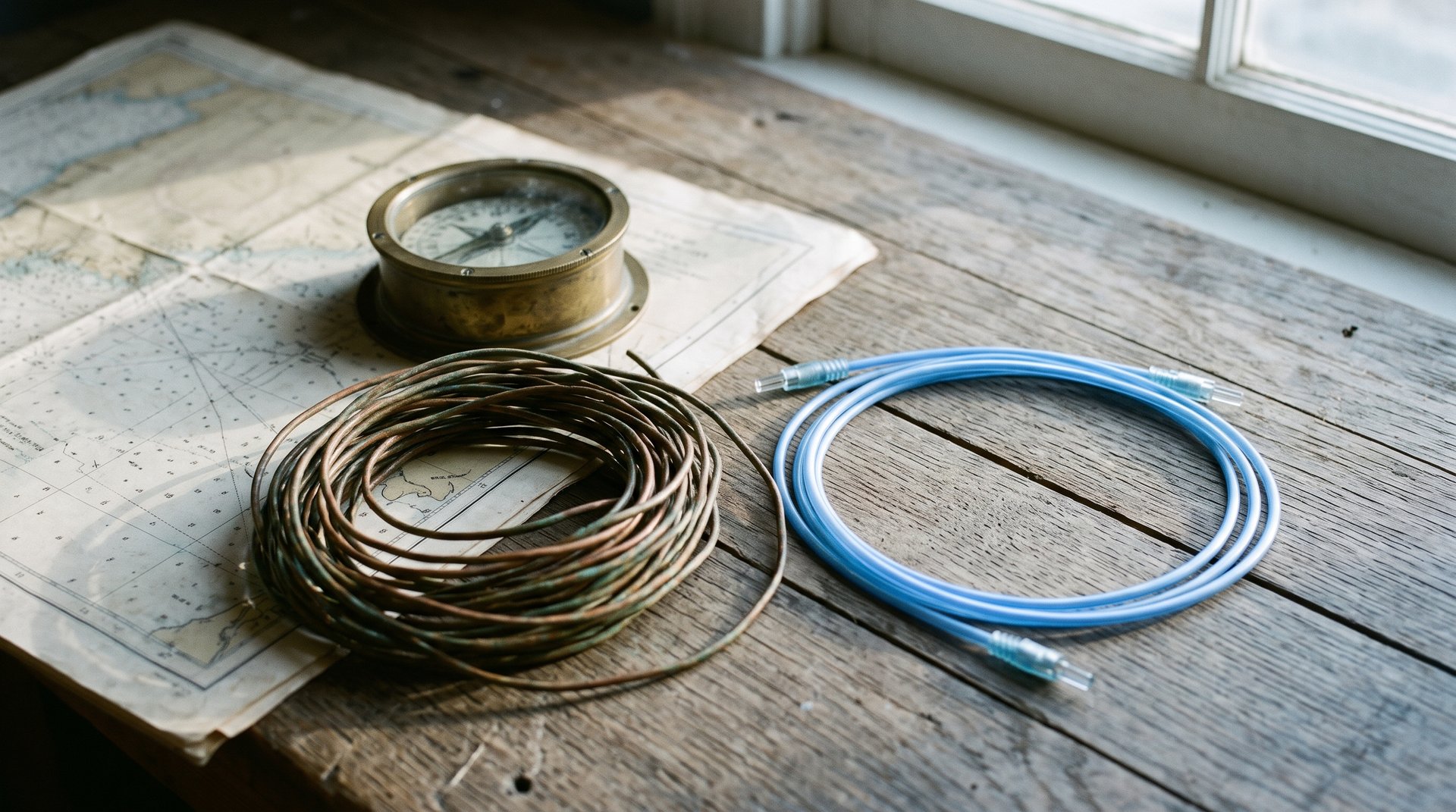
According to the official account from the Federal Aviation Administration, the Transportation Department, and federal investigators, there was no evidence of a cyberattack. During routine work to transition aging copper telecommunications lines to fiber, circuit-to-packet devices at remote sites in El Dorado, Arkansas, and Amarillo, Texas, began flooding the agency's network with more than a thousand connection attempts every four to five seconds. Because the decades-old network lacked real segmentation or fallback, that storm cascaded into 17 of the nation's 22 en route air-traffic control centers. Departures froze nationwide for nearly five hours, and thousands of flights unraveled across the weekend.
Yet almost as soon as the tarmac cleared, skepticism filled the air. Seasoned aviation hands questioned how a single maintenance seam in Arkansas could ripple across a supposedly redundant national grid. Coming in the middle of a shooting war with Iran—and alongside a November wave of corporate and federal tech outages—reports and rumors circulated that the "bad router" explanation was a cover-up for an Iranian cyberattack, or a rushed software rollout nobody wanted to own.
Here is the uncomfortable reality of our moment: when nearly every powerful actor treats strategic deception as an "art of the deal," ordinary people cannot tell from a press briefing what actually happened inside the rack. The hardware maker's parent company noted that its device functioned as configured, pointing past the box to the blueprint. And that points to the one thing we can verify without clearance: whether a packet storm begins by accident or by hostile intrusion, a flat, brittle architecture built for a bygone era—one that trusts every wire, logs maintenance on paper, and puts off a full rebuild for decades—goes down the exact same way.
Today is November 28—eighty-three years to the day after Franklin Roosevelt, Winston Churchill, and Joseph Stalin opened the Tehran Conference in 1943. Watching the war with Iran unfold on this November morning, I keep seeing that same legacy network diagram staring back at us.
The Geography Never Changed; the Wiring Did
There is a sharp irony built into that 1943 meeting. The Allies needed Iran's geography to move war supplies through the country to defeat a common enemy. Yet even while thanking Iran and signing pledges of sovereignty, outside powers treated the country less as an equal partner and more as an indispensable trunk line.
What connects 1943 to 2026 is not a straight line from cooperation to hostility. It is an unbroken pattern of foreign intervention, choices by Iran's own leaders, and compounding mistrust wired onto the exact same piece of the map.

: Anglo-Soviet invasion of Iran
Britain and the Soviet Union invade neutral Iran to secure oil fields and open the Persian Corridor supply route, forcing Reza Shah to abdicate in favor of his son.
: Tehran Conference opens
Roosevelt, Churchill, and Stalin meet in occupied Tehran to plan D-Day and formally pledge respect for Iran's independence, sovereignty, and territorial integrity.
: Soviet withdrawal crisis
Stalin delays withdrawing Soviet troops from northern Iran after the war, touching off one of the earliest standoffs of the Cold War.
: Coup topples Prime Minister Mossadegh
After Mossadegh nationalizes Iran's British-owned oil industry, British and U.S. intelligence help overthrow him, strengthening the shah's U.S.-backed rule.
25 years with no entries
: Islamic Revolution and embassy seizure
A broad uprising ousts the shah and creates the Islamic Republic; after Washington admits the shah for medical treatment, students seize the U.S. embassy for 444 days.
1980 to 1988: Iran-Iraq War
Saddam Hussein invades Iran in an eight-year war marked by Iraqi chemical weapons and a U.S. tilt toward Baghdad, hardening Tehran's drive for its own deterrent and regional allies.
: U.S. invasion removes Saddam Hussein
Removing Iran's most dangerous neighbor expands Iranian political and militia ties in Iraq while putting U.S. forces within reach of Iran-backed groups.
2015 to 2018: Nuclear deal signed, then abandoned
The 2015 accord caps Iran's uranium enrichment under international monitoring for sanctions relief; Washington withdraws in 2018 and reimposes sanctions, and Iran later exceeds the limits.
: Strikes leave an oversight blind spot
Israel and the United States strike Iran; afterward, International Atomic Energy Agency inspectors can no longer verify what happened to Iran's declared stockpile of highly enriched uranium.
: Direct U.S.-Israeli war with Iran begins
Joint strikes open the current war; despite a June memorandum aimed at ending the fighting, talks remain stalled as of late November while both sides continue exchanging strikes.
Notice how the failure mode echoes what happens when primary and backup cables share one tunnel. When great powers treat a living nation—home to millions of ordinary people who want safety, dignity, and a future—as a single choke valve in somebody else's strategic machine, every shock on the wire travels at full voltage.
Two Flat Networks, One Shared Failure Mode
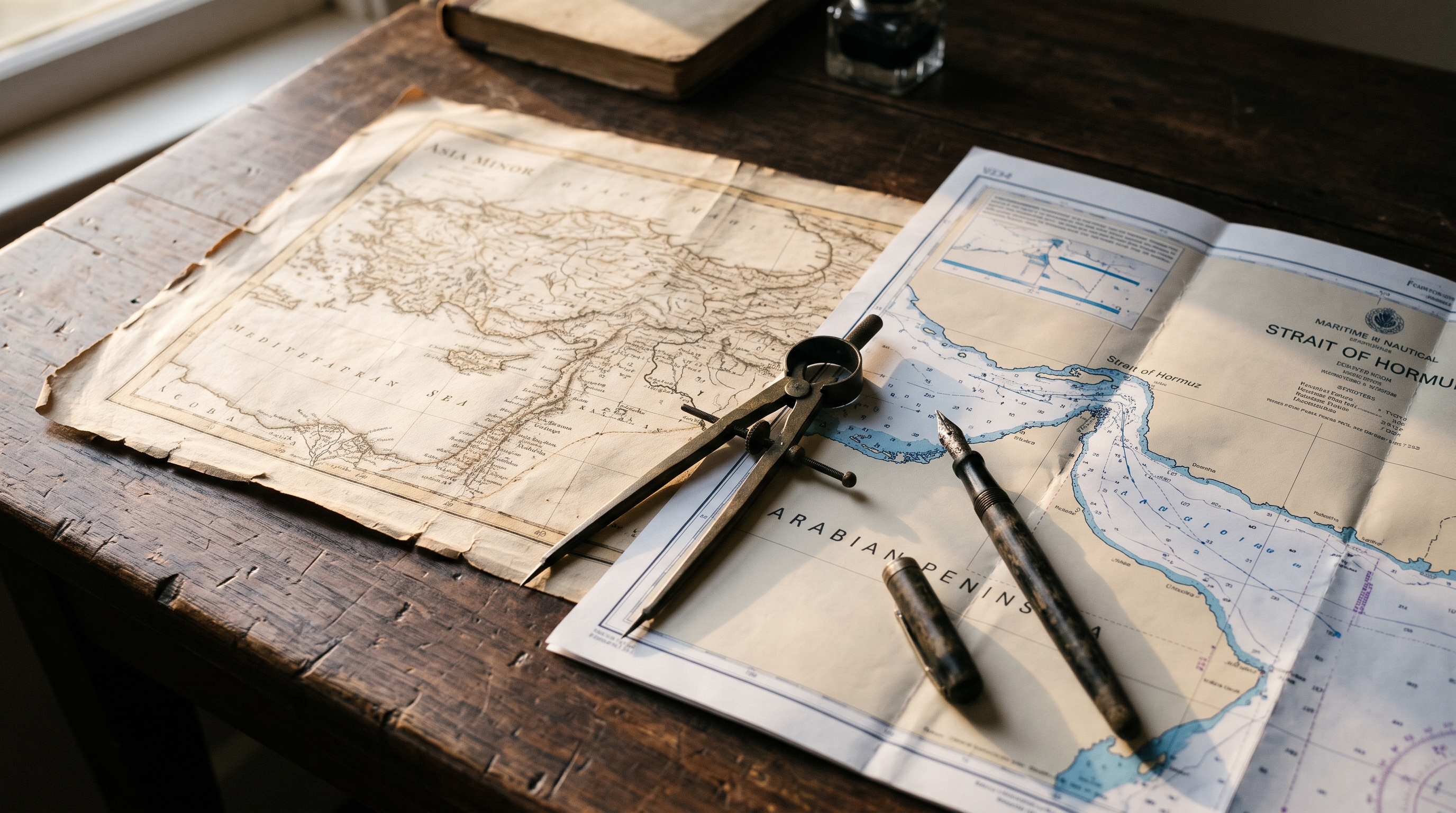
In 1943, Washington and Moscow needed supplies to move through Iran. In 2026, Washington and Tehran are fighting in part over who can move goods past Iran. A conflict there never stays local for the same structural reason a fault in Arkansas destabilized radar feeds across seventeen regional centers: there is almost no isolation between the chokepoint and everyone else.
Put the two architectures in one table and the structural kinship is hard to miss.
Failure Layer | FAA Ground Stop (Nov. 2026) | Iran & Strait of Hormuz (1943–2026) |
|---|---|---|
Legacy architecture | Decades-old copper lines bridged onto fiber with minimal segmentation | Global fossil-fuel trade wired through one narrow maritime strait |
Tight coupling | One remote site cascades across 17 of 22 national control centers | Regional ties link Iraq, Lebanon, Yemen, Gaza, and Gulf shipping—crossing even Sunni-Shia lines |
Loss of visibility | Paper maintenance logs, 45 minutes to trace the storm, and no open forensic log to settle cover-up doubts | Blocked IAEA verification after strikes turns uncertainty into escalation |
Patchwork reflex | Disable a feature on 60-plus boxes and defer full copper retirement to 2028 | Trade sanctions, proxies, and strikes without changing the underlying dependency |
You cannot bomb a topology into resilience, any more than you can fix a flat network by yelling at the router—or spinning the press release.
Damaging a facility and verifying what happened to the nuclear material inside it are two different operations. Likewise, disabling a broadcast feature on sixty-plus boxes gets planes back in the air for Thanksgiving, yet leaves both the legacy seams and the public's doubts right where they started.
Maybe It Is Time to Upgrade the Infrastructure
When a system fails this predictably—whether from wear, negligence, or sabotage—engineers stop arguing over the spin and start redesigning the network. Carrying that calm triage from the server room into civic life points to three overdue upgrades.
First, upgrade the physical energy architecture. As long as a fifth of the world's liquid fuel and gas must squeeze through one strait, every regional rupture becomes a global kitchen-table emergency, just as it did in 1974. Moving toward distributed renewables, storage, efficiency, and local microgrids is not just climate policy; it is basic fault isolation. We have already seen what happens when the grid stays down under brittle, centralized design. Diversifying where energy lives shrinks the blast radius of every chokepoint on earth.
Second, upgrade our verification and diplomatic channels. Nobody runs a safe airspace on guesswork, and nobody prevents nuclear miscalculation—or puts cover-up rumors to rest—without live, inspectable telemetry. Restoring verifiable guardrails, open post-mortems, and direct diplomatic off-ramps is not weakness; it is putting working gauges back on the panel so leaders and citizens alike stop mistaking darkness for an incoming strike.
Third, upgrade our own civic headroom. Healthy circuits depend on Transistor-Transistor Logic (TTL)A classic family of 5-volt digital logic circuits built from bipolar transistors, where safe voltage buffers—called noise margins—keep analog interference from flipping bits.More on this term, the buffer that keeps stray static from flipping a clear signal into garbage—a lesson I keep coming back to in Margin and Perspective. Outrage feeds profit by running our nervous systems at zero headroom, flattening eighty years of human history into instant tribal slogans. Building local resilience—through mutual aid, liberation technology, and tools communities actually control in the shell of the old—gives ordinary neighbors a steadier footing whenever distant networks shake.
Eighty-three years after Tehran—and fifty-two years after those 1974 gas lines—we cannot redraw the Strait of Hormuz any more than the FAA can wish away the sky over Arkansas and Texas. What we can change is the architecture we build around those places. Maybe—just maybe—it is finally time to retire the 1940s wiring and build a network that does not go dark every time one circuit trips.
Everything here is free. If this one helped you, there’s a tip jar.