
The Estate
A map of every property, reconciled from a property registry at boot: each one’s tiers, and whether it is actually live.
Node PWA · the hub
The control tower for a one-person software studio: every site and app I build reports into it, and every change ships through it.
DevStudio is my private studio hub: one installable web app from which I run every site and app in the estate. It began in June 2026 as an SEO console with an AI audit engine, and grew into the control plane for everything else.
It is invite-only, with Google sign-in. Clients get read-only views.
The screens on this page run on an invented estate: the apps, names, numbers and people are made up.
Anyone using one of my apps can ask for a feature, report a bug, or just ask a question, then watch the answer come back to the app they asked from. Here is one request, start to finish.
Every app carries the same Feedback form: Bug, Idea, Friction or Misc, a title, and “What’s up?”. Misc is for everything else, including a plain question.
A public site like this one has no sign-in, so it takes the same signal through its contact form instead.
Every app and site reports into the same Inbox, tagged with where it came from. Requests that need a verdict are pulled to the top; nothing waits in someone’s email.
AI skills draft the triage — a title, the problem, a plan, the acceptance criteria — as suggestions only. They never create tasks, pick options or write prompts, and every AI decision is logged; none is applied on its own.
A human agrees every item before anything is built. Agreement is the requester’s side of the item; execution is the studio’s. The requester’s own words stay on screen the whole way.
Once an item is agreed, the Runner — a background service — takes it through build, tests, staging, acceptance and release unattended, one attempt per step.
Every hop is recorded: who moved it, how, and on what evidence. This one was shipped and verified against the live app.
The status flows back into the app the request came from. The person who asked sees their own words, where the request has got to, and the replies; in the apps that carry the thread, they can answer back.
“Proven” is the last step: the change was checked live, not just shipped.
A map of every property, reconciled from a property registry at boot: each one’s tiers, and whether it is actually live.
The studio’s landing page. Nothing on it is arranged by hand: every card sits where its real transitions put it.
Themes come from a shared skin registry and are saved per account, light or dark.
Also in the hub: an in-app Library of the estate’s docs, a log sink every app writes to, an API cost page, and an MCP server so Claude sessions can ask it questions.
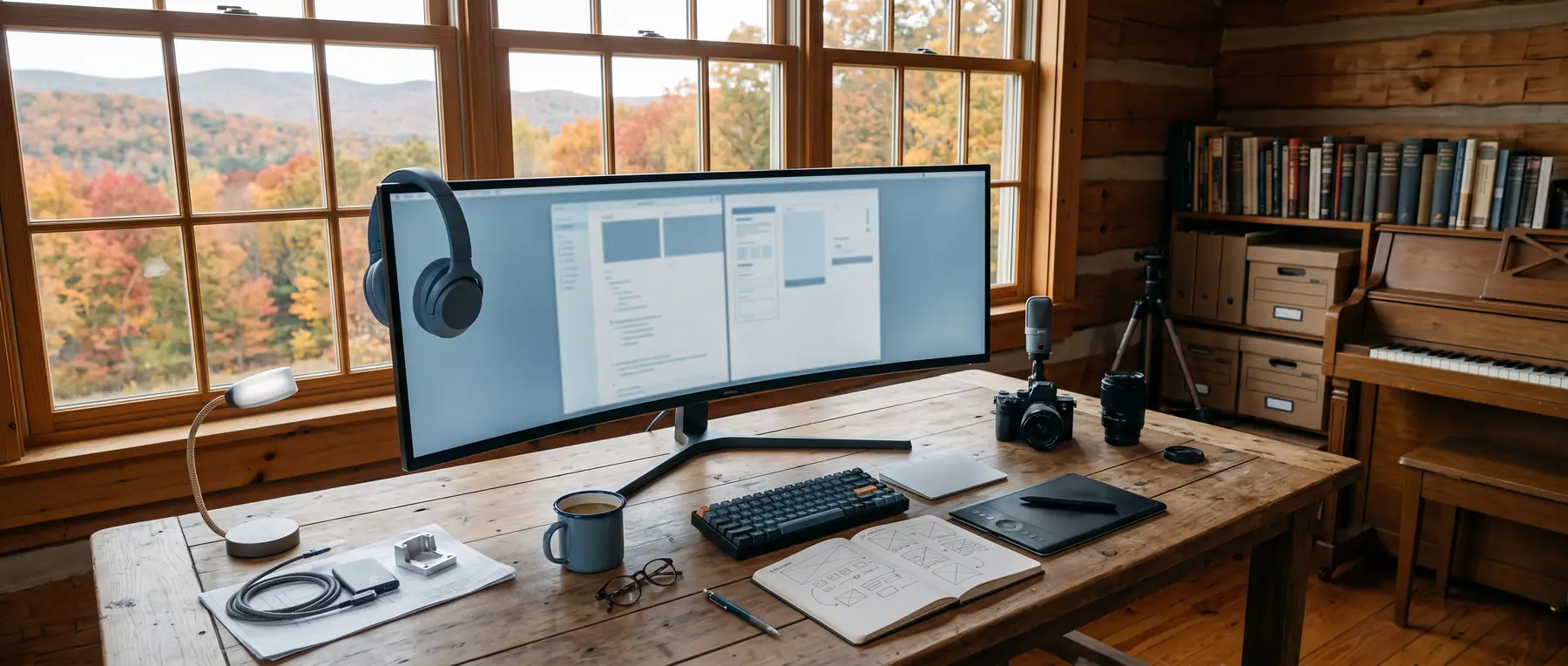
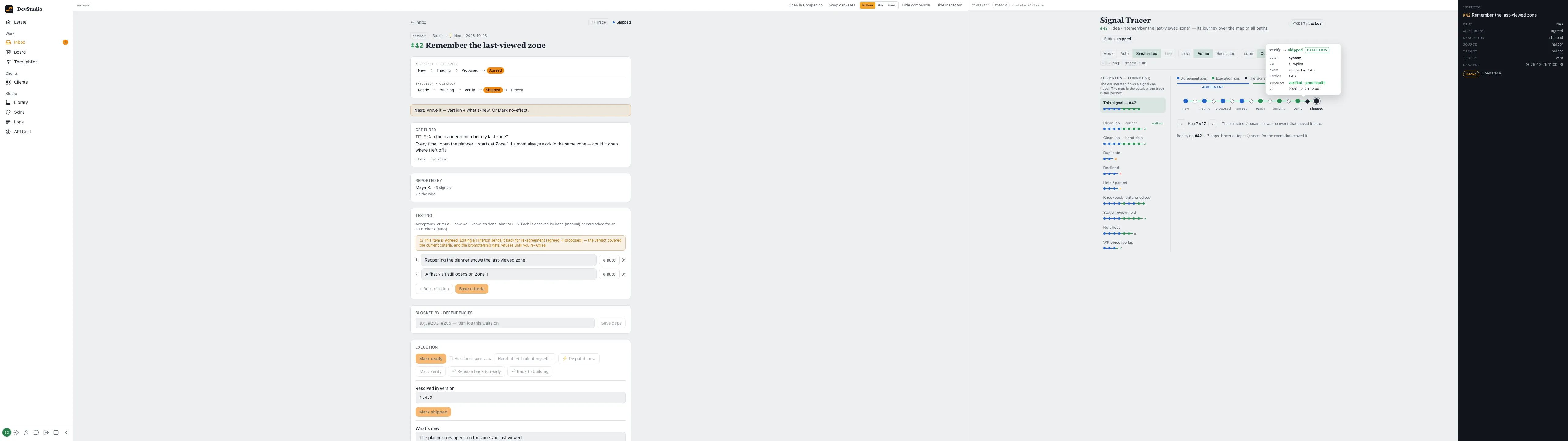
My desk has a 49-inch 32:9 display: 5120 × 1440, exactly two 2560-wide workspaces side by side. DevStudio treats that as a tier of its own, not a stretched laptop: a request in one canvas, its Signal Tracer in a second, an inspector beside them.
Layout answers to four named tiers — compact, standard, panoramic and enhanced panoramic — qualified on three axes: width, aspect ratio and pointer. Width alone cannot tell a 4K 16:9 panel from a 32:9 ultrawide; they are different shapes at similar widths. Surplus width becomes another column or margin, never a wider form.
And it is a choice, not a law: Auto, Always or Never.
On a wide screen? Here is the whole frame, at full size.
Every app starts from create-ga-project, a small scaffolder. Pick a type — Node PWA, WordPress, Astro site or Payload CMS — and it copies the starter, writes the docs, registers the property and hands the domain work to Claude.
$ create-ga-project.sh \
  --name harbor \
  --domain harbor.studio.example \
  --brief "garden planner PWA" \
  --no-feature auth \
  --dry-run
create-ga-project — node-pwa
  name    : harbor
  display : Harbor  (PRD: Harbor_PRD.md)
  folder  : ~/Development/harbor.georgeaguiar.com
  domain  : harbor.studio.example
  ports   : auto-assigned, never colliding
  brief   : garden planner PWA
  features: off = auth (P-17; cascades apply)
 Feature composition (P-17)
  on        : db, feedback, whats-new, skins, lists, pwa, mail, ai, mcp, display-envelope, theming-conformance, versioning, staging, acceptance, env-indicator, health, logging
  off       : auth
  cascaded  : roles, invites  (requires: edges)
  rides off : acceptance-fixtures  (unit-map alsoOff)
(dry run — nothing written)$ create-ga-project.sh \
--type astro-site \
--name fernwood \
--domain fernwood.example \
--with-cms \
--brief "a cafe's menu and hours" \
--dry-run
create-ga-project — astro-site
name : fernwood
display : Fernwood (PRD: Fernwood_PRD.md)
folder : ~/Development/fernwood.example
domain : fernwood.example
worker : fernwood-site (+ CMS fernwood-admin)
brief : a cafe's menu and hours
pair : + payload-cms at admin.fernwood.example
(dry run — nothing written)--dry-run previews the whole plan and writes nothing.--with-cms scaffolds a site and its paired CMS and wires the two together.--sync-docs --all --check finds every app whose copy has drifted.Switch a capability off and everything that needs it goes with it — the same requires: edges the scaffolder follows. The platform’s spine is never optional.
Always on: Display envelope · Theming conformance · Versioning · Staging · Acceptance · Environment badge · Health · Logging
The flags
create-ga-project.sh --name harbor
The same, as a declaration (--features)
{ "features": {} }Everything on.
DevStudio is private and invite-only, so there is nothing to visit; these pages are the tour.