
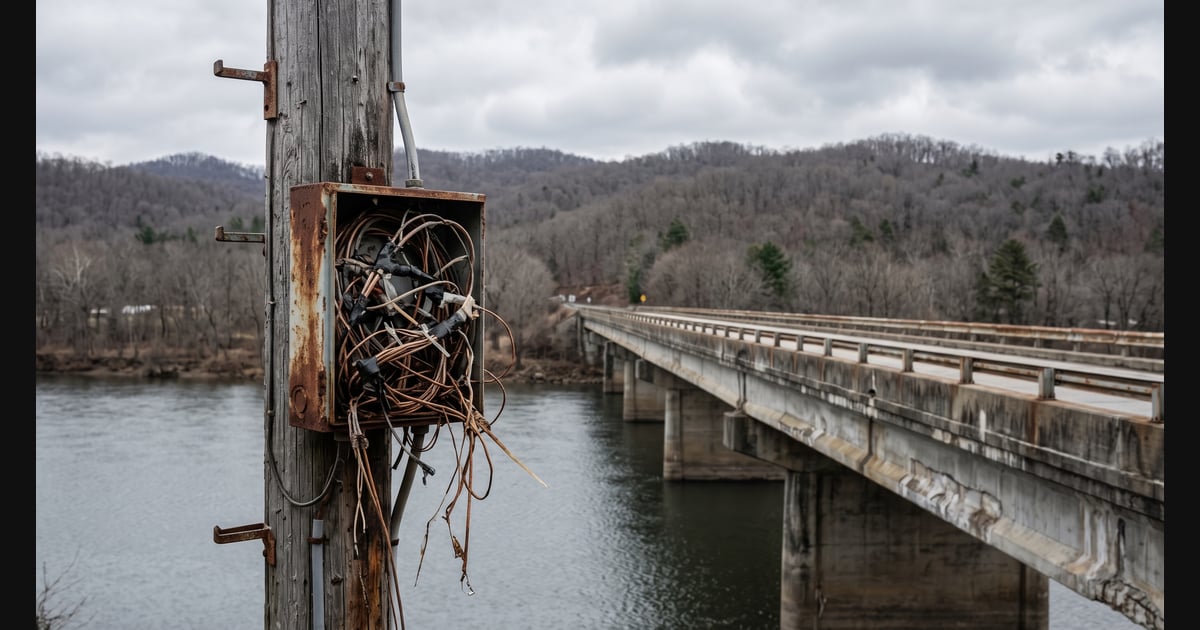
When Everything Runs on Duct Tape, Peace Is the Only Answer
Six major outages in a week exposed more than software bugs. When digital and civic systems hit cascading tipping points, peace stops being an ideal and becomes survival.
There is nothing funny about what happened to America's critical systems last week, and it is time we stopped treating alarms like entertainment.
If the ground felt unusually unstable over the past seven days, the public record confirms it was not just a feeling. Downdetector—the closest thing ordinary citizens have to a national outage scoreboard—logged 6.4 million U.S. outage reports in the seven days ending Tuesday, roughly four times a normal week, alongside 14 million worldwide. On Tuesday, November 17 alone, 67 U.S. services lit up the board, compared with about 16 on a typical day.
Five headline failures drove the shockwave:
- Microsoft 365 (Nov. 12–14): Roughly 3.9 million U.S. reports and 7.8 million worldwide—the largest Downdetector event since last October's AWS collapse—blamed on a latent networking-gateway defect.
- The FAA (Nov. 13): A nationwide ground stop lasting more than four hours, only the second since 9/11, after router work flooded aging telecom gear—an engineering failure I looked at in Dulles Tower, November Two Seven Niner Requesting a Working Network.
- JPMorgan Chase and United Airlines (Nov. 16): Chase drew about 90,000 U.S. reports—roughly 165 times normal—when a software bug jammed transactions that cascaded into other banks, the same day United stumbled.
- Apple (Nov. 17): About 81,000 reports across iCloud, Apple Pay, and the App Store from what the company called a faulty internal update.
- The NSA (Nov. 17): Even the National Security Agency's internal classified network, NSANet, suffered what officials described as "temporary degradation during scheduled routine maintenance"—an incident completely invisible to public trackers.
Honesty matters when reading the instruments. Downdetector measures complaints rather than verified root causes, and outage headlines draw more people to report secondary hiccups. Officials including Secretary of State Marco Rubio maintain there is no evidence linking these failures to a single coordinated cyberattack, and Ookla's research director called the cluster a big blip and a coincidence.
Even if every word of that official explanation is accurate, we are staring at a far deeper crisis.
Denial at the Controls
When Americans naturally asked what was happening, President Trump dismissed the week as "individual events" and pointed the finger at Joe Biden.
We have to be plainspoken here. Donald Trump has spent years demonstrating that his word cannot be trusted when facts become inconvenient. Calling a week of cascading national disruptions routine—and blaming the last administration—does not stabilize a single router, bank ledger, or air-traffic circuit.
Worse, constant belligerence from the White House does not project strength in the twenty-first century. It paints a massive bullseye on the President's back and on every ordinary household connected to American infrastructure. Cyberweapons are no longer locked inside a handful of superpower vaults. They are cheap, increasingly automated, and accessible to state and non-state actors alike. Picking fights with the world while our own digital backbone is visibly cracking is not deterrence. It is negligence.
The Hockey Stick of Cascading Tipping Points
Step away from the server rooms for a moment and look out the windshield. The real danger is not one software bug or one bad week on Downdetector. It is what happens when tipping points stop happening one at a time.
Complexity scientists and ecologists have warned for decades about cascading tipping points—the moment when stress in one strained system triggers failure in the next, bending the curve upward in an exponential hockey stick. Once a network of interdependent systems crosses that threshold, you no longer get neat, isolated problems with tidy fixes. You get compounding shocks.
We do not need a classified intelligence briefing to see how thin the ice has grown. Look at the physical commons we rely on every single day:
- Our roads and bridges, patched decades past their intended design life.
- Our public schools, underfunded, overburdened, and asked to absorb every social wound the economy leaves behind.
- Our municipal water systems, running on century-old mains held together with duct tape and baling wire.
When air traffic, banking, cloud communications, roads, schools, and clean water are all straining at once, we have to ask an uncomfortable, dead-serious question: Are we witnessing late-stage capitalism's tipping point?
I am not talking about honest local trade between neighbors. I am talking about an extractive economic engine that treats maintenance as a drag on quarterly profit, strips away redundancy to squeeze out another point of margin, centralizes vital infrastructure into a handful of brittle corporate choke points, and funnels trillions into weapons and geopolitical dominance while the foundations of daily life corrode underneath us.
Whether a breakdown begins with a hostile cyberweapon or a neglected patch, the underlying failure is the same. We have spent forty years burning through our safety margin, and the bill is coming due all at once.
From Here, Peace Is Clearly the Only Answer
After thirty-five years building and running complex software systems, I learned one unforgiving rule of engineering: when a machine runs out of safety margin, you do not push the throttle harder. You reduce load, you stop introducing new shocks, and you dedicate every available hand to repair.
From where humanity stands today, peace is clearly the only answer.
That is no longer an idealistic slogan. It is a basic condition for survival. A civilization whose digital networks, water pipes, power grids, and public institutions are held together with duct tape and baling wire cannot survive permanent conflict, cyber brinkmanship, or the fantasy of global dominance. Every dollar poured into hostility abroad—and every ounce of energy wasted on manufactured partisan hatred at home—is stolen directly from the urgent work of keeping our communities whole.
Choosing peace means two concrete things right now. Externally, it means demanding de-escalation, diplomacy, and an end to the reckless provocations that turn civilian infrastructure into a battlefield. Internally, it means turning our attention homeward—repairing our physical commons, investing in our neighbors, and stepping off centralized monopolies toward open, resilient, locally controlled tools, the work we explore in The Architecture of Resistance and In the Shell of the Old.
We have reached the steep part of the curve. We cannot bully, lie, or patch our way past cascading tipping points. We need sobriety, honest repair, and peace—while we still have the margin left to choose them.
Everything here is free. If this one helped you, there’s a tip jar.