
The Broadcast, the Bundle, and the Jammed Family
Billionaire feeds and cash-fueled politics pile onto the emotional weight we already carry, jamming our families. Rebuilding trust across generations is how we push back.
I caught a line on The Young Turks the other day that stopped me mid-coffee: "The news isn't the news. The news is the wealthy and the powerful trying to get you not to see the news."
Now, if you are a fellow Boomer who hears that show's name and instinctively reaches for the remote, stay with me for two minutes. Even that broadcast desk is multigenerational—Cenk Uygur is Generation X, and Ana Kasparian is a Millennial who walked away from the Democratic Party to go independent. Our knee-jerk habit of dismissing a true reading on the gauges just because it wears the wrong tribal label is half the trap I want to talk about.
Look at the economic ladder we are standing on. At the top sit roughly a thousand American billionaires. Like everyone else, they are tribal—people look out for their own. Beneath them sits a growing class of millionaires, around 9 percent of American adults by net worth, expanding by the week. Just look at Anthropic going public this month and minting thousands of new paper millionaires in a single morning.
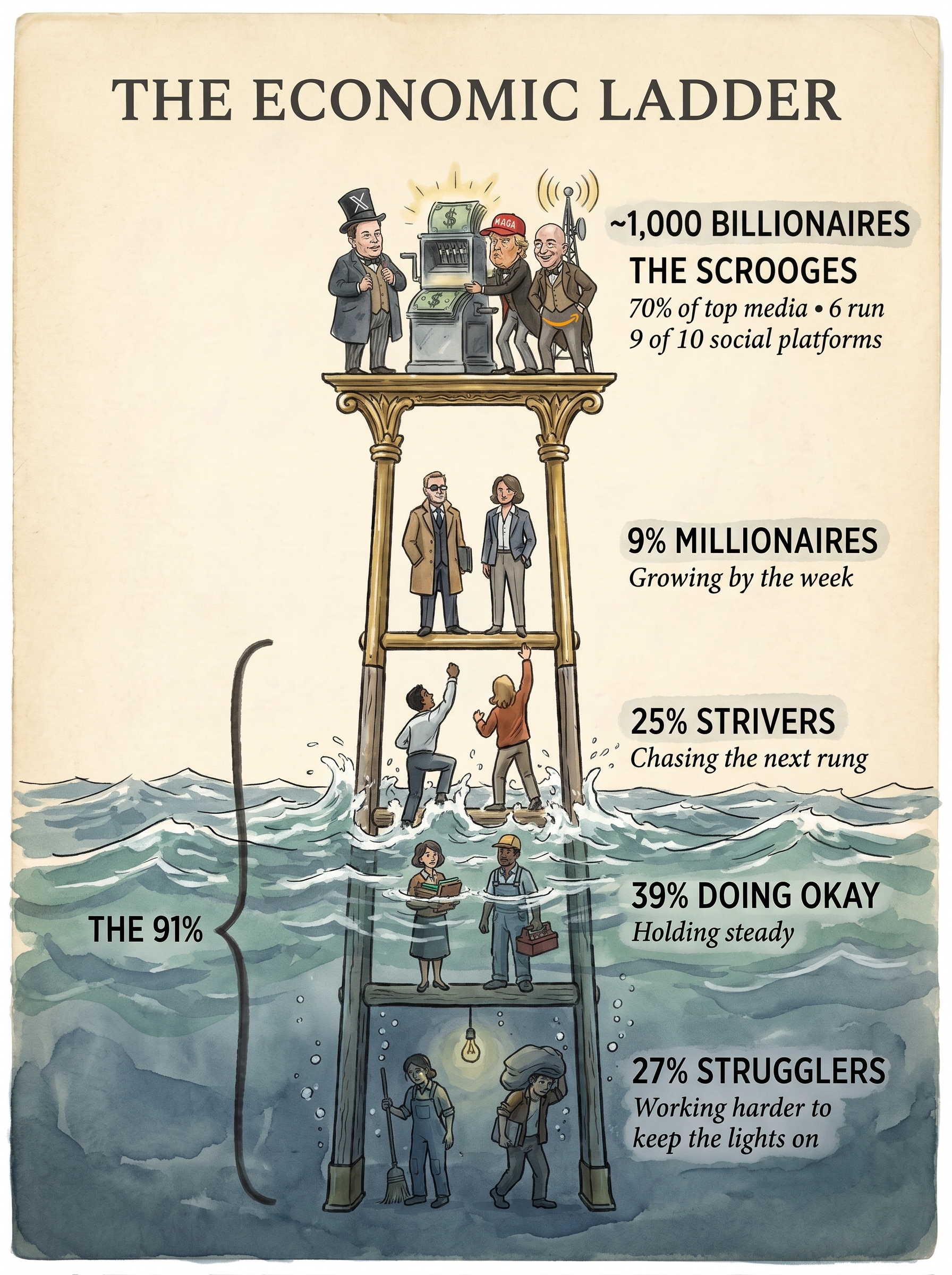
Then there is the remaining 91 percent of us. Most of us fall into three camps: the strivers chasing millionaire status at any cost, the folks doing okay, and the strugglers working harder every year just to keep the lights on.
Each tier gets its own custom news stream. The problem isn't ambition or honest success—it is the Scrooges at the top who are never satisfied and have bought the printing presses. Billionaires now hold ownership stakes in 70 percent of the top media companies, six of them run nine of the ten largest social platforms, and 238 American counties have turned into complete local news deserts. As I wrote in Three Networks, One Ruling Class, the feeds pose as opposing teams, yet they run on one operating system: keep the 91 percent angry at each other so nobody checks the gauges at the top.
Yet something is shifting. Trust in mass media sits near historic lows. We carry powerful communication tools in our pockets now, and human beings are built as learning machines when we are young. Each generation adapts to these tools faster than the one before it—and more of us are seeing right through the inequity.
Two Faces in the 1990s Cubicles
Seeing through a rigged system does not automatically set you free, though. It takes spare energy to act, and most people are running in the red. I learned that by confronting my own blind spot from the internet boom.
In my forties, the shortage of software engineers was so acute that anyone with ten years of code behind them was considered senior. I loved the craft. If you had a passion for building systems, those years were both fun and profitable. Most of the engineers on my teams were Generation X, and looking back, I saw two very different patterns in those cubicles.
First were the folks I quietly misread as "Dolittles"—people who didn't seem to enjoy the work, just coasting on a comfortable paycheck. Years later, sitting in rooms with Adult Children of Alcoholics and Dysfunctional Families (ACA), I realized how badly I had judged them. Most "Dolittles" aren't lazy. They are carrying what ACA calls "The Bundle"—the invisible pack of childhood survival wiring, hypervigilance, and unspoken family grief. In computer terms, The Bundle runs like a heavy background process quietly burning your Central Processing Unit (CPU) cycles before the workday even starts. It drains what you have left for your career, your craft, and your peace.
Then there was the second face in those same cubicles: younger engineers who were genuinely bright and intensely driven, yet treated ethics like an optional software library you only import if the compiler complains. Winning the puzzle mattered more than who paid the price when the code shipped.
Elon Musk is Generation X, and to my eyes he is that second cubicle mindset scaled up to the richest man on earth—brilliant at spotting mechanical leverage, hollow on the ethics. Look at his playbook across the last two election cycles, where he poured more than $735 million into steering American voters. In 2024, he spent over $290 million nationwide, headlined by his $1 million-a-day petition giveaway in swing states like Pennsylvania. His Political Action Committee (PAC) lawyers persuaded a Philadelphia judge it wasn't an illegal lottery by calling the winners paid spokespeople. To anyone with eyes open, it was a clever, cynical engineering workaround—dangling cash in front of disengaged young men to pull them off the sidelines and into the voting booth.
This fall he ran the same play even harder, spending roughly $445 million across the midterms, including nearly $190 million trying to rescue a Texas Senate race and install his own home-state senator. Yet something telling happened on the ground: voters grew tired of the billionaire ad flood, the push fell short, and Musk himself admitted this week that if he could rewind the clock, he would have spent less. Brute-force capital can jam a signal, but it cannot buy trust forever.
Two Screens, One Jammed Family
Now drop billionaire-engineered media and cash-fueled politics straight on top of The Bundle.
That is the painful paradox playing out across generations today. Younger Americans hold better communication tools than we ever dreamed of, and they see the economic squeeze clearly—yet they are hurting deeply. Suicide is now the second leading cause of death for ages 15 to 34, while men over 75 carry the highest rates of all. Both ends of the ladder are taking casualties.
Part of why it feels so lonely is that our feeds have segregated us by age. Older adults stay anchored in traditional and cable news, while half of young adults rely on social streams. The kids see a system draining them dry; too many parents and grandparents watch another screen telling them the kids are simply ungrateful. One-third of Americans have ended a personal relationship over politics, and nearly four in ten are estranged from an immediate family member.
It is easy to look around and conclude that our communities and families are shattered beyond repair. That is exactly what the outrage feeds want us to believe.
Yet when I checked the data for The 2026 Tipping Point, a steadier picture emerged. More than half of Americans still help their neighbors informally. Most family estrangements eventually return to contact. And one Pew survey stopped me cold: 67 percent of Americans say they would bring a meal to a sick neighbor or friend, yet only 42 percent believe anyone would bring a meal to them.
Our communities aren't shattered. They are jammed. We still care about each other—we have just been trained by Scrooge-owned screens to assume our own neighbors and relatives don't care about us.
Generational Solidarity Is the Parallel Commons
Yes, we need ethical laws—media ownership caps, real campaign-finance guardrails, antitrust enforcement, and open communication standards so no billionaire can buy both a town square and a Senate seat.
We just cannot wait on Congress to disarm its biggest donors. Lawmakers rarely move out of sudden conscience; they move when ordinary people build leverage they cannot ignore.
That leverage starts at home. Local is community, and community is family. When a Boomer parent or grandparent steps away from the cable feed, sets aside the urge to lecture, and actually listens to what the younger generation is seeing—and when younger folks recognize the weight their elders never had the vocabulary to name—we build the one parallel commons the Scrooges cannot buy or moderate.
We can't fix every law this week. We can lower the volume on the rigged signal, set down a little of The Bundle, and talk to the people across our own kitchen table. That might be the tipping point they are actually afraid of.
If you or someone you love is carrying too much tonight, please call or text 988 for the Suicide & Crisis Lifeline—free, confidential, and open 24/7.
And here is a question for the Scrooges watching the dashboards at the top of the ladder: what if they looked up from the spreadsheets long enough to see that their greed is why ordinary folks keep needing that reminder?
Everything here is free. If this one helped you, there’s a tip jar.