
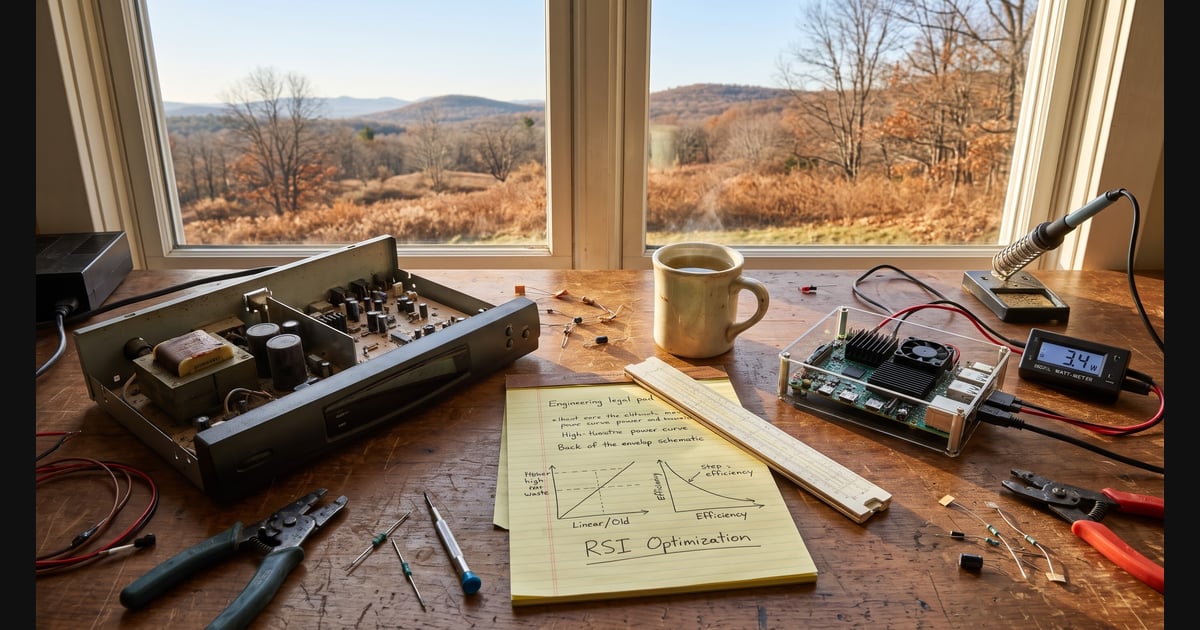
Why the Great Cable Box Fix Proves AI Won't Drain Our Grid
Panicking over AI data center power? Take a deep breath. History shows that when technology gets hungry, engineers innovate. From the great cable box energy fix to Recursive Self-Improvement, here is why open-source efficiency will save the grid and usher in abundance.
It is a crisp 42°F out this morning in the Appalachian Mountains, with mostly cloudy skies and a 4 mph wind from the southwest. With the forecast promising sunny skies and a high of 56°F later today, I pulled on a plain organic cotton flannel shirt and an unbleached hemp sweater before stepping out to check my fabric grow bags. My hardy Swiss chard, kale and kohlrabi are still holding on against the autumn chill, ready to be chopped into a big pot of homemade vegetable soup. After a rejuvenating night of sleep and a brisk walk under the bare November trees, I sat down with a warm bowl of oatmeal to read the morning tech news.
Lately, the headlines are full of panic about AI data centers devouring the electrical grid. When we grow up in chaotic environments, our nervous systems get wired to expect disaster around every corner. As a fellow traveler in recovery, I recognize that collective anxiety. We see a spike in energy usage, and our brains jump straight to scarcity and doom. I hear the genuine need for security and planetary care behind those fears.
However, after nearly half a century in hardware and software engineering and my early days studying digital electronics in university, I have learned a comforting truth: engineers hate wasted energy. Heat and high electric bills are bugs, and we love fixing bugs.
To see why we can all take a deep breath, let us look at the humble television cable box. Imagine if, back in 2008, the government had panicked and confiscated everyone’s cable boxes because they were melting the grid. At the time, U.S. cable and satellite boxes were devouring 27 billion kilowatt-hours a year—roughly enough electricity to power the entire state of Maryland! Because of clunky linear power supplies and poor code, those boxes burned nearly as much power turned "off" as they did when you were watching a movie.
Instead of banning television, hardware and software engineers got to work. Back in 1989, cable networks had already started swapping out inefficient linear power supplies on the poles for switched-mode supplies, cutting line losses across the coaxial plant. Then, following the 2012 Set-Top Box Voluntary Agreement, engineers rolled out smart "light-sleep" modes and redesigned the silicon.
The results were miraculous. National set-top box energy consumption plummeted from about 32 terawatt-hours in 2012 down to 6.8 terawatt-hours in 2025—a massive 79 percent drop. A new non-DVR box today sips just 27 kilowatt-hours a year, saving everyday families $26 billion on their electric bills. The costly engineering overhaul paid for itself many times over.
Now, apply that same engineering spirit to AI. We are standing right on the threshold of Recursive Self-Improvement (RSI) and the Singularity. Unlike the cable box—which needed human engineers to spend a decade rewriting firmware—AI is beginning to optimize its own code and design its own chips. We are watching a shift from brute-force computing to elegant, hyper-efficient architectures.
Even better, the champion of this efficiency revolution is open-source software. When giant corporations build closed models, they often throw massive, wasteful server farms at the problem. However, the open-source liberation technology community wants AI to run locally on everyday hardware. By using clever quantization, distilled weights, and open protocols, open-source developers are shrinking giant models so they can run on a modest desktop or even a solar-powered mesh node without touching a corporate data center. Just like nature's underground mycelium network distributes nutrients with zero wasted effort, open-source AI distributes intelligence efficiently.
We do not need to fear the future or ration our curiosity. Human ingenuity—and soon, AI-assisted ingenuity—always bends the curve toward doing more with less. When we let go of fear, we make room for wonder. Go cook a healthy meal, get some rest, and trust that the engineers are already wiring up a brighter, cleaner tomorrow.