
Thirty Grow Bags, a Half-Built Greenhouse, and Peace Before the Freeze
With a freeze hours away, 30 grow bags outside an unfinished greenhouse, and a kitchen full of late harvest, calm triage and local abundance remind me how to live one day at a time—with a plan.
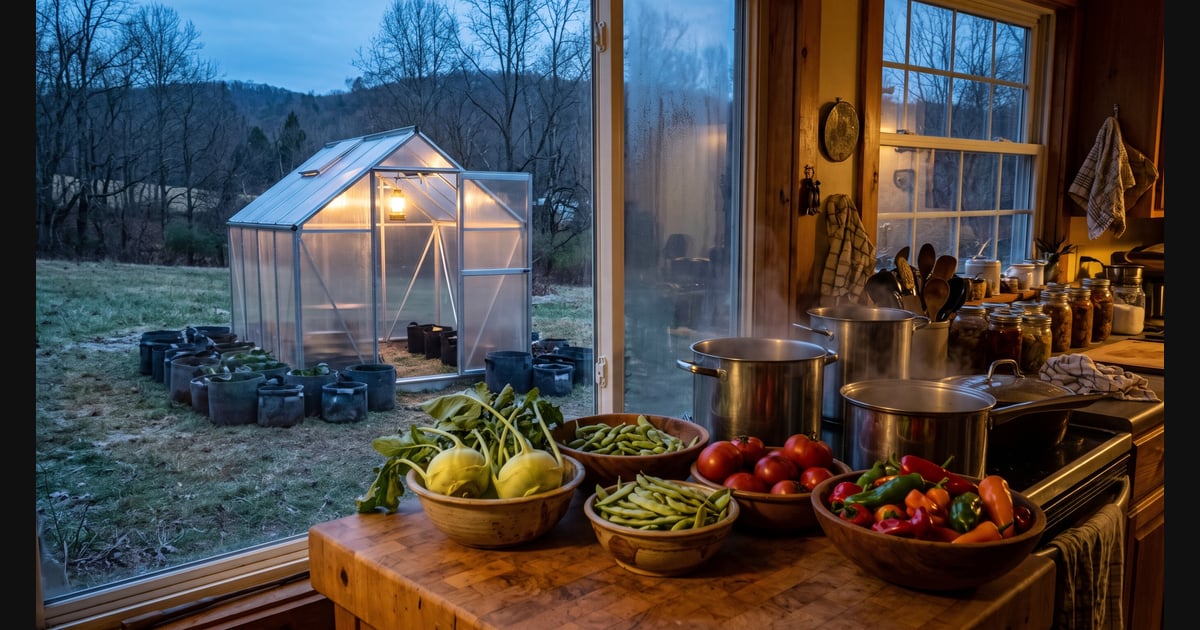
On paper, I have every reason to be pacing the floor tonight. Tomorrow morning, a hard November freeze is dropping into the hills, and out in the yard sit thirty fabric grow bags still waiting to move into a new seven-by-ten-foot greenhouse that is not quite finished. Step inside my kitchen, and there is barely an inch of open counter space. It is a steady, joyful whir of clanking pots and pans as the final harvests of the season wait their turn at the stove: bowls of lima beans, late tomatoes, sweet and hot peppers, and awkward, pale-green globes of kohlrabi that look like satellites from the early space program. Yet instead of panic, a pleasant stream of relaxing music is floating through the room, and my shoulders are down where they belong.
Decades ago, an evening like this would have lit up my nervous system like a pinball machine. When you grow up around dysfunction, or spend thirty-five years in software engineering watching production deadlines barrel toward unfinished codebases, your brain learns to treat every incomplete checklist as a five-alarm emergency. You start living in tomorrow's frost instead of tonight's kitchen. In recovery, we talk a lot about taking life one day at a time. That is the bedrock of emotional sobriety, though as I like to remind myself when the temperature starts plunging, it is still smart to have a plan, Stan. Presence does not mean sitting on the porch watching the peppers freeze; it means working the problem in front of you without letting fear drive the bus.
If you open a browser or turn on the news tonight, the wider world feels like it is on fire. Every feed is engineered to convince us that the sky is falling and that our outrage is required immediately. Outrage, however, has never tightened a single bolt on an aluminum greenhouse frame or blanched a single pot of lima beans. When you trade the algorithmic firehose for the positivity of what is local and right in your hands, the math changes. In software—and in flying—when weather moves in faster than expected, you do not throw up your hands; you run a calm triage. Tonight's plan is simple: get the roof and windward panels buttoned up enough to break the frost, huddle those thirty fabric bags together so they share thermal mass, and keep the stockpots simmering inside.
That is really what being a Liberation Technologist looks like when the rubber meets the garden path. We talk about open-source tools, local-first software, and sovereign infrastructure because centralized systems thrive on keeping us anxious and helpless. When we build at a human scale—whether we are self-hosting our own data or buttoning up a backyard shelter for thirty bags of soil and roots—we discover that "good enough for tonight's weather" beats perfection paralysis every time. The kohlrabi does not care if the greenhouse trim is finished by sunrise, and the tomatoes simmering on the burner only ask that I stir the pot when the music changes tracks.
We do not have to put out every fire in the world before we are allowed to feel peace in our own kitchens. If you are staring down an unfinished project or feeling the weight of a noisy, frantic culture tonight, take a breath with me. Put on a record that slows your pulse down, pick the one small task that protects what matters before morning, and let the rest wait for daylight. One day at a time, with a workable plan and a warm stove, is more than enough to carry us through the frost.
Everything here is free. If this one helped you, there’s a tip jar.