
They'll Probably Miss
America has booked a firing squad, a date, and a livestream. It has not booked anywhere to put it.
America has the energy of a guy insisting his car is “basically fine” while it rolls backward down the driveway, door open, smoke coming out of the dashboard. Nobody can quite say the gig is up, because then somebody would have to admit they were driving. So we blame the mechanic, the passenger, the weather, the deep state, the user manual, and finally the person recording it.
On September 30, Tennessee tried to execute Christa Pike with lethal injection and somehow turned a killing into an emergency-room visit. Pike survived two doses of pentobarbital, was hospitalized, and later woke up angry and confused—the appropriate emotional response, frankly, to surviving your own government-ordered death. Governor Bill Lee halted the state’s remaining executions this year and ordered an outside review.
Five days later, the Pentagon announced the answer to all this procedural embarrassment: less chemistry, more rifles.
The sequel nobody asked for
Former Army Major Nidal Malik Hasan is scheduled to be executed by firing squad at Fort Hood on December 3, 2026. Hasan killed 13 people and wounded 32 in a 2009 shooting at the Texas base, a horror for which he was convicted and sentenced to death in 2013.
There is no moral confusion about the atrocity. Hasan murdered people lined up in a medical building, many preparing for deployment. The question is not whether the country can condemn what he did. The question is why, every time America confronts a terrible thing, it immediately reaches for a worse press strategy.
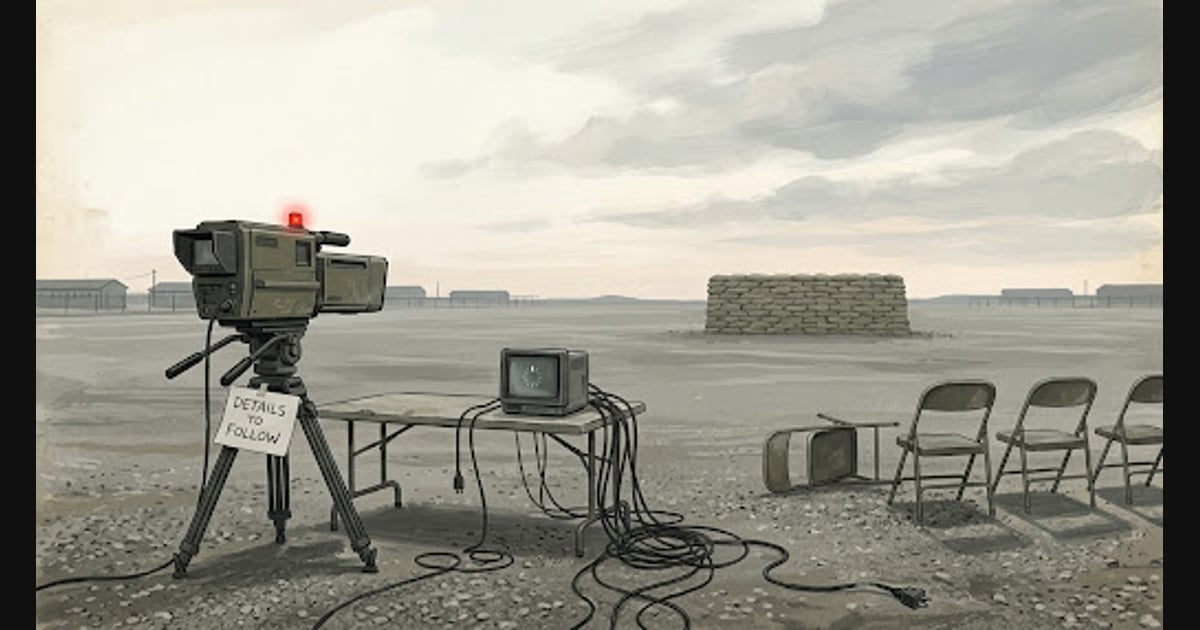
Defense Secretary Pete Hegseth said the execution would be livestreamed. The Pentagon confirmed it with the kind of sentence that should be printed on the national flag: “It will be livestreamed. Details will follow.”
Details will follow. This is now the administrative philosophy of the United States. The planes have a panel missing? Details will follow. The execution drugs did not execute? Details will follow. The government will broadcast a firing squad killing online, apparently from a website nobody has built yet? Details, as always, will follow.
Boeing’s 737 MAX 9 door plug blew out over Oregon in 2024 after key bolts were missing. The National Transportation Safety Board called it a manufacturing and oversight failure, which is a polite way of saying the airplane had an unauthorized sunroof. America no longer has failures; it has “learning opportunities” that plummet at 16,000 feet.
Content is the product
The proposed Hasan broadcast has produced the predictable American reaction: bipartisan alarm, procedural uncertainty, and a feverish need to know which platform will host it. The military has never livestreamed a legal execution, and existing Army rules contemplate a limited witness list—not an internet audience assembling in the chat.
Meta prohibits livestreams of capital punishment. YouTube, TikTok, and X have restrictions on graphic violence. Truth Social, beautifully, does not offer a livestreaming feature. Even the platforms that monetized every indignity of human life have glanced at this one and said, “Maybe not.”
Imagine the production meeting.
“Do we blur the shooters?”
“Can we sell ads before the chaplain?”
“Will there be a countdown clock?”
“Do we need a content warning?”
“Yes: *Warning: democracy may contain scenes of government incompetence.*”
Vice President JD Vance said he did not know whether the stream would happen and that he would not watch it. President Donald Trump said a determination still had to be made. So the official plan is that the execution will be livestreamed, except perhaps not, through an unknown venue, using unnamed procedures, after an administration-wide decision process best described as “a podcast interview got away from us.”
That is not justice. That is a group project where everybody waits for the least-prepared guy to share his screen.
The five-grand consolation prize
Still, there may be a bright side, in the way people call an incoming hailstorm “good for the lawn.”
If they can find somewhere to air it, this could be the biggest livestream in American government history: a national spectacle, engineered by people who apparently learned production logistics from a halftime-show comment section. Maybe the stream goes viral. Maybe it gets sponsorships. Maybe somebody sells commemorative hoodies reading DETAILS WILL FOLLOW.
Then perhaps everyone gets the promised $5,000 from the president.
Trump has floated a tariff-funded dividend, but his descriptions of who qualifies have shifted, and only 21 percent of registered voters in a September Economist/YouGov poll thought he would definitely or probably deliver it. Fifty-seven percent thought he probably or definitely would not.
Naturally, this is perfect. The country that cannot reliably secure a plane door, administer an execution drug, or identify a livestream platform has also promised cash payments funded by tariffs. It is like hearing your unreliable uncle explain that he has invested in cryptocurrency, except your uncle has the nuclear codes and the ability to schedule a firing squad.
Maybe the money arrives. Maybe it arrives in the form of a coupon. Maybe it is paid in airport food vouchers, redeemable only after your Boeing flight reaches the gate with all its original parts.
Aiming at the wrong thing
Firing squads are supposed to be simple. The prisoner is restrained, a target is placed over the heart, and several shooters fire together. One rifle may contain a blank so nobody knows whose round killed him.
This is meant to distribute the burden. It is also a remarkably tidy metaphor for America in 2026: everybody pulls the trigger, nobody knows who did it, and afterward everyone blames the person holding the clipboard.
The country will not necessarily miss Hasan. The shooters may be perfectly accurate. But the larger shot—at solemnity, competence, restraint, and the belief that the state should not turn death into content—has already gone wide.
They will miss because that is what we do now. Then we will hold a press conference explaining that the miss was actually a hit, the hit was somebody else’s fault, and your $5,000 is in the mail.