
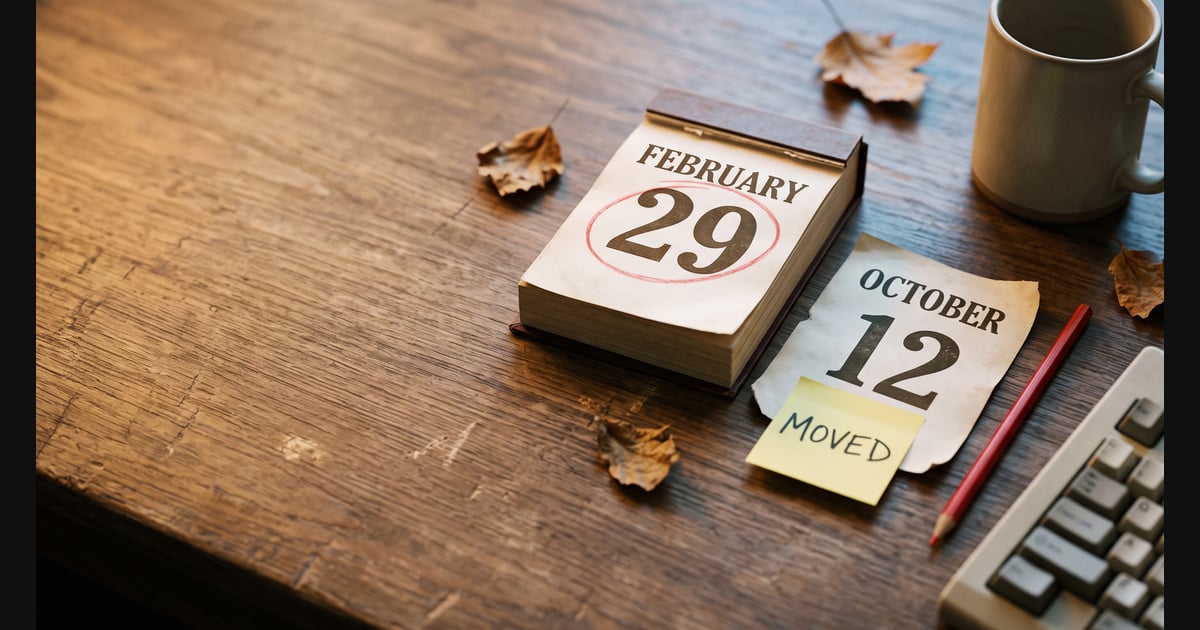
The Leap Day Patch: Engineering Unity in a Divided America
Today is either Columbus Day or Indigenous Peoples' Day, depending on who you ask. If we can't agree, this retired engineer has a patch: move the whole thing to February 29th and argue about it once every four years. A lighthearted look at what the date really asks of us, and how to keep the algorithms from answering for us.
Today is Monday, October 12, 2026. Depending on where you look or who you ask, it is either Columbus Day or Indigenous Peoples' Day. With the midterm elections three weeks out, that feels about right: one date, two names, and a country split down the middle over which one to say out loud.
As a retired software engineer with 35 years in the trade, I tend to read a clash like this as a systems problem. Two branches of code are claiming the same slot on the calendar, and nobody will approve the merge. My first instinct was to split the processor time: run the Columbus Day protocol from midnight to noon and the Indigenous Peoples' Day protocol from noon to midnight. But that only schedules the argument for lunch.
So here is a better patch. If we can't decide what holiday today is, let's move it to February 29th.
Think about what that buys us. We would only have to think about this once every four years. The other three years, October 12 goes back to being a perfectly good day to rake leaves. Nobody has claimed the 29th, so there is no legacy code to break. And people born on leap day finally get their birthday off, which seems like the least we can do for folks who wait four years for a cake.
I did find one bug in testing. Leap years are also presidential election years, so we would be saving our most contested holiday for the exact years when we are already at each other's throats. On reflection, I am filing that as a feature. One big argument every four years, all in one place, and then three years off.
Jokes aside, no patch fixes this, because both sides are honoring something real.
On October 12, 1492, Christopher Columbus reached the Bahamas and began the sustained European colonization of the Americas. That set off the Columbian Exchange, and it brought devastating consequences for the people who already lived here. Decades ago, Columbus Day became a federal holiday largely to honor Italian Americans, a community that faced entrenched prejudice and wanted a symbol of belonging and contribution to American life.
Indigenous Peoples' Day emerged as a direct challenge to that same date. It sets aside the uncomplicated hero story and centers Native survival, sovereignty, and living cultures instead. Today the federal government and thirty states still recognize Columbus Day in some form, while seventeen states and Washington, D.C., have an October holiday honoring Indigenous peoples. In my neck of the woods, state employees get a paid day off for Columbus Day, with no matching recognition for Indigenous Peoples' Day.
The disagreement, in other words, is not really about what happened in 1492. It is about what the United States chooses to honor in public.
That is a hard conversation and a worthwhile one, and it is exactly the kind our digital tools are built to ruin. As a Liberation Technologist, I study how the platforms we use every day amplify division instead of fostering connection. They are algorithmic battlegrounds, tuned to maximize engagement through polarization. They trap us in a digital double bind, where the outrage that wears us down is the same outrage that keeps us scrolling. A holiday with two names is a gift to a system like that: two teams, one date, and an endless supply of things to be angry about.
We do not have to accept those terms. We can hold two truths at once. We can honor the immigrant struggle to be accepted in the United States, and we can celebrate the endurance, prior presence, and living cultures of Indigenous peoples. Neither one cancels the other, no matter what the feed insists.
The better model is not a battleground at all. It is closer to the mycelium under a healthy forest: decentralized, resilient, and quietly connecting things that look separate from above. That is the kind of network worth building, one that respects every part of our complicated history without mining it for profit.
So until Congress takes up my leap-day amendment, here is my hope for you today. Step away from the digital noise. Take a long walk, pick up a guitar, or cook a good meal for people you love. Call the day whatever your conscience tells you to, and let your neighbor do the same. We are all in this together, so let's write a better program for our future.
And mark your calendar for February 29, 2028. We can argue about it then.