
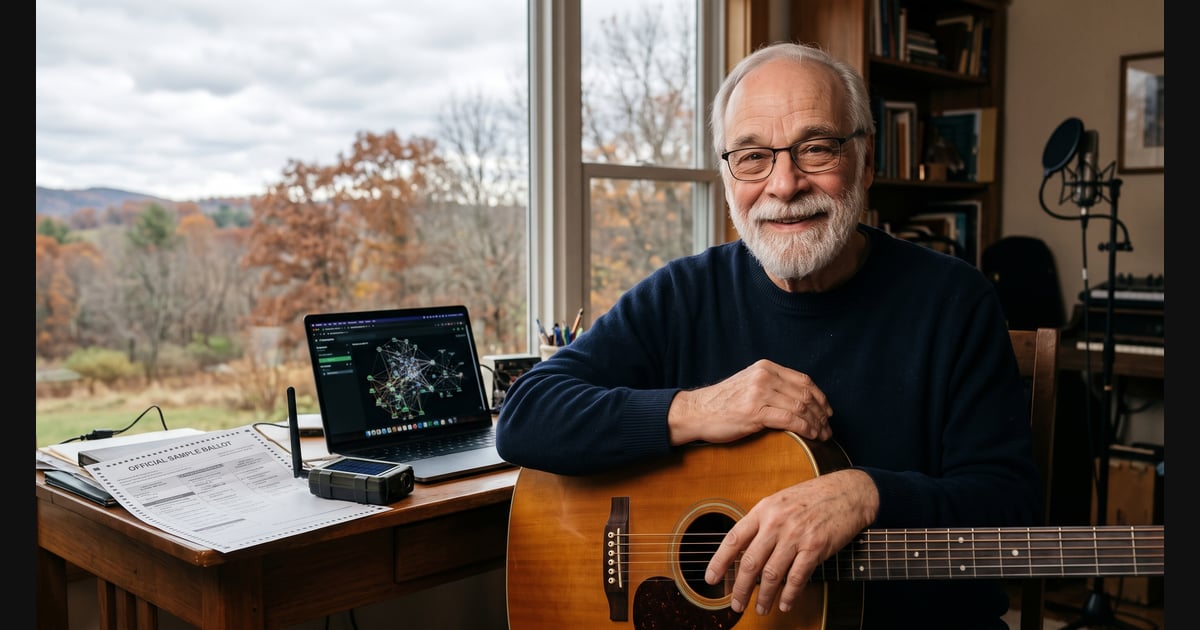
Stepping Off the Political See Saw Through Joyful Liberation Technology
After reflecting on the morning news and strumming my acoustic guitar, I am pondering my sample ballot on the eve of Election Day. Instead of getting trapped in a two-party binary, we can use Nonviolent Communication and decentralized liberation tech to build real peace and community freedom.
And now I am inspired to write this second article today after more news, more thought, more reflection, and of course, after some guitar. Earlier this morning, after my creek walk and a bowl of vegetable soup, I wrote about how people stack up hidden frustrations like an old calculator until they spill over. After posting that piece, I stepped outside to check the drip lines on my fabric grow bags, where a few late-autumn greens are still thriving. Right now it is 50°F and mostly cloudy, with a 4 mph wind from the southeast, 79% humidity, and a 10% chance of rain. Today’s forecast calls for a cloudy sky with a high of 68°F, a low of 49°F, and a 7 mph wind from the south. Back inside, I picked up my acoustic guitar and fingerpicked an old folk progression until my shoulders dropped.
That quiet music gave me space to look honestly at the sample ballot beside my keyboard. Here I sit on the day before Election Day, waiting until tomorrow to vote in case anything big changes at the last minute. Yet as I ponder the ballot, a blunt realization hits me: it does not matter. Nothing truly important will change by design. Watching politics feels like the old nursery rhyme, See Saw Margery Daw. Up and down we go, deluded into believing we have a choice between the Democrats and the Republicans, when both halves of this uniparty keep the same war machine humming. Looking down the page, our only real choices are Green or Libertarian, obviously, because both talk about ending wars tomorrow. Part of me wonders if I should burn my ballot in honor of those who burned their draft cards back when I served as a Vietnam-era Army computer repairman.
As a fellow traveler in recovery, however, I have learned to pause and listen beneath that cynicism. Using Marshall Rosenberg’s Nonviolent Communication, I can translate that frustration into what is truly alive in us: our unmet human needs for peace, honesty, and agency. When I studied electrical engineering in university, we built digital electronics with flip-flop circuits that only toggle between two states, zero and one. Later, across thirty-five years in full-stack software—from cubicle project leader to corner offices as VP of Development and CTO—and through my years as a commercially licensed pilot, I saw how closed systems behave. When a control loop oscillates between two extremes, pulling harder on the yoke only worsens the dive. You have to step outside the binary loop and upgrade the architecture.
That is where my joy as a Liberation Technologist comes alive. Today’s political see-saw is driven by algorithmic primacy, where corporate platforms use artificial intelligence and intentional manipulation to reward outrage and lock us into divisive filter bubbles. Meanwhile, generative AI and bot networks flood our feeds with noise to exhaust us into apathy. Because I still geek out on pushing computers to their maximum productivity, I love championing algorithmic resistance and trauma-informed design. Instead of letting the rage machine hijack our nervous systems, we can move onto decentralized protocols like the AT Protocol on Bluesky, which offers algorithmic choice so communities can curate trusted feeds. We can share ideas over Nostr relays where no central gatekeeper can silence us, and connect solar-powered Meshtastic radio nodes that pass encrypted messages off the grid like an underground forest mycelium network. Paired with privacy-preserving AI and community data sovereignty, these tools return real power to everyday people.
So tomorrow morning, after a solid night’s sleep, I will leave the matches in the drawer and cast my ballot in peace, without expecting a rigged see-saw to save us. Real liberation never comes from the top down. We build it every day through the open-source code we run, the gardens we tend, the guitars we strum, and the empathy we share as fellow travelers.