
Seeking Common Ground: What a Fragmented Floppy Drive Teaches Us Today
In 1980, listening to my homemade computer defragment an eight-inch floppy disk taught me a vital lesson about system health. Today, our country suffers from a similar mechanical exhaustion. Here is how we can stop endlessly seeking across partisan divides, clear out toxic algorithmic cache, and restore our shared human connection.
This morning, after a brisk walk through the garden to gather ingredients for a super veggie omelet I sat down at my piano. Working on a tricky jazz progression, I noticed that whenever my hands jumped wildly across the keyboard instead of finding smooth, nearby voicings, the music stalled. That clumsy jumping—burning energy just trying to reach the next chord—transported me straight back to 1980.
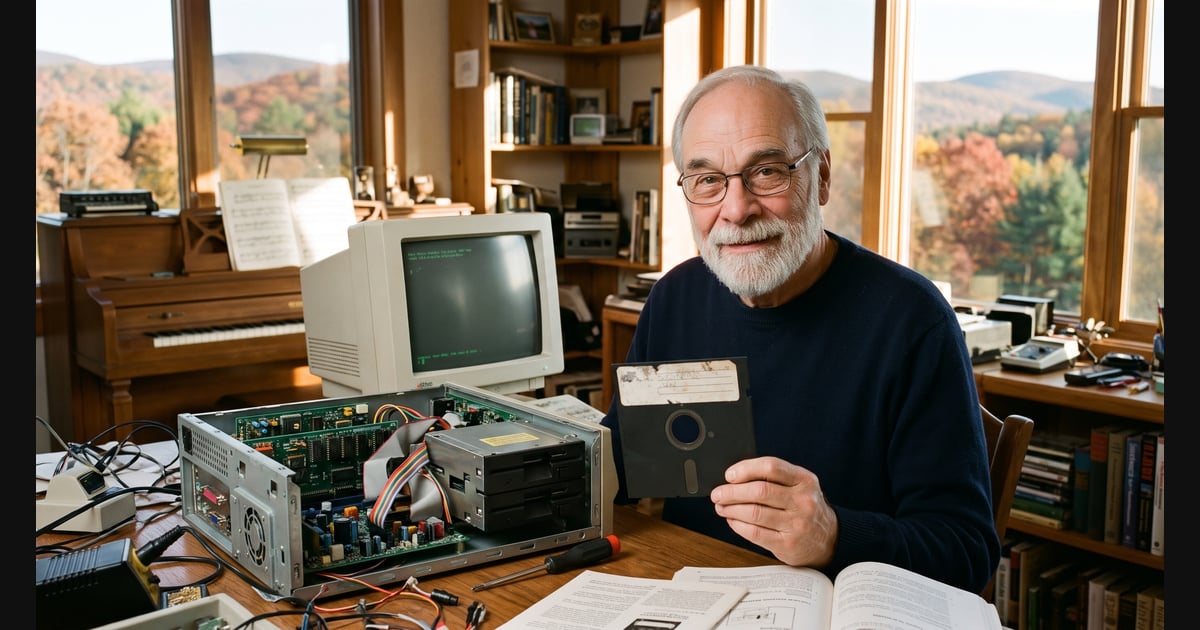
Back then, I was studying electrical engineering at Northeastern University. Most, perhaps all, of my classmates had to trudge to the campus machine room, punch their Fortran homework onto stacks of IBM cards, and hand them to an operator for the CDC Cyber 6000 mainframe. A single typo could cost hours. Utilizing my Army computer repair background, I built my own Intel 8080-based computer at home running CP/M, the predecessor to MS-DOS. Working at my bedroom desk with eight-inch, 360-kilobyte floppy disks gave me a huge advantage. I still get a geeky thrill remembering the sound of that drive defragmenting: the stepper motor and lead screw ratcheting the read/write head back and forth to reorganize scattered data.
Today, as a retired software engineer and Liberation Technologist, I hear that same frantic mechanical thrashing across America. A fragmented drive and a polarized country fail the exact same way: the valuable data is still there, but the system can no longer read related pieces in one pass. It spends all its time seeking. On a spinning disk, years of creating and deleting files chop free space into tiny holes, splitting new files across distant clusters. The bytes remain intact, yet the machine slows to a crawl because the head must constantly leap across the platter to assemble one complete thought.
Our political landscape mirrors that drive. Decades of ideological sorting have packed each party into its own tidy bloc. That is a local defrag: in-party reads happen fast, while cross-party reads thrash the system. Yet the big files that truly matter—housing, taxes, and the cost of living, which 41 percent of local leaders in a 2026 survey say are hurting from polarization—sit across both volumes. Researchers call our emotional divide "affective polarization." Since 1978, the gap between how warmly we view our party versus the other has doubled, driven by coldness, aversion, and moralizing. In recovery rooms, we recognize how fear makes us wall people off. In computer terms, we are marking our neighbors as "bad sectors"—unreadable and routed around forever, costing us both speed and capacity.
Meanwhile, our system directory is lying to us. Corporate social media algorithms optimize for personalized virality and outrage rather than democratic health. Because attention metrics reward conflict, the directory indexes the loudest extremes, tricking us into believing ordinary neighbors are hostile caricatures. As fellow travelers, how do we restore our system? First, a real defrag does not mean wiping the other side's files. Disagreement is essential data. Just as nature relies on biodiversity rather than brittle monocultures for resilience, a democracy needs diverse perspectives to recover from bad writes.
Second, our modern information ecosystem acts less like a spinning platter and more like a solid-state drive behind a hostile cache. Old-style defragging on flash memory only causes wear. Instead, modern drives run a TRIM command to discard stale, dead blocks so the system stops rewriting them until they fail. Civically, running TRIM means stepping away from the algorithmic rage machine and choosing trauma-informed, decentralized tools that return control to communities. We cannot force a hasty rewrite during peak election noise, and we don't need to. Beneath the daily seeking, the bytes of our shared humanity remain intact. Get some good sleep, share a home-cooked meal with a neighbor, and let's start reading from the same page again.