
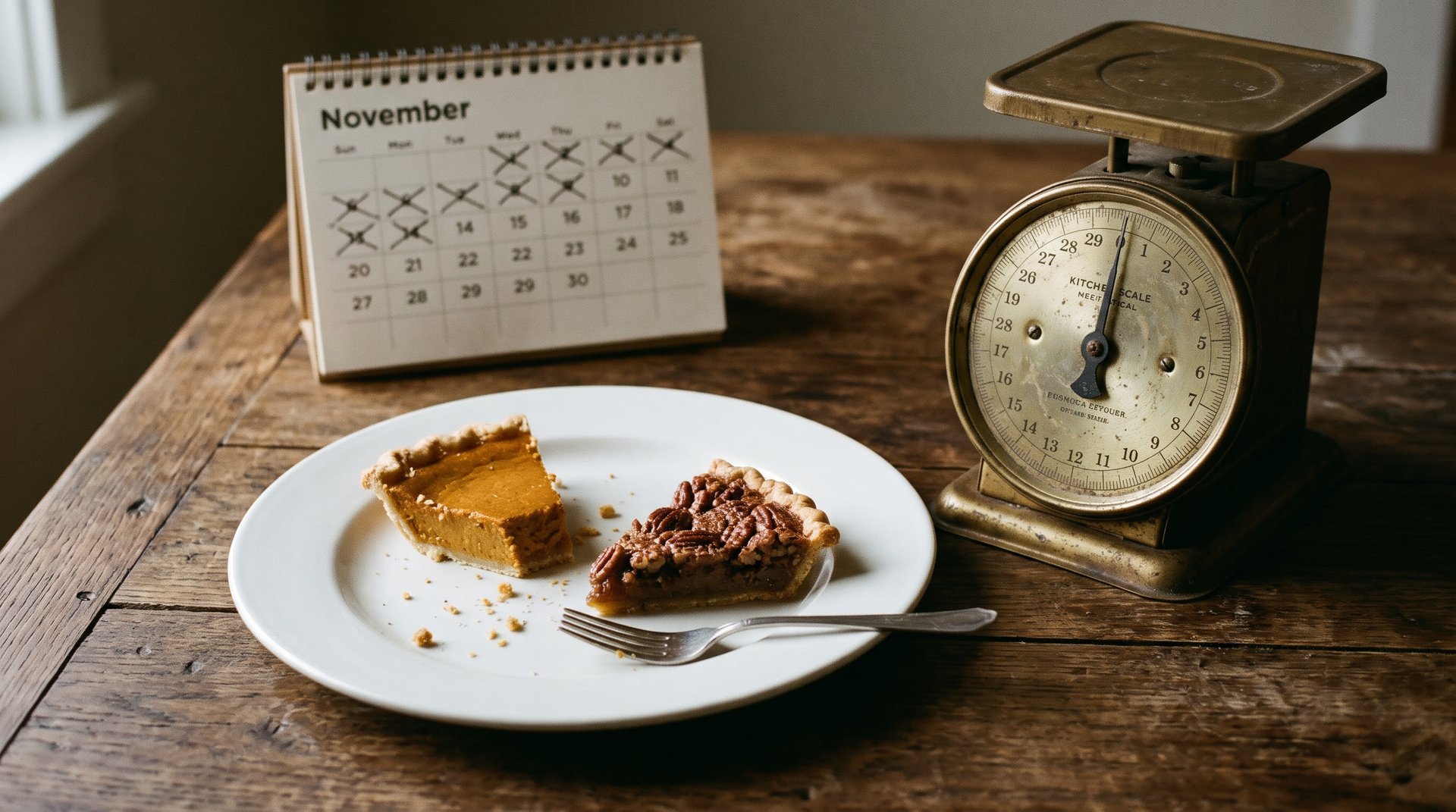
SAD: Let the Dieting Begin
The six-week holiday bump starts today—not as a 10-pound collapse, but as a denser dose of the Standard American Diet, stacked with social permission and shame.
Good morning from the Friday after Thanksgiving. Let us hope the internet—and the power grid underneath it—stays upright long enough for this post to reach you. After spending part of this week writing When the Grid Stays Down, I no longer treat a blinking router light as a guarantee.
Whatever the wires are doing, another clock just started ticking. Today marks the unofficial opening of the six-week holiday eating window running from Thanksgiving through the day after New Year’s. With all the political turmoil, economic strain, and background static humming through the country right now, Americans have plenty of reasons to feel heavy-hearted this November.
There is a dark irony in the acronym nutrition researchers use for how the country eats the other forty-six weeks of the year: SAD, the Standard American Diet.
Every late November, the same cultural script rolls out. Headlines warn of a five-to-ten-pound holiday disaster, talk shows joke about 4,500-calorie feasts, and the diet industry quietly queues up its January rescue packages. When you look at the actual evidence, though, the holiday bump is not a sudden collapse from clean eating into ruin. It is a denser overlay on an already compromised baseline—and the real trap has far less to do with willpower than with social permission, ultra-processed food, and shame.
The Baseline Was Already Loaded
Holiday meals do not invent the Standard American Diet; they simply turn up the volume on what is already playing in the background.
Federal surveillance from August 2021 through August 2023 shows that ultra-processed foods supply 55 percent of total calories across the United States—53 percent for adults and 61.9 percent for kids and teens ages 1 to 18 [1]. The biggest adult sources are everyday staples: sandwiches and burgers, sweet bakery items, sweetened drinks, savory snacks, and refined breads and tortillas [1]. Added sugars average nearly 270 calories a day, pushing past 13 percent of total calories against the longstanding 10 percent cap [2]. Meanwhile, roughly three in four Americans eat no fruit on a given day, and nearly nine in ten miss the daily vegetable minimum [3]. One 2019 analysis tied that year-round pattern to more than $50 billion a year in cardiometabolic healthcare costs [4].
So when the pies, rolls, creamy sides, office cookie tins, and December drinks arrive, they land on a table that is already short on fiber and long on sugar, refined starch, and sodium.
Even the famous folklore about Thanksgiving calories turns out to be vendor math. That widely repeated claim of a 3,000-calorie dinner and a 4,500-calorie day did not come from a national dietary survey; it came from the Calorie Control Council, a trade group representing reduced-calorie food makers [5]. USDA-based estimates put a typical Thanksgiving plate closer to 1,200 calories, or roughly 1,750 once you add pie and two glasses of wine [5].
What the Scale Actually Shows
The myth of an average five-to-ten-pound holiday gain has floated around since at least the 1990s without a credible study behind it [6]. Measured research paints a smaller—and sneakier—picture.
Study | What It Measured | The Catch |
|---|---|---|
Yanovski et al., NEJM (2000), 195 U.S. adults | +0.37 kg (0.8 lb) from mid-November to early January; not lost by March; drove most of the +0.62 kg annual gain | Participants thought they gained 1.57 kg—four times reality; NIH sample may be more health-conscious [6] |
Helander et al., NEJM (2016), 1,781 Americans | +0.2% at Thanksgiving, +0.4% after Christmas, ~+0.6 kg peak from yearly low | Roughly half came off soon after; half stuck into summer; self-selected wireless scale users [7] |
Scoping review (Academy of Nutrition and Dietetics) | About 70% of 23 studies found significant gain; mean around 0.7 kg (1.5 lb) | Accounted for half or more of annual weight gain in two studies; pooled across countries [8] |
Stevenson et al. (2013), 148 adults | +0.78 kg, +0.5 percentage points of body fat, and higher blood pressure | Self-reported exercise did not reliably prevent the gain [9] |
Notice the real danger: it is not a dramatic ten-pound spike in one winter. It is a quiet pound that never leaves. Over a decade, a sticky holiday bump becomes one of the steady engines of adult weight creep [6][8].
A Stacked Set of Permissions
If a single Thanksgiving plate is only a fraction of a year’s eating, why do these six weeks trip so many of us up? Psychologists who study appetite do not blame weak character. They point to a stacked set of permissions built straight into the season.
- Company stretches the meal. John de Castro’s diary research found that meal size rises steadily with the number of people at the table, mostly because we stay seated longer—an effect strongest with family and friends [11]. Psychologist C. Peter Herman put it plainly: with strangers we hold back, but with people who accept us the brake comes off, and part of why we gather around food is to share the guilt [11]. Refusing a second helping or a host’s signature dessert can feel like refusing the relationship.
- Variety defeats fullness. Appetite researcher Lenny Vartanian points to sensory-specific satiety: eat enough of one dish and your brain loses interest, but put six sides, three pies, and a week of counter leftovers in front of you, and every new taste resets appetite [14].
- Stress and alcohol lower the gauges. Census retail data shows alcohol sales peak in December, and survey figures from Responsibility.org report that 60 percent of Americans see alcohol as part of family holiday tradition while 22 percent drink to cope with holiday stress [10]. In a year of deep political friction and family tension, emotional eating cuts both ways—celebration and nostalgia open the appetite right alongside grief, loneliness, and news-cycle dread.
- The what-the-hell effect. Chronic dieters face the sharpest trap. Researchers Janet Polivy and C. Peter Herman found that restrained eaters often eat more the moment they believe a rule is broken [12]. Swear off sugar until New Year’s, eat one office cookie, and the nervous system declares the whole stretch ruined until January 1. Digital tracking shows diet searches collapse between Thanksgiving and Christmas, spike in January, and fizzle in weeks rather than months [15].
Shame is a terrible stop signal. When a rigid rule snaps, guilt does not tighten our grip—it shuts off the gauges and turns one holiday dinner into a six-week season.
Keeping Our Margin Without the January Cliff
In Margin and Perspective, I wrote about why real circuits and real lives both depend on headroom. Run a system right up against a razor-thin cliff, and the first bit of noise clips the whole signal flat.
Rigid holiday dieting runs with zero headroom. Starving yourself before a feast or swearing off every treat until January sets up a brittle rule designed to snap. And for anyone living with an active eating disorder, researcher Carol Peterson notes that disrupted routines, constant food talk, and swinging between total restriction and total permission carry real clinical risk—not ordinary holiday indulgence [13]. Compassion belongs at the head of the table.
We cannot control the political spectacle outside our doors, and we cannot guarantee the network never blinks. We can step off the conveyor belt that runs from the ultra-processed food aisle straight into the January diet pitch.
Enjoy the pie on the holiday. Put the leftovers out of sight before they turn the kitchen counter into a six-week queue of holiday cheer. Cook a real meal on Friday, give yourself a little grace, and keep your margin intact.
Sources
- Ultra-Processed Food Consumption in Youth and Adults: United States, August 2021–August 2023 | CDC NCHS Data Brief No. 536
- Dietary Guidelines for Americans, 2020–2025 | USDA & HHS
- Standard American Diet | NutritionFacts.org (citing National Cancer Institute analysis)
- Western Diet: How It Affects Health, Risks, and Complications | Medical News Today
- How Many Calories Are in the Average Thanksgiving Dinner? | The Hill
- A Prospective Study of Holiday Weight Gain | Yanovski et al., NEJM / PMC
- Weight Gain over the Holidays in Three Countries | Helander et al., NEJM
- Study Examines Holiday Weight Gain | Academy of Nutrition and Dietetics
- Winter Holidays and Their Impact on Eating Behavior: A Systematic Review | PMC
- How Americans Manage Holiday Stress & Alcohol Responsibility | Responsibility.org
- The Social Facilitation of Eating or the Facilitation of Social Eating? | Herman, PMC
- Avoiding the What-the-Hell Health Effect | U.S. News Health
- Can Healthy Holiday Eating Actually Be Unhealthy? | University of Minnesota Medical School
- Are You a Holiday Overeater? Practical Tips on How to Manage Your Appetite | UNSW Newsroom
- How Long Do People Stick to a Diet Resolution? A Digital Study | PMC
Everything here is free. If this one helped you, there’s a tip jar.