
Looking at the Web from Both Sides Now: Picking, Grinning, and Open Source
On the anniversary of the 1990 memo that sparked the World Wide Web, I’m strumming "Both Sides Now" and reflecting on our digital roots. From CERN’s gift of free code to today’s decentralized protocols, open source remains our greatest tool for human connection and freedom.
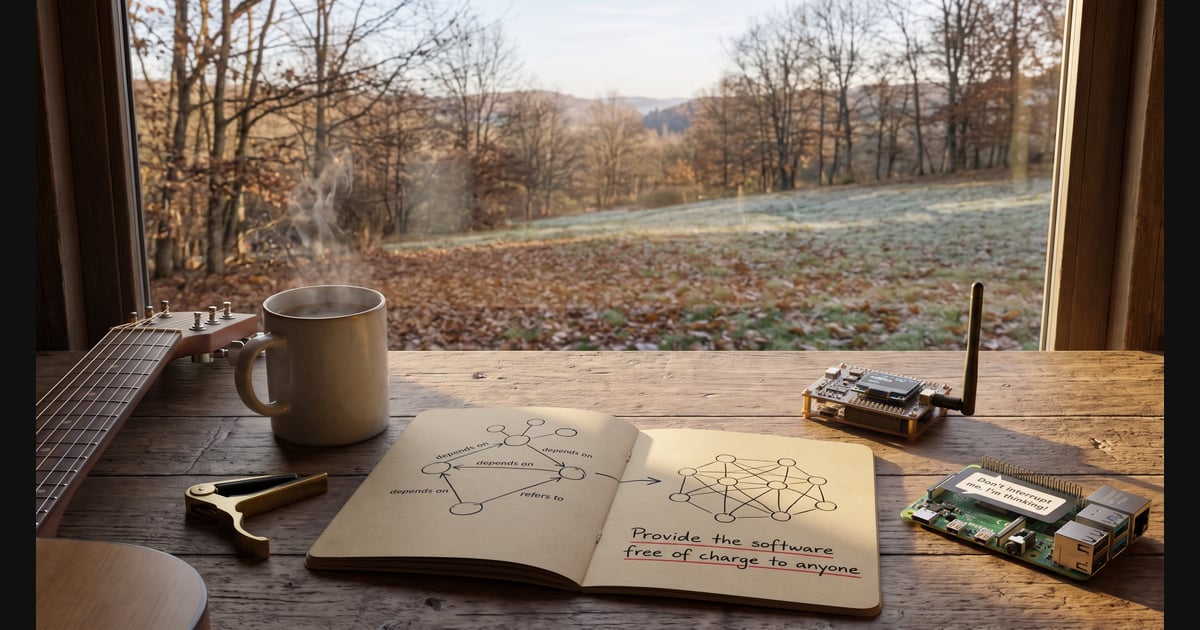
I started this crisp November morning wrapped in a plain cotton flannel shirt, sitting by the window with my acoustic guitar. Outside, the Appalachian hills are dressed in bare oak branches and a quiet layer of morning frost. I began by gently strumming the open chords to Joni Mitchell’s "Both Sides Now," letting the warm wood of the guitar resonate in the quiet room. Before long, as always happens when my fingers warm up and a good night's sleep kicks in, that gentle strumming descended into flat-out picking and grinning. There is nothing quite like acoustic music to ground the nervous system before firing up the computers for the day.
Today—November 12—marks a special milestone for those of us who have spent our lives around circuit boards and compilers. Back on November 12, 1990, Tim Berners-Lee and Robert Cailliau wrote a short management memo at CERN proposing a "HyperText project" called the WorldWideWeb.
I’ve looked at the Web from both sides now—from its scrappy birth during my early years sitting in engineering cubicles, all the way to the corner offices where I later worked as a VP of Development and CTO. Back in 1990, Berners-Lee wasn't trying to build a massive corporate media machine; he was just trying to keep a temporary city of visiting scientists from losing track of their work. Earlier that year, his boss Mike Sendall had scribbled "Vague, but exciting" on an initial sketch, eventually letting him buy a NeXT computer to build the first web server and browser. A handwritten red label on that machine warned: "This machine is a server. DO NOT POWER IT DOWN!!"
What really made that 80,000-Swiss-franc proposal matter, though, was a quiet promise tucked inside the text: they would provide the software "free of charge to anyone." Along with math student Nicola Pellow’s portable 80-by-24 character line-mode browser—which let any ordinary terminal follow numbered links—CERN kept its word. On April 30, 1993, they placed the code in the public domain, and in 1994, François Flückiger refined that gift into an open-source license that kept the credit while granting everyone a perpetual, royalty-free right to build upon it. Because nobody locked the link format or the server protocol inside a proprietary vault, the entire world was invited to innovate without asking permission.
Yet, as fellow travelers on this human journey, we have to be honest about both sides of the cloud. Over the last fifteen years, we have watched that open gift get fenced in. Centralized platforms and algorithmic "rage machines" now try to hijack our attention, while authoritarian firewalls use semantic AI to monitor what people say and think. We find ourselves in a digital double bind, where the tools we need to connect are often the same ones used to control us.
When we practice nonviolent communication, we learn to look beneath the surface noise and ask what fundamental human needs are going unmet. Right now, our digital world has an unmet need for autonomy, safety, and honest connection. That is why I am a Liberation Technologist, and why open source is still my champion.
Just as CERN gave the code away so no single company could own the Web, today’s open-source builders are handing us the keys to our own digital sanctuaries. We see it in decentralized protocols like Nostr and the AT Protocol, which give us algorithmic choice and make it impossible for a single billionaire or censor to silence a community. We see it in privacy-preserving local AI, and in off-grid LoRa mesh radios running open-source Meshtastic firmware, bouncing encrypted messages from hilltop to hilltop like an underground mycelium network in the forest soil.
We don't have to surrender our joy or our curiosity to the black-box algorithms. Whether we are simmering a pot of home-cooked soup, trading chords on a guitar, or spinning up a local open-source server, we are reclaiming our agency. We have seen the Web from both sides now—and the best code is still the code we share freely with one another.