
I Went to Vote and Nothing Will Happen, Again
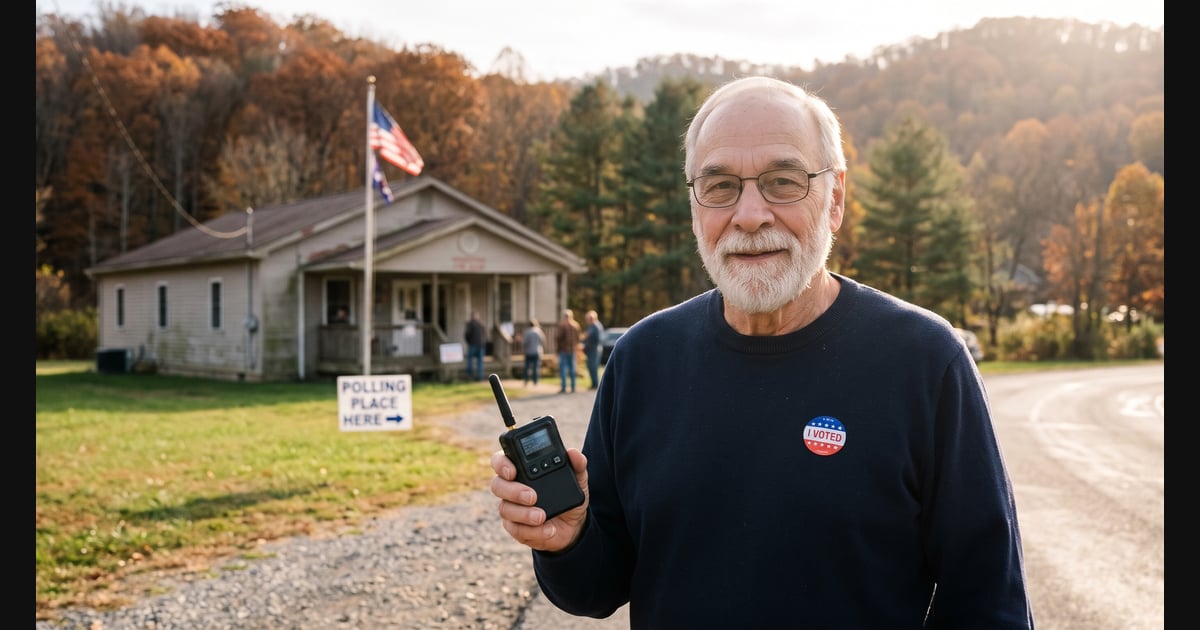
After sitting out 2024 for the first time since 1976, I walked into my local polling place this afternoon out of pure engineer's curiosity. While billionaire Super PACs dominate national politics, watching two neighborly poll workers verify my ballot reminded me that real liberation starts with local trust and decentralized tools.
This morning started the way I love best: a brisk walk along leaf-strewn trails near my home, followed by a warm home-cooked breakfast and twenty quiet minutes at the piano. If you stepped outside this Election Day, November 3, you might have thought the calendar was playing a trick on us. Instead of a frosty chill, we have sunny skies, a high of 78°F, a low of 48°F, 83% humidity, and a gentle 5 mph wind from the southeast. Still, my lifelong curiosity got the better of me, and I decided to walk into my local precinct and cast a ballot. Having studied the sample ballot over coffee, I saw nothing on it that sparked my interest or seemed likely to matter. I voted mostly out of curiosity, and when I walked back outside, I had that familiar feeling that nothing will happen, again.
As a fellow traveler in recovery, I practice Marshall Rosenberg’s Nonviolent Communication by observing facts, naming feelings, and honoring our shared needs without blame. In 2024, for the first time since becoming eligible to vote in 1976, back when I was a Vietnam-era Army computer repairman, I stayed home. I felt discouraged because I value fairness and need to know everyday voices matter. We watched Joe Biden step aside only after George Clooney and wealthy donors pulled his campaign money. Since the 2010 Citizens United ruling unleashed unlimited Super PAC spending, federal elections have swelled into a $15.9 billion industry with $1.9 billion in dark money. We saw Elon Musk invest roughly $290 million, a tiny fraction of his trillion-dollar fortune, into his special interests through Super PACs and million-dollar voter giveaways. Polling suggests that massive investment will go the way of the Tesla Roadster, and Musk will not even notice.
Studying electrical engineering and digital electronics in university taught me to trace any system back to its core architecture. Voting has always been a long struggle between elite gatekeepers and ordinary citizens. In ancient Athens around 508 BCE, male citizens cast pebbles in the ekklesia, while the Roman Republic weighted ballots by wealth. From the 1850s Australian secret ballot to the 15th and 19th Amendments and the 1965 Voting Rights Act, generations fought for equal suffrage. Yet what struck me yesterday is how differently states verify voters today. In Maine, a registered voter does not need to show ID to get a ballot, and in Massachusetts, voters usually just state their name and registered address unless specific identification rules apply. Here in West Virginia, voters must present a valid photo ID. At my precinct, two volunteer poll workers, one blue and one red, each checked my government photo ID, and both they and I signed to ensure a legitimate voter.
After decades as a full-stack software engineer, project leader, commercial pilot, and decision maker, I can tell you that those neighborly poll workers are not the bug in our democracy. The bug is centralization at the top. As a Liberation Technologist, I see the same vulnerability in corporate social media and national politics. When power is concentrated in centralized platforms, billionaire owners and opaque algorithms hijack public discourse, creating what researchers call the "digital double bind" and "algorithmic primacy". Nature solves this problem underground through the mycelium network, where thousands of connected nodes share nutrients without a central boss. In technology, we are building that same freedom through decentralized protocols like Bluesky’s AT Protocol, cryptographic Nostr relays, privacy-preserving AI, and off-grid Meshtastic radio nodes that keep communities connected without corporate gatekeepers.
We do not have to wait for broken campaign finance laws to heal before we reclaim our agency. Real liberation grows every day when we get good sleep, cook nourishing meals, play music, listen with empathy across divides, and adopt open-source tools that belong to the people. Stepping out of the voting booth, I felt genuine hope knowing that we can build our own resilient future from the ground up.