
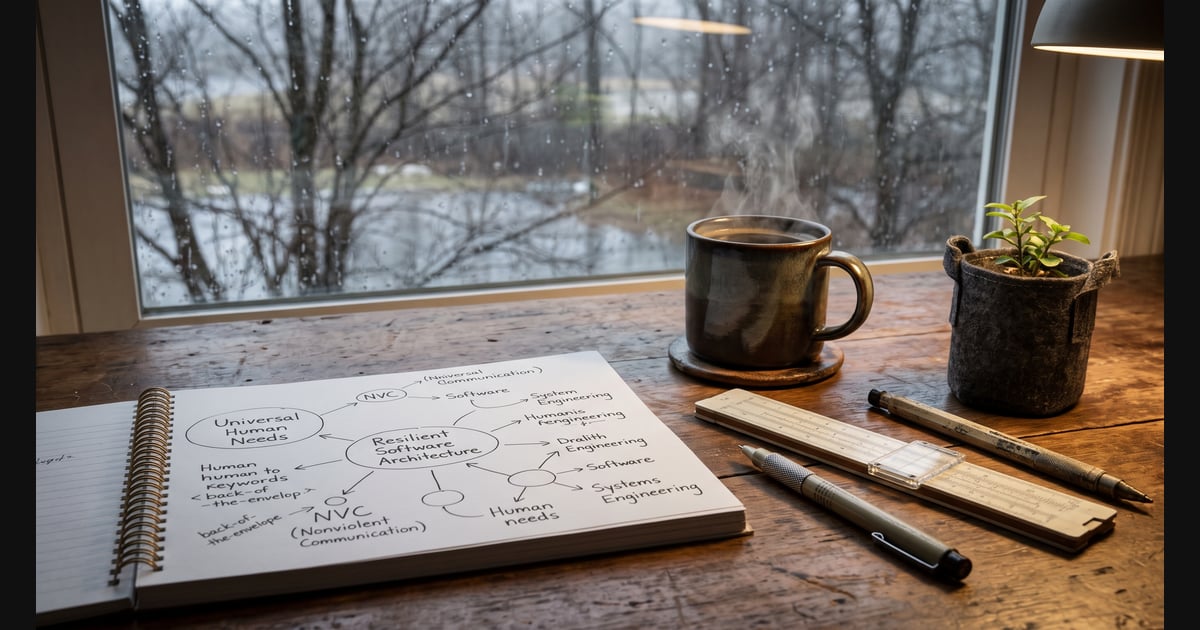
Healing the System: A Software Engineer's Guide to Nonviolent Communication
Our political systems feel like they are collapsing under the weight of outrage. Through the lens of Nonviolent Communication, we can debug this dysfunction. Today, we explore how universal unmet human needs drive chaos and how liberation technology can help us build healthier, connection-driven systems for everyone.
It is a rainy 46 degrees here today, with a crisp wind blowing in from the west. I threw on my plain, organic cotton sweater and a simple waterproof shell to step outside and check on my fabric grow bags. Gardening in the cold November rain reminds me of the importance of tending to what matters, even when the environment is uncooperative. I came back inside, warmed up with a home-cooked bowl of oatmeal, and sat down at the keyboard. My journey into the ACA (Adult Children of Alcoholics and Dysfunctional Families) fellow traveler philosophy has taught me a lot about unmet human needs. Growing up in a family where my needs as a child went unmet resulted in survival behaviors I’ve had to learn about and consciously avoid. However, this isn't about me blaming my parents, as they simply inherited what we call “The Bundle.” We all do the best we can.
Like debugging a legacy software architecture that keeps crashing, we can apply this compassionate understanding to our broader society. Back when I was an Army computer repairman, or later as a commercially licensed pilot, I learned that you cannot just yell at a failing system or a storm; you have to understand the underlying mechanics. When I studied digital electronics, I saw how a single misrouted signal could crash the whole board. As a retired full-stack software engineer of 35 years—and a fellow traveler who now champions the decentralized, open-source tools of liberation technology—I see our political dysfunction as a massive system failure.
Marshall Rosenberg’s framework of Nonviolent Communication (NVC) provides a profound lens for diagnosing exactly the political dysfunction, toxic leadership, and civic exhaustion we see today. At its core, NVC is built on a single, radical premise: Everything human beings do is an attempt to meet universal human needs. When applied to politics, NVC shifts the focus away from ideological warfare and exposes the deep, unmet needs driving both our polarized leaders and our disengaged citizens.
Consider the trap of discursive violence. The NVC process relies on four components: Observations, Feelings, Needs, and Requests. Modern political rhetoric does the exact opposite, relying heavily on moralistic judgments, blame, and binary frameworks. From an NVC perspective, this communication style is disastrous because it demands submission, not connection. When leaders use fear or guilt to mobilize voters, they force a result rather than inspire natural contribution. It triggers defensiveness, making deliberative reasoning neurologically impossible. All violence is a tragic expression of unmet needs.
To understand why voters abstain, we must look at NVC’s critical distinction between a Need and a Strategy. Needs are universal. Strategies are the specific methods we use to meet those needs. Voting is a strategy. If millions are abandoning it, NVC suggests they are doing so because the strategy is failing to meet their needs. This isn't apathy; it is a protective response.
A common misconception is that NVC is just about tolerating bad behavior. Rosenberg explicitly warned against using empathy simply to make people feel better while they remain trapped in a dysfunctional system. NVC is not an analgesic. Its ultimate goal is liberatory: to help humans co-create new systems that actually serve life, much like how open-source developers build decentralized networks to bypass algorithmic hegemony. NVC even advocates for the protective use of force to stop harm, provided the intent is solely to protect the vulnerable, never to punish.
Healing the civic divide requires moving past the addictive cycle of political outrage. It requires us to look at those we vehemently disagree with and ask: What unmet human need is driving this behavior? Only then can we begin to design a system that functions for its people. Take care of yourselves today, get some good sleep, and keep building. Our future depends on it.