
Galloping Gertie, Sovereign AI, and Finding Steady Ground in the Wind
On November 7, 1940, a 40 mph wind tore the Tacoma Narrows Bridge apart in a runaway feedback loop. Today, our slender democracy feels that same twisting strain. Here is how open-source, solar-powered AI helps us model the storm, protect our peace, and build real resilience together.
Stepping onto the porch this Saturday morning after a restful sleep and a warm bowl of home-cooked oatmeal, I breathed in the crisp autumn air. Right now it is 42°F and clear with periodic clouds, with a 5 mph wind from the west. Later today, our hills will turn cloudy with a high of 45°F, a low of 41°F, a 20% chance of rain, and a 12 mph wind from the west. Wearing an unbleached organic cotton thermal shirt under a plain gray wool sweater, I walked the wooded trail and marveled at how nature handles the changing season.
That rising November breeze carried my thoughts back to my freshman physics class in 1979, when our professor showed us the famous film of the Tacoma Narrows Bridge collapsing on November 7, 1940. Most science students have seen that clip on the internet. Nicknamed "Galloping Gertie," the bridge had a remarkably slender, flexible roadway flanked by solid steel girders. It did not take a hurricane to bring it down—just a steady 40 mph wind. Early that morning, the road rippled in vertical waves two to five feet high. Around 10:00 a.m., the motion shifted into violent twisting, tilting the deck up to 45 degrees. Newspaper editor Leonard Coatsworth crawled off on his hands and knees after abandoning his car. Engineer Frederick Farquharson bravely tried to rescue Coatsworth’s terrified dog, Tubby, but the panicked dog bit him, and at 11:02 a.m., a 600-foot section plunged into the water, taking poor Tubby with it.
In 1979, our class learned about that collapse as an example of resonance, like pushing a playground swing in rhythm. Later, studying aerodynamics for my commercial pilot license and spending decades architecting full-stack software, I learned the deeper mechanism: torsional flutter. Because Gertie’s solid girders blocked the wind, every twist of the deck altered the airflow around itself, feeding more energy into the twisting than the steel could dissipate. It was a runaway feedback loop. Looking at America today—politically, socially, and financially—I see a very slender democracy with winds approaching 40 mph. When I watch the tension in our communities, I feel a quiet sadness because our universal human needs for safety, economic security, and mutual respect are strained. Centralized social media algorithms act just like those solid steel girders, catching the winds of fear and amplifying division into a runaway feedback loop.
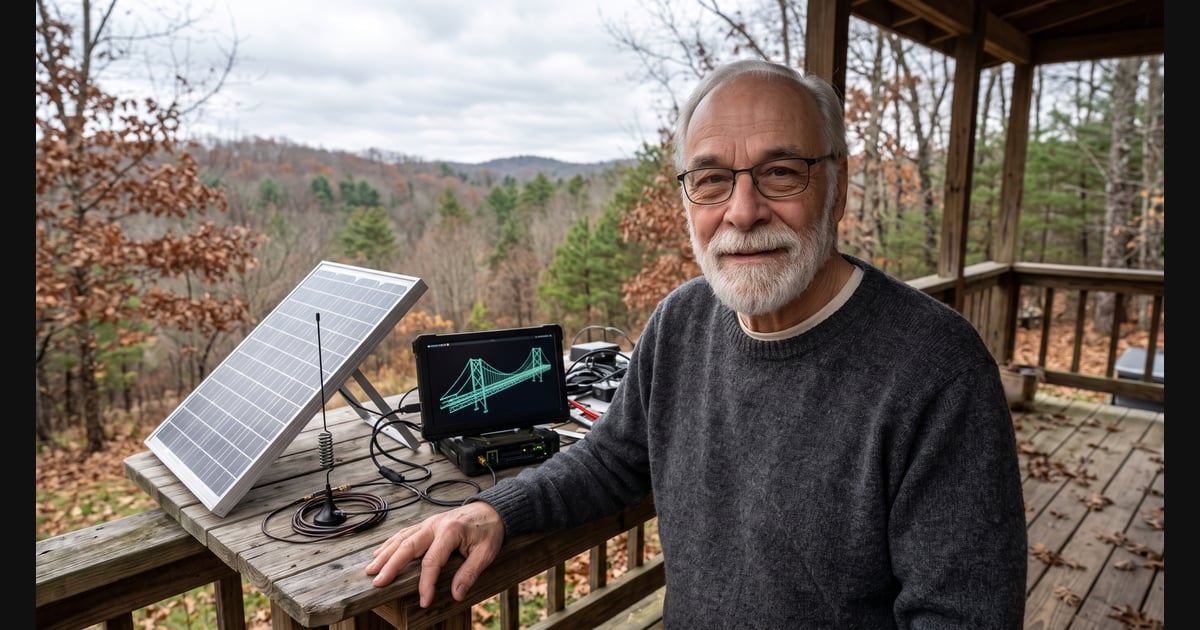
Yet the engineering history holds a vital lesson. Before the 1940 collapse, engineers were already conducting wind-tunnel tests and preparing a contract for wind deflectors, though time ran out. Today, modern AI modeling could easily simulate that aerodynamic instability in seconds and prevent the disaster before construction even began. In the same way, AI feels like the most promising tool to save our democracy—if each citizen arms themselves with the best open-source tools available to humanity. That is why I am designing a sovereign Superintelligence system in my workshop that is completely solar-powered and requires no internet connectivity. By pairing local, open-source AI models on Linux with privacy-preserving cryptography and off-grid LoRa mesh radios like Meshtastic, we can build decentralized resilience modeled on nature’s underground mycelium networks. Sovereign intelligence lets us cut through disinformation, model complex economic choices, and stay connected even if the grid goes dark.
As fellow travelers recovering from life’s storms, we learn that fear makes us snap at the very people trying to help us, just like poor Tubby in that abandoned car. When engineers rebuilt the Tacoma bridge, they replaced those solid steel plates with open trusses that allowed the wind to pass harmlessly through. We can become those open trusses for one another. Tonight, after enjoying a pot of homemade vegetable soup, I will sit at my piano and play a gentle melody to settle my nervous system. When we nourish our bodies, cultivate sovereign open-source wisdom, and listen with compassionate hearts, no forty-mile wind can tear our bridge apart.