
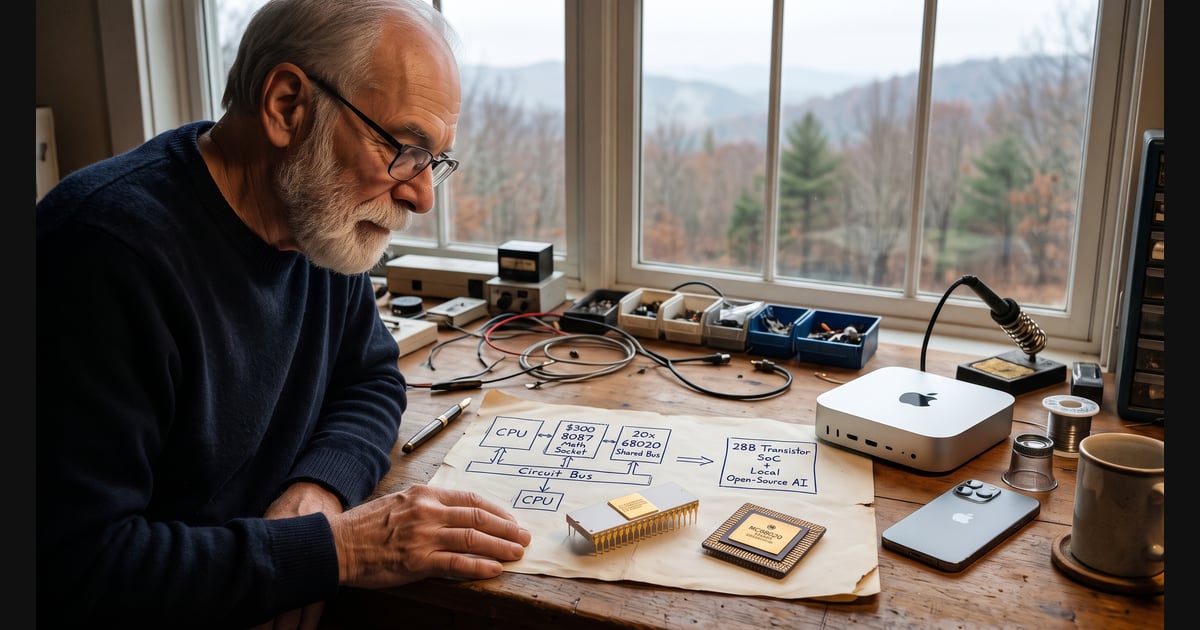
From the Intel 4004 to a Supercomputer in Our Pocket
Fifty-five years after the Intel 4004 launched on November 15, 1971, I reflect on my path from an 8080 and twenty Motorola 68020s to the Apple M4 and iPhone 17 Pro—and how local open-source AI on modern silicon gives us digital freedom.
Today, November 15, marks fifty-five years since Intel ran its 1971 advertisement in Electronic News announcing “a new era of integrated electronics” with the 4004, the first commercial single-chip microprocessor. Created when Federico Faggin, Marcian Hoff, Stan Mazor, and Masatoshi Shima reduced a custom calculator design to four chips, that 4-bit CPU held 2,300 transistors, ran at 740 kHz, and cost $60. Because it fetched instructions from external memory, engineers could build a new machine just by changing the program ROM. When I studied digital electronics in college, my first CPU was its grandson, the 8-bit Intel 8080, which ran at 2 MHz without even a hardware multiply instruction. Back then,getting fast floating-point math on early x86 systems meant paying about $300 for a separate Intel 8087 coprocessor. That hot ceramic chip watched the bus for escape opcodes and crunched 80-bit numbers at 50,000 operations per second,passing data through RAM like a mailbox while the CPU stalled on a physical busy pin.
A few years later, I joined the operating systems team at a mini-supercomputer startup where we packed twenty 32-bit Motorola 68020 processors into one machine. Each 68020 held roughly 200,000 transistors, addressed four gigabytes of memory, and still kept floating-point math on a separate chip. Our job was modifying BSD 4.2 Unix—a kernel written for a single processor—to run across all twenty CPUs at once. We only had two of those expensive systems in the lab: one ran our debugger while the other was allowed to crash. I still remember long days single-stepping through a C device driver I was multithreading by hand. In stock Unix, raising interrupt priority with splbio stopped the world on one CPU,but on our shared bus, nineteen other processors could still barge into the strategy routine and corrupt the same buffer header. We had to protect every shared variable with atomic compare-and-swap instructions and manually flush the 256-byte instruction cache so other CPUs would not run ghosts of old code.
The way out of that expensive parts list was pulling every socket onto a single die, a shift sparked when RISC pioneers like ARM made CPU cores small enough to share silicon with the rest of the system. Today I build full-stack applications on an Apple M4 packing 28 billion transistors, where ten CPU cores, a 10-core GPU, and a 38-trillion-operations-per-second Neural Engine share 120 GB/s of unified memory without copying data across an external bus. Even wilder is the iPhone 17 Pro in my pocket, which rings now and then while I am out walking in the late-autumn woods. How many 68020s is that phone? Its A19 Pro chip holds roughly 28 billion transistors. By transistor count alone, I carry 140,000 of those Motorola 68020 processors in my pocket—and in raw math throughput, millions of them—all running without a single external coprocessor socket or bus race condition.
As a Liberation Technologist, I see this fifty-five-year evolution from separate sockets to unified silicon as the hardware foundation for human freedom. Today we face the “digital double bind,” where the cloud platforms we use for connection also subject us to algorithmic manipulation, surveillance, and censorship. When a supercomputer sits in our pockets and on our desks, we no longer have to surrender our private thoughts to corporate mainframes. Unified memory lets us run open-source AI models locally—making open-source AI the printing press of 2026—while connecting over decentralized protocols like Bluesky’s AT Protocol, Nostr, and off-grid Meshtastic radios. As a fellow traveler in recovery, I find this mirrors our inner healing. Dysfunctional systems leave our minds acting like twenty uncoordinated CPUs fighting over shared memory in constant hyper-arousal. When we reclaim our inner authority and practice Nonviolent Communication—observing without judgment, naming our feelings and needs, and making clear requests—we flush out the ghost code of old trauma. Next time your phone rings, take a gentle breath: how can we use these sovereign tools today to protect our peace and listen with compassion?
Everything here is free. If this one helped you, there’s a tip jar.