
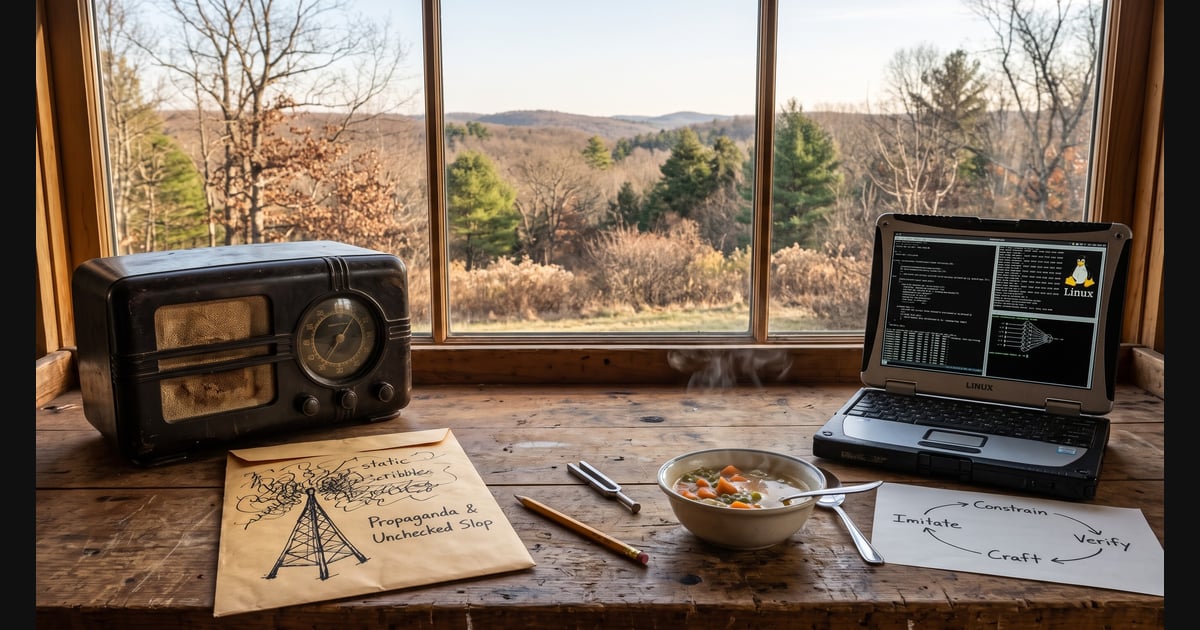
From Radio Slop to Open-Source Craft: Reclaiming Our Digital Commons
In the 1930s, state-controlled radio pumped out noisy propaganda—the original slop—to keep neighbors divided and hold onto power. Today’s AI slop works the same way, unless we pair open-source models with human judgment, verification, and deliberate practice.
After wrapping up this morning’s post on division, I stepped away from my desk to chop root vegetables for a slow-simmered soup and walk the ridge trail. Moving my body after a solid night of sleep always loosens up my thinking. As I walked under the bare oaks, I kept turning over some further thoughts on division and how it connects to the flood of "AI slop" clogging our screens.
History gives us a sobering bridge here. When Hitler came to power in 1933, radio was still a relatively new mass medium. Historians note a crucial qualification: radio did not actually help the Nazi regime seize power in the first place. Instead, once they held the levers of the state, Joseph Goebbels deliberately mastered the wireless receiver to keep and use that power. Much of what poured out of those cheap state-tuned radios was the 1930s equivalent of slop—mass-produced, emotionally manipulative noise designed to exhaust critical thinking and sow division.
Today, we face a new flood of low-effort, synthetic noise—so much so that "slop" became a defining word of our era. In our recovery circles and through Marshall Rosenberg’s Nonviolent Communication, we learn to pause and ask what unmet human need sits underneath our frustration. When we recoil at AI slop, we are mourning our need for honesty, care, and real human presence. Yet when critics try to defend that need by dismissing large language models as mere photocopiers or "stochastic parrots," they mix up two very different claims. Learning from examples is how skill is built, both in people and in models. Slop is what happens when fluent output gets published with no judgment, no constraint, and an incentive to maximize volume.
Back when I earned my commercial pilot’s license, and later across thirty-five years of writing full-stack software and serving as a team leader, I learned that imitation is the normal on-ramp to any craft. Copying good penmanship or playing someone else’s jazz chords on my guitar does not turn me into a photocopier. It builds a mental model of how patterns work. Expertise research calls this deliberate practice: setting a clear goal at the edge of your ability, getting feedback, and building rich mental chunks.
Under the hood, a language model compresses regularities rather than filing away the internet. A 2024 study tracing open models back to their pretraining data found a clear split. Factual lookup leans on memorization, and yes, researchers like Carlini have shown models can be pushed to regurgitate rare strings. However, translation and reasoning shift toward true generalization as models grow. Even at the neuron level, memorization and generalization are distinct, steerable modes.
Cognitive scientist Margaret Boden mapped creativity into three buckets: combining familiar ideas, exploring an existing style, and transforming the rules entirely. Most working engineers and artists live in those first two spaces, and a strong model walks them right alongside us. What the machine cannot do is care. It has no body, no stakes, and no reputation.
That is why slop is an editorial and economic failure, not the nature of the tool. Whether it is 1930s state radio, authoritarian influence bots, or corporate engagement farms, slop happens when fluency becomes cheap and verification is skipped. As a Liberation Technologist, my joy comes from flipping that script with open-source tools. When we run open-weight local models on sovereign hardware, check their output against real unit tests, and share our work on community-governed protocols like the AT Protocol or Nostr, we put human conscience back in the loop. A recipe card is not a meal until someone tastes it at the stove. Keep testing, keep tasting, and only publish what truly nourishes our shared table.