
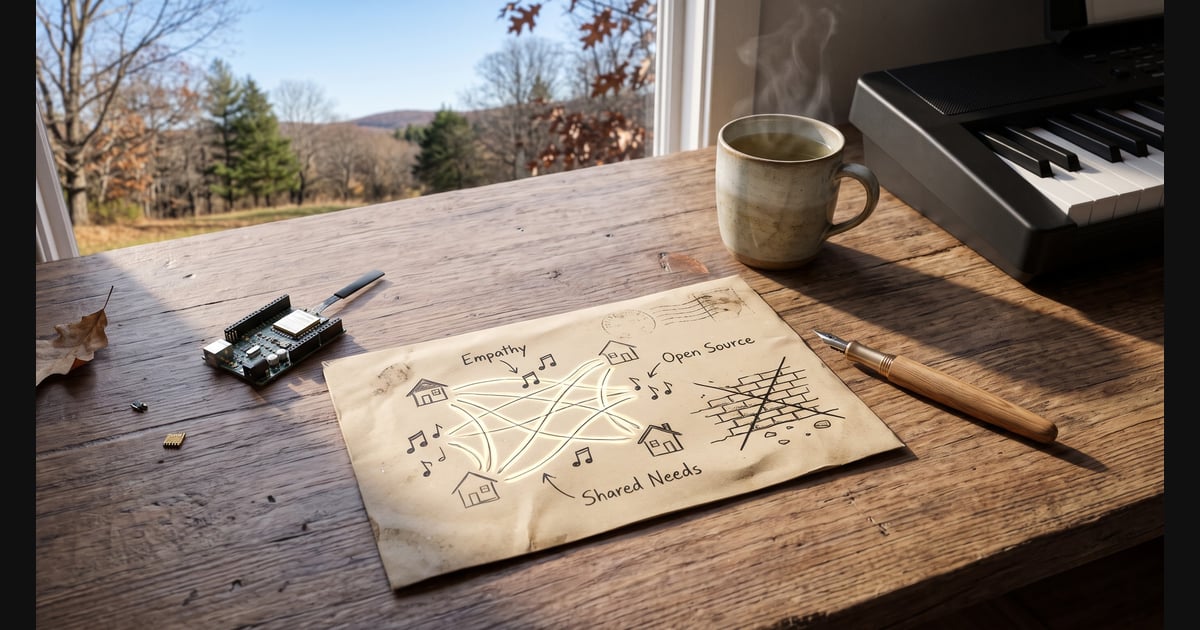
From Broken Glass to Open Nodes: Choosing Connection Over Division
On Germany's Day of Destiny, history reminds us how quickly a single spark of fear can shatter a nation. As we enter a two-year window of political transition, we can use open-source networks and compassionate communication to heal our divides and build a resilient community together.
The pre-dawn air in Appalachia is clear and a crisp 42°F—feeling like 38°F with a 6 mph wind from the southwest—as I pull on a plain, unbleached organic cotton flannel shirt and a humble wool sweater. Before the sun comes up to bring us a sunny 59°F afternoon with an 11 mph west wind, I like to sit at my piano with a warm mug of water and play a few slow, grounding chords. Letting those acoustic vibrations fill the room is how I regulate my nervous system after a solid night of sleep. In recovery circles, we learn that before we can step out into a noisy, reactive world, we have to find our own center. When we nourish ourselves with simple rhythms and quiet reflection, we don’t have to carry yesterday’s armor into today’s conversations.
Today is November 9, a date Germany calls Schicksalstag—the "Day of Destiny." It holds two massive historical moments in the exact same hand: the dark tragedy of the 1938 November Pogrom, known as Kristallnacht, and the joyful tearing down of the Berlin Wall fifty-one years later. Looking back at 1938, we see how a state-engineered machine used a single spark to turn neighbor against neighbor, shattering 7,500 shop windows, burning over 1,400 synagogues, and invading thousands of private homes. It is a sobering reminder of what happens when centralized power weaponizes fear and erases our shared humanity. Yet 1989 showed us the other side of human nature: that walls eventually crumble when ordinary people choose connection over fear.
Right now, in our own country, we are entering a unique two-year window as President Trump moves into the most pronounced lame-duck period in American history. When political engines start to stall and the noise of partisan battle grows exhausting, we are handed a rare gift: an opportunity to stop waiting for top-down solutions and start growing together from the ground up. In the fellowship of recovery, we don't fix a dysfunctional family by arguing over who is in charge of the house; we heal by changing how we relate to one another in the living room.
Back when I was sitting in cubicles as a project leader—long before the corner offices—I learned that the most brittle computer architectures are the ones with a single point of failure. When one central processor dictates every move, a single bad instruction can crash the whole board. Today’s corporate social media algorithms work the same way, acting like digital rage machines that profit by keeping us terrified of our neighbors.
As a Liberation Technologist, I get so excited about how open-source tools let us wire around that trap. Instead of letting proprietary algorithms dictate who our enemies are, we can turn to open, community-driven protocols like the Fediverse and Mastodon, or build local, off-grid community networks using simple open-source hardware. There is pure geeky joy in configuring a local server or testing an open protocol where nobody owns the switchboard and every node supports its neighbor.
These open-source tools are the digital equivalent of Marshall Rosenberg’s Nonviolent Communication. When we strip away the manipulative middleman, we can actually observe what is happening without judgment, name our shared human feelings, and speak honestly about our needs. Whether a neighbor leans left or right, we all share the same fundamental needs: safety for our families, dignity in our work, a healthy meal at the end of the day, and a community where we belong.
History shows us that glass breaks easily, and walls take decades to tear down. We don't have to wait for Washington to give us permission to heal. Let’s use these next two years to step away from the outrage algorithms, pick up open tools that respect our autonomy, and listen to the human needs beating underneath our neighbors' words. Together, we can build a network of grace that no spark of division can ever burn down.