
Free Waters and Flexible Frames: Engineering Lessons from Lisbon’s 1755 Earthquake
On November 1, 1755, a massive earthquake nearly erased Lisbon, yet the Águas Livres Aqueduct stood unbroken. Having walked its full length in 2016, I see powerful lessons in its stone arches for how we build resilient, decentralized technology and navigate personal recovery when our world shakes.
My internal clock does not care that we set the dials back an hour last night. I still woke up on my old schedule, watching the early morning light creep over the hills while my body adjusted to the fall time change. Stepping into my backyard with a mug of coffee, I could hardly believe the calendar says November 1st. The trees along the ridges are already past peak, dropping a thick carpet of russet and brown leaves across the lawn, yet we are enjoying an unusually warm spell running ten degrees above normal. Without a single frost so far, my garden refuses to quit. I walked down the rows and picked a handful of crisp, late-season peppers to chop into a pan for a warm breakfast scramble. Standing there in my shirtsleeves on All Saints’ Day, my mind wandered back to a walk I took in 2016, and to a catastrophe that shook the world on this exact morning in 1755.
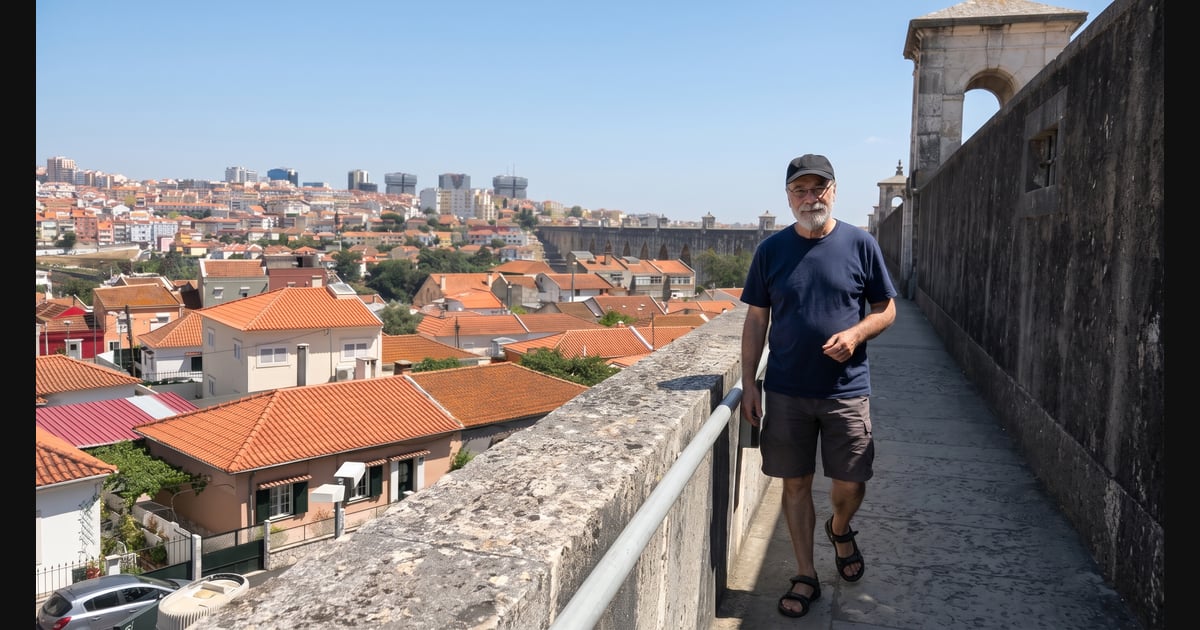
Back in 2016, I had the incredible privilege of walking the full fourteen-kilometer main line of the Águas Livres Aqueduct—the "Aqueduct of the Free Waters"—in Lisbon, Portugal. Most visitors just snap photos of the famous 941-meter arcade of stone arches towering 65 meters above the Alcântara valley. Those 35 arches are breathtaking, featuring the largest pointed stone arch in the world. Back when I flew - and sometimes jumped out of - planes, I learned to appreciate what landmarks look like from above, but as a guy who studied digital electronics and spent 35 years in full-stack software engineering, I love tracing how hidden systems work under the hood. Those towering arches are less than two percent of a 58-kilometer network of underground galleries drawing from 58 springs. Delivering water by 1748, the system moved 1,300 cubic meters a day by gravity alone at a gentle drop of three millimeters per meter. Walking that stone channel felt like tracing the data bus of an eighteenth-century mainframe.
That stone machine faced the ultimate stress test on November 1, 1755. At 9:40 a.m., while churches were packed for Mass, a massive Atlantic earthquake struck Lisbon in three brutal pulses, opening five-meter fissures in the streets. Survivors who fled to the open riverfront watched the Tagus River suck back into the sea before a five-meter tsunami roared ashore. Then overturned church candles and kitchen lamps sparked a firestorm that gutted the city. Roughly 30,000 to 40,000 people died in Lisbon, and 85 percent of its buildings collapsed or burned. Yet, sitting directly across the Alcântara seismic fault, the Águas Livres Aqueduct survived without major damage, keeping fresh water flowing when palaces and wells lay in ruins. Engineer Custódio Vieira had abandoned the old Roman rulebook of stacked tiers, building one row of giant pointed arches that threw the heavy weight straight down into cut limestone piers.
In the aftermath, royal minister Sebastião José de Carvalho e Melo—later the Marquis of Pombal—focused on a practical mission: "Bury the dead and heal the living." He sent a detailed survey to every parish to study how the earth moved, launching modern seismology. Meanwhile, aqueduct engineers Manuel da Maia and Carlos Mardel cleared the medieval maze to build wide streets and invented the gaiola pombalina, or "Pombaline cage"—an internal timber frame designed to flex in a quake, tested by marching troops around wooden models. That shift from brittle stone to resilient infrastructure is what drives us as Liberation Technologists today. Right now, centralized social platforms and manipulative AI algorithms act like fragile traps that profit from division and surveillance. When authoritarian censors or corporate giants flip the kill switch, centralized networks collapse. We need modern "Aqueducts of Free Waters"—decentralized protocols like Bluesky's AT Protocol and Nostr, privacy-preserving AI, and off-grid Meshtastic radio meshes that keep truth and community flowing.
As a fellow traveler in recovery, I see this same engineering truth in our personal lives. Growing up in chaotic homes, many of us built rigid emotional walls just to survive. When adulthood hits us with an earthquake, those brittle defenses shatter. Recovery teaches us to clear the old rubble and build an internal Pombaline cage—a flexible framework of honesty, fellowship, and self-care that lets us sway with life’s tremors without breaking. Even as the clocks shift and the seasons turn, we can keep tending our gardens and keep the free waters of hope flowing.