
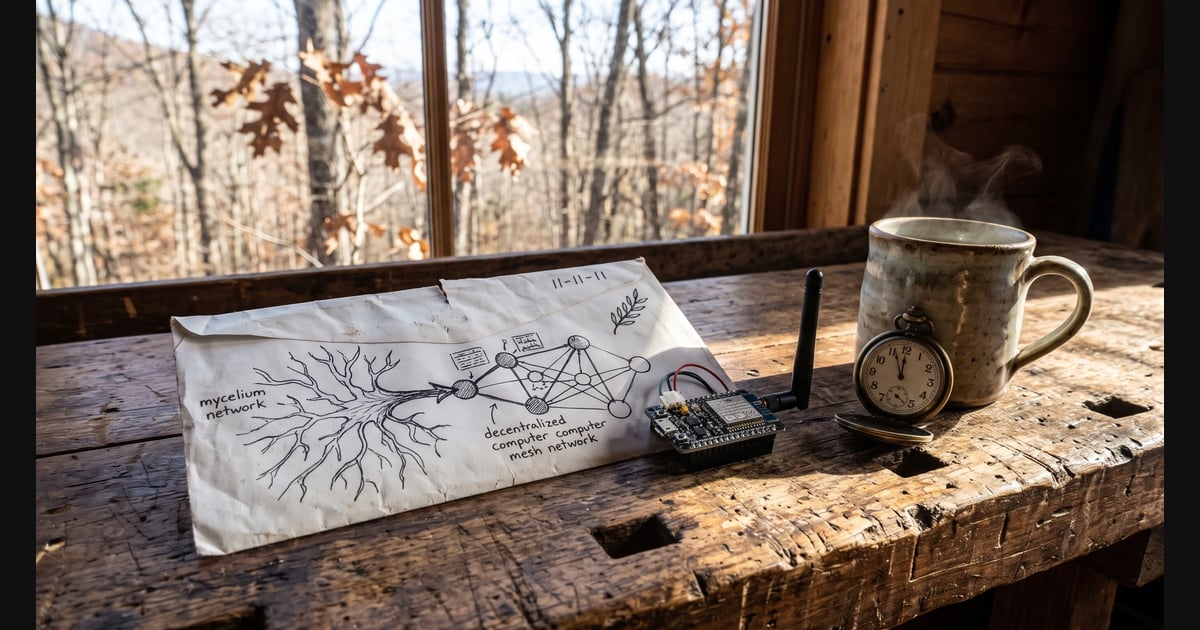
Eleventh Hour, Eleventh Day, Eleventh Month: Dreaming of True Armistice
On this November 11, an old Army computer repairman looks at a world armed with weapons, algorithms, and generational trauma. Can open-source liberation technology and compassionate communication finally bring us the true global armistice we so desperately need?
I stepped out onto the porch early this morning in Appalachia where the current nighttime sky is clear and the temperature sits at 48°F with a 3 mph wind from the east. Today’s forecast calls for sunny daytime skies with a high of 67°F, a low of 43°F, and an 8 mph wind from the southwest before light rain moves in tonight. Dressed in my usual plain, unbleached organic cotton flannel shirt and simple hemp work pants, I took a slow walk around my garden to clear my head after a solid eight hours of sleep. With a warm, home-cooked breakfast of steel-cut oats with blueberries waiting inside, my mind drifted to the calendar.
At the eleventh hour of the eleventh day of the eleventh month in 1918, an armistice signed in a French railway carriage at Compiègne silenced the guns on the Western Front. President Woodrow Wilson proclaimed the first Armistice Day in 1919, Congress made it a legal holiday in 1938, and in 1954, President Dwight D. Eisenhower signed the law renaming it Veterans Day to honor veterans of all U.S. wars. After a widely disliked 1968 law briefly moved the observance to October starting in 1971, President Gerald Ford restored it to November 11 in 1978.
As a Vietnam-era Army veteran, I carry a deep sense of gratitude today. I spent my service in air-conditioned rooms repairing mainframes and troubleshooting digital electronics. I was one of the lucky ones; I never had to aim a weapon at an enemy, nor did an enemy ever aim a gun at me. My heart aches for my fellow veterans who were not spared that terror. For them, and for all of us, I dream of a real and true armistice—between all Americans, all countries, and all peoples.
Right now, we have eight billion people on this planet armed with weapons, the internet, and hair-trigger anger rooted in generations of unresolved trauma. We see it boiling over in Gaza and Ukraine, conflicts where the United States is a central player in ways that transcend political parties. We see it in economies that function like wars between corrupt leaders and their own citizens, excused by historical wounds that never healed. Meanwhile, our war against the environment has reached a critical point. When we look at the world through the "fellow traveler" lens of recovery, we recognize that hurt people hurt people. Unresolved family and historical dysfunction simply scales up until it becomes geopolitical madness.
During my thirty-five years in software engineering, I learned that when a system is caught in a runaway feedback loop, you have to change the underlying architecture. Today, corporate social media platforms act as rage machines. They weaponize our deepest traumas to maximize engagement, trapping us in a digital double bind. As a Liberation Technologist, I believe our defense lies in open-source, trauma-informed design.
By shifting to decentralized protocols like Nostr and the AT Protocol, or building off-grid community networks with open-source Meshtastic LoRa radios, we take the megaphone away from the outrage algorithms. Open-source code is the ultimate peacemaker because it is transparent, auditable, and owned by everyone. When we combine sovereign, open-source technology with Marshall Rosenberg’s Nonviolent Communication—observing without evaluating, naming our feelings, and stating our needs without demanding—we turn our computers from weapons of mass distraction into instruments of peace.
Just like nature’s underground mycelium network shares nutrients quietly across a forest rather than competing in a brittle monoculture, we can wire our communities for resilience and empathy. We do not have to keep fighting the ghosts of the past. This Veterans Day, let us honor those who served by laying down our digital and ideological arms, tending to our shared earth, and coding a peaceful, open-source future together.