
Dulles Tower, November Two Seven Niner Requesting a Working Network
Friday’s nationwide ground stop wasn’t caused by hackers—it was forty years of technical debt crashing at once. As a commercial pilot and retired engineer, I see how patching new tech onto crumbling analog bones breaks our systems, and why open, resilient architecture is our only safe landing.
A crisp mid-November frost settled over the Appalachian hills this morning, the kind of brisk forty-degree air that makes a heavy organic cotton flannel shirt and a mug of hot black coffee feel like pure luxury. After eight hours of deep sleep and a warm breakfast of eggs and roasted winter squash, I sat down at my piano to practice a few slow jazz chord progressions. When your fingers hit a sour note on the keys, you hear it immediately and adjust. You don’t wait forty years for the piano bench to collapse before you admit the wood is rotten.
Yesterday, the Federal Aviation Administration’s piano bench finally gave out. At 3:36 p.m. Eastern, the telecom backbone connecting all twenty-two Air Route Traffic Control Centers buckled, triggering only the third nationwide ground stop of the modern era. Over 3,500 planes in the sky had to be brought down safely while departures sat frozen for nearly five hours, stranding thousands of travelers just days before the Thanksgiving rush.
When I used to fly as a commercially licensed pilot, keying the mic to call the tower required absolute trust. You trusted that the voice on the other end had clear radar and a solid radio link. Hearing that controllers were suddenly dealing with unstable data and intermittent radios gives me a knot in my stomach. Yet as a retired software engineer who spent thirty-five years building and leading complex digital systems, the technical post-mortem didn’t surprise me one bit.
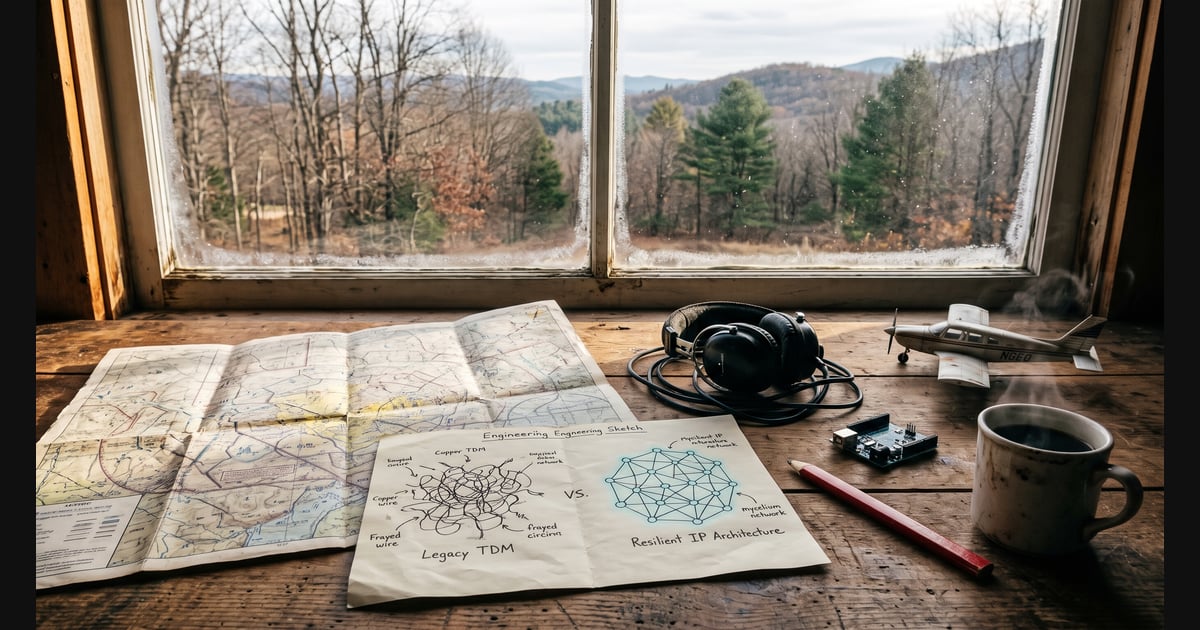
This wasn’t a shadowy cyberattack. Our air traffic system still relies on ancient time-division multiplexing—analog telecom gear and copper wires that belong in a museum. Officials admitted that newly installed equipment and software patches literally overwhelmed the legacy routers, triggering a cascading failure across a private contractor network. In software engineering, we know that splicing shiny modern internet protocol switches onto fragile, forty-year-old analog hardware doesn’t make a network stronger; it makes it less predictable.
In our recovery fellowships, we talk a lot about what happens when we try to build a healthy new life on top of unexamined, dysfunctional foundations. If we just slap a fresh coat of paint over old habits without doing the deep structural work, the first heavy storm brings the whole roof down. Using Marshall Rosenberg’s Nonviolent Communication lens, we can look at the FAA without playing the blame game and simply observe the unmet need: our country needs safety, transparency, and reliability, but our governance model is trapped in a cycle of short-term fixes.
Since the 1980s, the agency has poured billions into serial replacement programs that arrive late, run over budget, and leave the decaying core untouched. Even today, over three-quarters of our air traffic systems are rated unsustainable, with technicians literally hunting down replacement parts on auction sites or making them with 3D printers. Now leaders are tossing around emergency price tags between thirty and fifty billion dollars, even though auditors warn the agency has over eleven thousand separate project schedules and no unified master plan.
As a Liberation Technologist, I look at this monoculture failure and see why open-source principles and decentralized architecturesare so vital for our future. Nature never relies on a single brittle wire; a forest survives because its underground mycelium network routes nutrients around damaged roots. True modernization means building a parallel, open-standard IP network with automatic failover and real isolation, testing it in the light of day, and cutting over cleanly—while supporting the overworked human controllers who keep us safe.
We don’t have to accept crumbling systems, whether in our national infrastructure, our proprietary digital tools, or our own daily lives. When we choose open architectures, honest schedules, and patient foundational work, we give ourselves and our communities the freedom to fly safely through any storm.
Everything here is free. If this one helped you, there’s a tip jar.