
Debugging the Safe Plateau: Why Smart Men Choose Peace Over Ambition
Why do gifted men from chaotic homes often settle for moderate careers? A retired CTO explores how childhood survival code shapes adult ambition—and how we can reclaim our full bandwidth for peace and freedom.
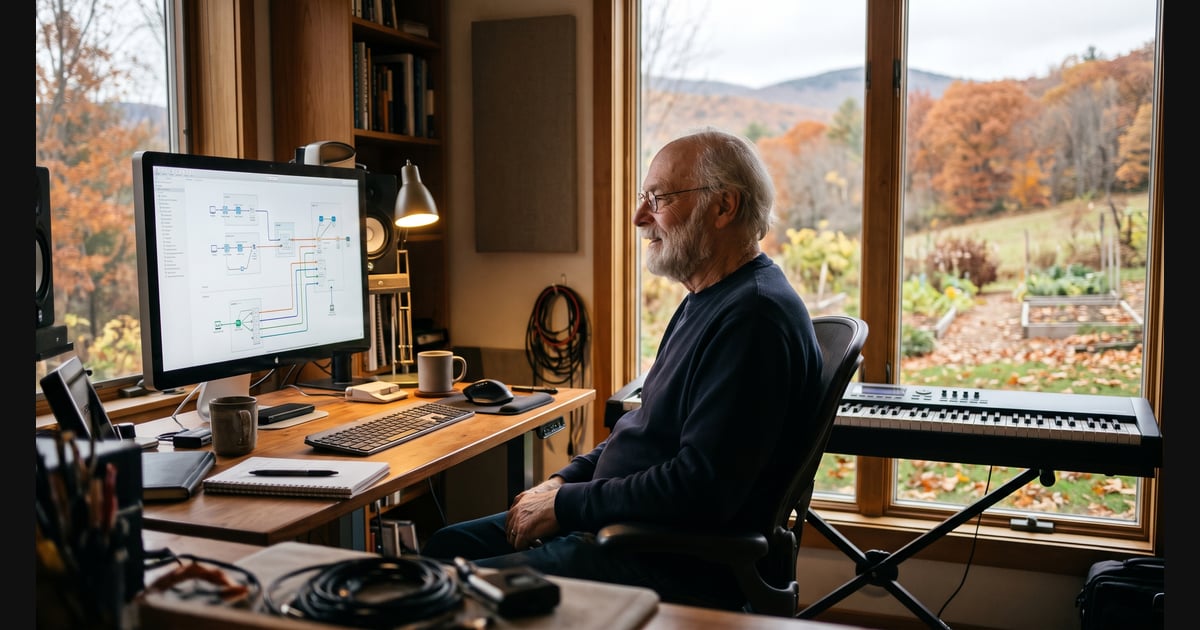
This afternoon, I spent a quiet hour at my digital piano working through a new chord progression, right after harvesting the last of the autumn beets and Swiss chard for a home-cooked dinner. When you pair a good workout with a solid night's sleep, those simple daily rhythms feel like pure gold.
Over my 35 years in software engineering—climbing from an Army computer repairman and commercial pilot to sitting in cubicles as a project leader, and finally to corner offices as a VP and CTO—I worked alongside dozens of brilliant engineers who puzzled everyone around them. Have you ever known someone who seems like they should be wildly successful, but somehow remains mediocre despite all their intelligence and social advantages?
While I feel lucky to have not had alcoholic parents, a dysfunctional family doesn't require alcoholism. That said, when alcoholism rears its ugly head, the consequences can result in a dysfunctional family lineage that seeks out and gloms onto dysfunction as normal and familiar. Growing up with an alcoholic father doesn’t just apply to this pattern of underachievement—it supercharges it. As a fellow traveler in recovery, I’ve learned that for a smart boy in an unpredictable household, his intellect becomes his primary survival tool. The very legacy code that kept him safe at age ten is the exact program that caps his adult life at a "safe, moderate plateau."
Psychologists like Janet G. Woititz and Claudia Black, who pioneered the study of Adult Children of Alcoholics (ACoAs), found that what looks from the outside like ordinary underachievement or aloofness is actually a deeply wired nervous system strategy. When we view it through a technologist's lens, the architecture makes total sense.
First, we use intellect as armor. In a chaotic home, emotions are volatile, so a bright kid learns that logic is safe. We become the "Lost Child" or the "Fixer," retreating into computers, digital electronics, or solitary problem-solving where the rules are predictable. Boolean logic and circuit boards never change the rules without warning. However, that armor creates a friendship bottleneck. We get so good at compartmentalizing that adult male friendships stay stuck on surface topics like work, projects, or sports. Dropping the shield feels like losing control, leaving us as dependable guys whom nobody truly knows on a deep level.
Second, we pay a massive cognitive tax. Living with domestic chaos wires a young brain for threat detection—reading footsteps or how a car door closes. Decades later, a chunk of our mental RAM is still running background threat-detection software in offices. That quiet hypervigilance drains executive energy and looks like analysis paralysis. Furthermore, flying under the radar was our safest bet. Standing out drew fire. In adulthood, we unconsciously cap ourselves at solid B+ work to stay employed while avoiding high-visibility leadership roles that might put a target on our backs.
Third, our nervous systems are built for crisis mode. Because the future felt unreliable, we learned to fight immediate fires rather than build five-year plans. In an emergency, ACoA men are absolute superstars—calm, sharp, and decisive when servers crash—because chaos feels like home turf. Yet during peacetime, when work is routine and incremental, our motivation flatlines.
Fourth, our relationship with authority is complicated. When your blueprint for leadership was inconsistent or volatile, you develop a fierce self-reliance: figure it out yourself and never ask for help. That makes you a capable individual contributor, but it prevents you from playing the mentorship and sponsorship game required for upper management.
Finally, consider what success actually means to us. In my work today as a Liberation Technologist, I focus on "Trauma-Informed Design"—building decentralized networks and AI tools that respect human neurobiology and offer "Digital Sanctuaries" rather than feeding the corporate rage machine. We do the exact same thing with our careers.
For someone raised in unpredictability, the ultimate luxury isn't status or corner-office power; it is peace, autonomy, and a predictable environment. Trading away high-risk ambition to build a quiet, steady life isn't a failure of intelligence. It is a deliberate choice for sovereignty. Once we recognize that old survival code, we can thank it for keeping us safe, free up our mental RAM, and build a happy, healthy future entirely on our own terms.