
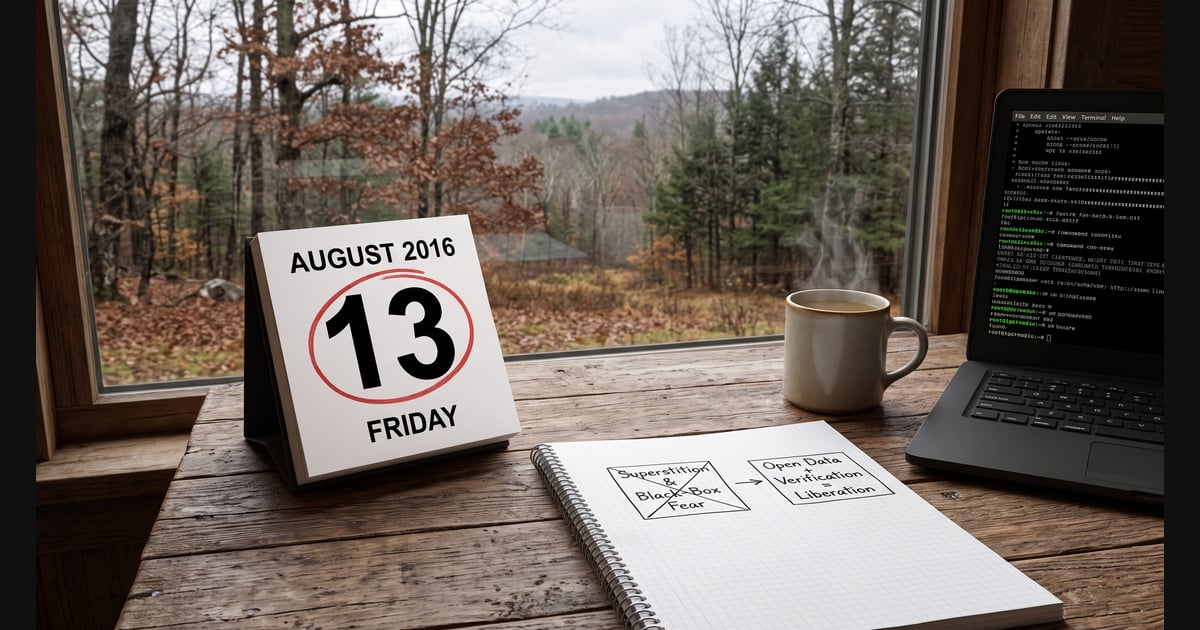
Debugging the Calendar: How Open Data Liberates Us From Superstition
2026 gives us three Friday the 13ths, but peer-reviewed data proves the calendar isn't out to get us. By examining the real statistics behind hospital visits, traffic, and human psychology, we can debug our anxious thoughts and reclaim our peace of mind through knowledge.
I pulled on a heavy, unbleached wool sweater and my plain canvas trousers this morning before stepping out onto the porch with a mug of hot broth. For the first time this season, the ten-day forecast finally looks like real mid-November in the mountains instead of sitting twenty degrees above average. Watching my breath frost in the crisp air, I realized today is November 13th—the third and final Friday the 13th of 2026. The first one back in March actually fell right on my 69th birthday, which gave me the freedom to decide right then that this would be a lucky year.
As a fellow traveler who values peace of mind, I know how easily old fears can hijack our nervous systems. In recovery and Nonviolent Communication, we learn to separate clear observations from the scary stories we tell ourselves. The same rule applies to debugging software—and debugging superstitions. Freedom can be from thought, and true liberation comes from knowledge. When we look at the hard data, we see that the calendar has zero power to curse us.
Consider where this bug in our collective programming originated. Friday and the number 13 existed as separate anxieties for centuries—linked to everything from Loki crashing a dinner party in Valhalla as the 13th guest to medieval "hangman's day"—before anyone merged them in the 1800s. A 1907 Wall Street novel by Thomas W. Lawson and a 1980 slasher movie cemented the mash-up into pop culture. It isn't even a global constant: in Italy, Friday the 17th is the dreaded date, while Spain and Greece side-eye Tuesday the 13th.
When researchers test the Friday the 13th curse using large datasets, the phantom crashes disappear. A review of over 49,000 emergency room visits across six hospitals from 2002 to 2009 found no spike in patient volume on Friday the 13th; in fact, visits were slightly lower than the following month (134.7 versus 150.1). Two massive surgical studies—one tracking 27,914 operations in Germany and another following 19,747 patients across 25 common procedures—found zero increase in complications, blood loss, or readmissions compared to flanking Fridays. Even the stock market shows no reliable Friday the 13th dip when analyzed across decades.
So why do people still cite "studies" proving the day is dangerous? Usually, they are remembering a famous 1993 British Medical Journal paper that claimed a 52% rise in traffic accident admissions. What most folks miss is that the sample size was tiny—just 65 vs. 45 admissions—and a coauthor later admitted the paper was written as "a bit of fun." Similarly, a 2002 Finnish study suggesting women had higher traffic deaths on the 13th fell apart when researchers rechecked a broader dataset from 1989 to 2002 and found no difference at all, proving the earlier headline was just statistical noise in a tiny sample. Dutch insurance data from 2008 even showed slightly fewer crashes, fires, and thefts on Friday the 13th, likely because nervous folks stayed home.
What actually rises on Friday the 13th isn't bad luck; it's confirmation bias and the nocebo loop. If we spill coffee on Thursday the 12th, we wipe it up and move on. If we spill it on Friday the 13th, our brains file it as proof of a curse. In the German surgical study, over 40% of medical staff believed lunar phases and cursed dates brought chaos, even when their own hospital logs proved otherwise.
This is why I love open-source tools and open-access science. When we use open data frameworks to inspect the code of our world instead of relying on black-box algorithms that feed on fear and outrage, we liberate ourselves. Just like Finland flipped the script in 1995 by turning Friday the 13th into National Accident Day to promote road safety, we can choose what today means for us. We don't have to be prisoners of a 400-year Gregorian calendar quirk. Take a deep breath of that cold autumn air, trust the data, and enjoy your Friday.