
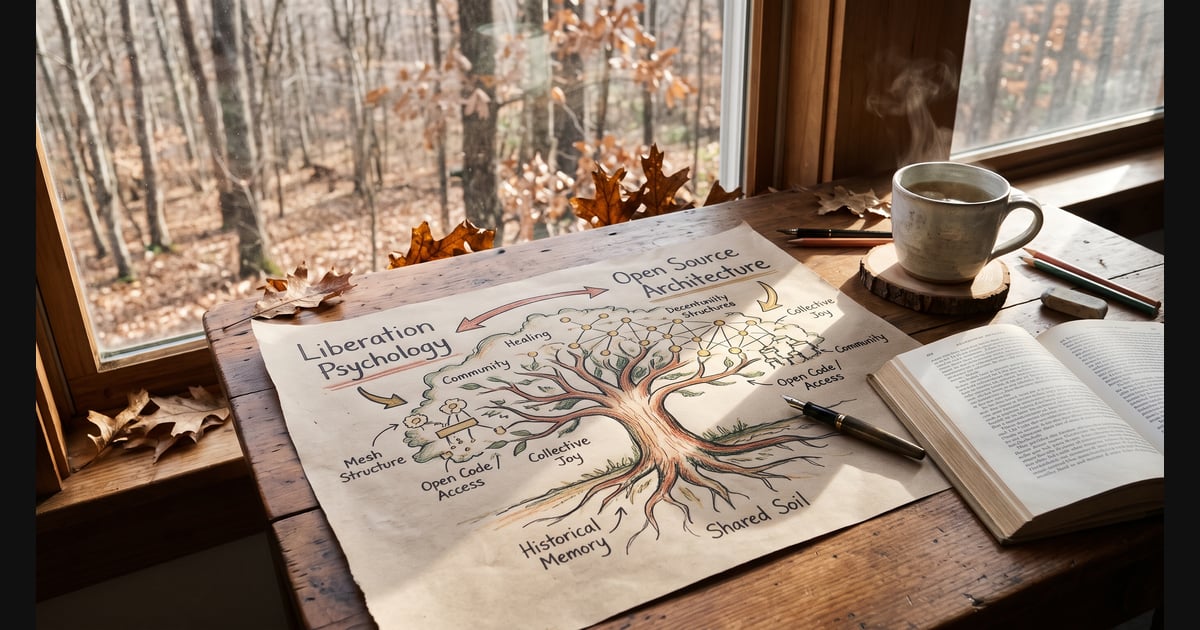
Debugging Generational Trauma: Ignacio Martín-Baró, Open Source, and Liberation Psychology
On the anniversary of Ignacio Martín-Baró’s 1989 assassination, we look at how centuries of systemic violence create deep generational trauma—and how Liberation Psychology and open-source tools offer us a hopeful path toward collective healing.
Today's weather forecast calls for sunny skies during the day and clear conditions at night, with a high of 47°F, a low of 31°F, a 15% daytime chance of rain, and a 4 mph wind from the north. Before sitting down at the keyboard, I pulled on a plain organic cotton flannel shirt and an unbleached wool sweater, then warmed up a bowl of homemade lentil soup. After spending a quiet half-hour working through a few jazz chord progressions on the piano, my mind felt rested and ready to reflect on why this specific Monday matters so much to our journey as fellow travelers.
Thirty-seven years ago on November 16, 1989, soldiers from the U.S.-backed Atlacatl Battalion entered the Central American University (UCA) in San Salvador. They assassinated Ignacio Martín-Baró—a Spanish-born Jesuit priest and social psychologist—alongside five fellow Jesuit scholars, their housekeeper, and her daughter. Many of the soldiers who carried out that massacre were trained right here in the United States at the School of the Americas. Billions of dollars in military aid had been funneled into that civil war, turning El Salvador into a laboratory for state terror.
When we step back and look at history with compassionate curiosity rather than judgment, we see how this kind of violence doesn't happen in a vacuum. Over centuries of colonialism, economic extraction, and military intervention, deep generational trauma builds up in the human nervous system. In recovery spaces, we often talk about how family dysfunction gets passed down until someone finally names the pain. In Marshall Rosenberg’s Nonviolent Communication, we learn that tragic expressions of power stem from deeply unmet human needs for safety, autonomy, and dignity.
Martín-Baró saw this clearly. He realized that traditional psychology was acting like a proprietary, closed-box system that blamed the individual user whenever the software crashed. If a peasant in El Salvador felt hopeless or anxious, mainstream psychology treated it as a private mental flaw. Martín-Baró flipped the script and founded Liberation Psychology. He argued that distress in the face of systemic violence isn't an abnormal reaction to normal circumstances—it is a completely normal reaction to abnormal, oppressive conditions.
During my decades in software engineering—long after my days sitting in cubicles as a project leader—I learned that you cannot fix a corrupted network by simply rebooting a single workstation. You have to examine the underlying architecture. Today, we face a digital version of those same oppressive structures. Corporate algorithms and surveillance capitalism profit by keeping our nervous systems in a state of constant hyper-arousal and division. They want us to believe our exhaustion is our own personal failure.
That is why open-source technology is the true champion of modern liberation. Just as Martín-Baró worked to "de-ideologize" reality so everyday people could see the hidden mechanics of state oppression, open-source protocols let us inspect the code running our lives. When we move away from walled gardens and build on transparent, community-owned tools—like Linux, decentralized federated networks, or local privacy-preserving AI—we reclaim our collective agency. We create trauma-informed digital sanctuaries where communities can recover historical memory and organize without a corporate middleman.
To dive deeper into how his life and methods connect to our work today, I put together a dedicated resource in my digital library: https://georgeaguiar.com/library/martin-baro-and-liberation-psychology/. It is a vital piece of the liberation puzzle because we cannot code truly free technical systems until we understand how to free our minds from internalized fatalism.
Heroes like Ignacio Martín-Baró remind us that truth cannot be silenced by bullets. When we pair the wisdom of Liberation Psychology with the transparency of open-source technology, we don't have to stay trapped in centuries of inherited pain. Take a deep breath today, nourish your body with good food and rest, and remember that together, we have all the tools we need to heal and build a freer world.
Everything here is free. If this one helped you, there’s a tip jar.