
Damping the Political Bridge: Open Source Truth Beyond the Disinformation Board
As post-election rhetoric hits a 40 mph resonant frequency and centralized "truth police" move underground, we don't have to hoard cash or panic. By combining open-source protocols with Nonviolent Communication, we can damp the partisan oscillation and reclaim our digital and emotional sovereignty.
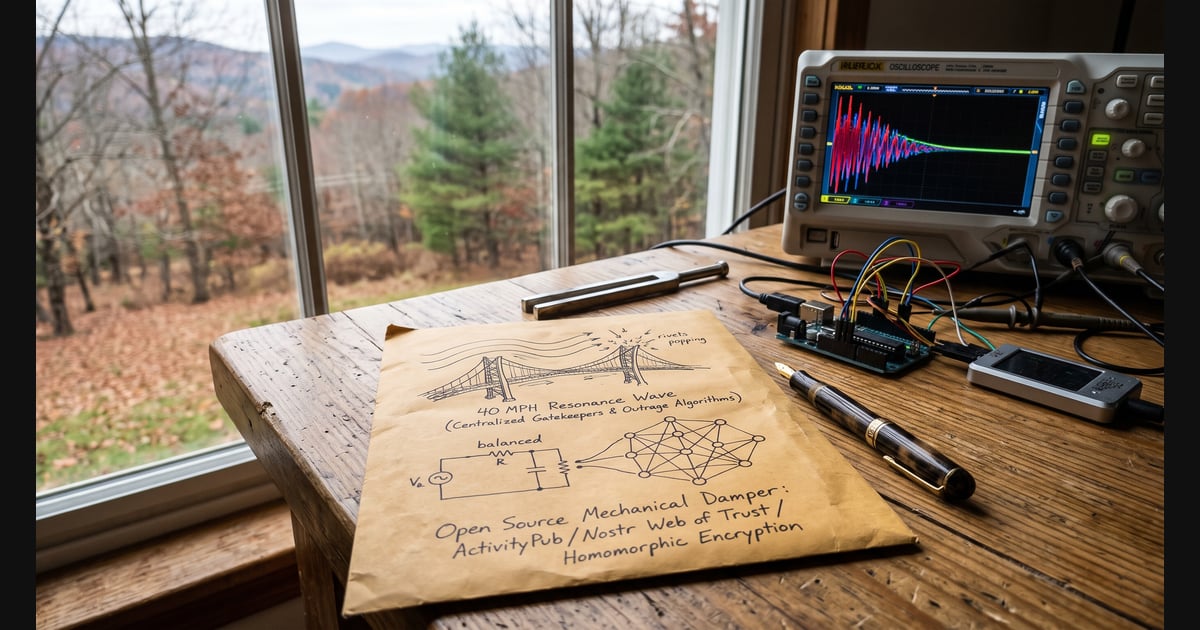
When I sit at my piano and strike two notes that are slightly out of tune, the sound waves collide and create a pulsing throb. Back when I studied electrical engineering in university, we analyzed how physical structures react to those same rhythms. When an outside force pushes a bridge at its natural frequency—like the 40 mph gale that tore apart the Tacoma Narrows Bridge—oscillations feed on themselves until steel twists and rivets pop. Watching this historic week in US election history, that left-right oscillation has intensified immensely. The lying by politicians, news organizations, and corporations has hit the 40 mph resonance of our cultural bridge. Rivets are popping as doomers stack cash at home for when the ATMs go down, while the blue team boasts of taking back their country—the exact tune the red team practically yodeled from every anthill from coast to coast just 2 years ago.
I have to smile gently, because history rhymes. Watching both teams fight over who defines reality takes me back to April 27, 2022, when the Department of Homeland Security announced its Disinformation Governance Board under Secretary Alejandro Mayorkas and executive director Nina Jankowicz. DHS framed it as an internal body meant to coordinate privacy and civil-liberty safeguards around foreign influence, migrant smuggling lies, disaster scams, and election falsehoods. Yet critics across the spectrum saw a potential federal "truth police." Senators Chuck Grassley and Josh Hawley cited internal documents suggesting a broader mandate, while opponents questioned Jankowicz's impartiality over her past skepticism of Hunter Biden's emails. Within three weeks, on May 18, DHS paused the board and Jankowicz resigned. By August 24, 2022, Mayorkas formally abolished it.
Was that impulse to control reality disbanded, or just driven underground? Decades ago, repairing Vietnam-era Army computers and later serving as a CTO taught me a basic systems rule: peeling a label off a chassis doesn't shut off the power supply. The board's termination was an administrative decision, not a court ruling under the First Amendment. An advisory review led by Michael Chertoff and Jamie Gorelick simply concluded that a separate board was unnecessary because the underlying work already existed inside CISA, FEMA, and Customs and Border Protection. Most revealing was the vocabulary left behind. Alongside false "misinformation," agencies tracked "malinformation"—genuine, true facts shared to cause harm. When government offices quietly flag posts for social media platforms, we get trapped in a "digital double bind" where civic connection exposes us to invisible state and corporate control.
How do we damp a resonant bridge without a central censor? In digital electronics, we distribute the load and build transparent feedback loops. As Liberation Technologists, our champion is open-source software. Corporate platforms thrive on outrage because opaque algorithms reward division. By moving to open-source, federated networks like Mastodon on ActivityPub or Bluesky's AT Protocol, we gain "algorithmic choice"—the freedom to inspect the code, share community governance, and tune out the rage machine. Further out, the open-source Nostr protocol lets us sign notes with cryptographic keys across independent relays, building a "Web of Trust" where neither bureaucrats nor billionaires can throttle speech. Paired with open-source, privacy-preserving AI and Fully Homomorphic Encryption, citizens can verify data locally without feeding a surveillance panopticon.
Even the cleanest open-source code, however, needs a steady human heart at the keyboard. As a fellow traveler in recovery, I recognize our national oscillation as a trauma response. When people feel powerless, fear drives us into survival modes—either yodeling for dominance on an anthill or hoarding emergency cash at home. Practicing Marshall Rosenberg's Nonviolent Communication helps me look past the partisan noise to hear the universal human needs underneath: safety, agency, and trust. We don't need a swaying partisan bridge or a government truth board. By pairing open-source digital sovereignty with compassionate listening, we become our own shock absorbers—stepping onto solid ground together with curiosity and quiet hope.