
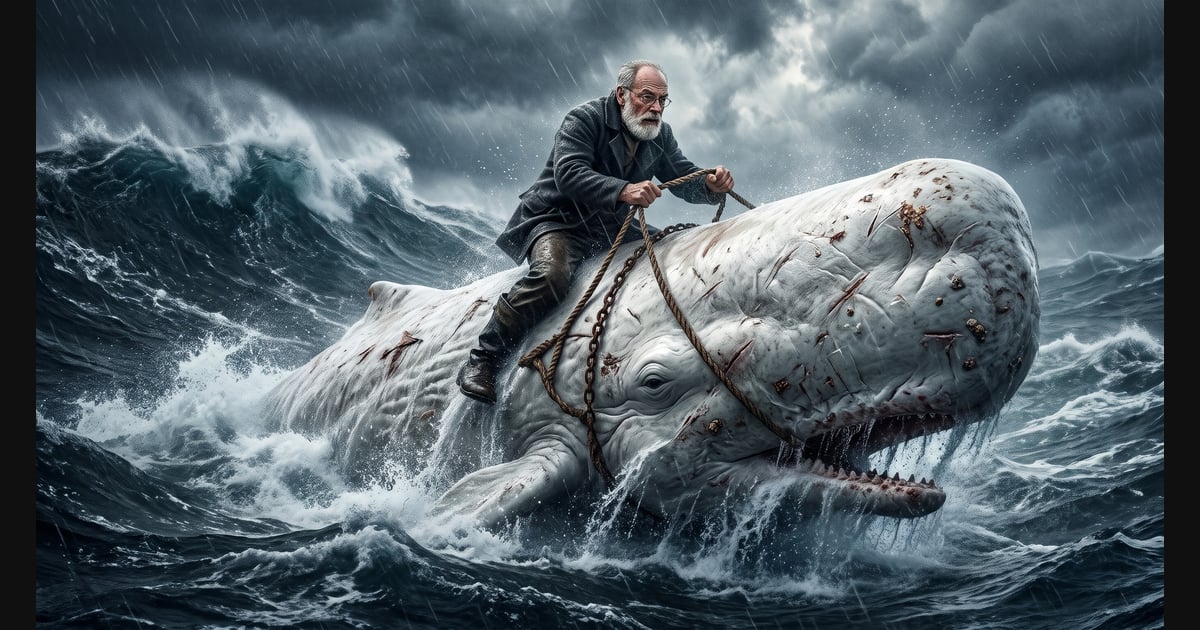
Call Me Geo: Navigating the White Whale of Failing Systems
On the anniversary of Moby-Dick, we explore how our childhood survival strategies mirror Captain Ahab's obsession. From the coastal air of New Bedford to the ports of Pusan, let us trade centralized, failing systems for the open-source freedom of recovery and decentralized connection.
Call me Geo. In my earlier post today about last night’s sudden FAA grounding, we looked at what happens when a massive, centralized system fails all at once. As a former pilot, seeing flights halted across the country reminds me that no giant machine is too big to break. That technological hiccup got me thinking about another massive voyage into the unknown. On this day, November 14, back in 1851, Herman Melville published Moby-Dick here in the United States.
I grew up in Somerset Massachusetts, just fifteen miles from the historic whaling port of New Bedford. My childhood was filled with the smell of salt air, the crash of the ocean, and the constant wonder of a huge world out there waiting to be explored. Like Ishmael signing onto the Pequod for a three-year voyage, I set out on my own three-year journey at eighteen by joining the Army. I spent a full year of that enlistment in Pusan, South Korea. At the time, South Korea was living under a strict military dictatorship, which is the ultimate centralized, top-down system. Yet Pusan was a coastal city that felt remarkably like New Bedford and Somerset. Whenever I was not repairing Army computers, I spent almost every weekend participating in local cultural events, soaking up the music, the food, and the warmth of the people. I learned early on that even inside a rigid regime, human connection is where we find real freedom.
When we look at Moby-Dick through the lens of our recovery in Adult Children of Alcoholics and Dysfunctional Families, the story takes on a whole new meaning. To Captain Ahab, the white whale is the face of everything that ever injured or limited him. In many ways, that giant, unreadable whale is just like the power of a dysfunctional family in childhood. It feels vast, overwhelming, and impossible to master.
When we grow up around family dysfunction, we often board that ship with Ahab. We develop survival traits that turn into obsessions. We try to control the uncontrollable, or we spend decades seeking revenge against the past, hoping to harpoon the beast that hurt us. But as Melville shows us, Ahab’s pride does not defeat the whale; it only sinks the Pequod. First mate Starbuck tried to warn him that chasing revenge instead of oil was a betrayal of the crew, yet Ahab could not let go of his line.
As a retired software engineer and Liberation Technologist, I see this exact same struggle in how we build and use software today. For years, we trusted monolithic, proprietary tech platforms that act like Ahab—demanding total control, tracking our every move, and steering us toward outrage just to keep our attention. And just like the FAA computers last night, or the Pequod near Japan, those single points of failure eventually crash.
Our journey to understand our past does not require us to conquer the whale. Instead, we can choose to be like Ishmael. Half of Melville’s book pauses the frantic chase just to examine the tools, the ropes, and the anatomy of the world around him. In recovery, and in Marshall Rosenberg’s Nonviolent Communication, we do the same thing. We pause the drama to observe our feelings and needs without judgment. We trade Ahab’s harpoon for open-source tools of liberation. Whether we are using Linux, writing transparent code, or communicating on decentralized, federated networks like the Fediverse, we are choosing systems where no single captain can drag the whole crew under.
Ishmael survived the wreck because he held onto a lifebuoy made from his friend Queequeg’s coffin—a symbol of fellowship turning tragedy into survival. We do not have to go down with the ship of our childhood programming or failing corporate tech. By sharing our experience, strength, and hope as fellow travelers, we stay afloat together on an open sea of possibility.
Everything here is free. If this one helped you, there’s a tip jar.